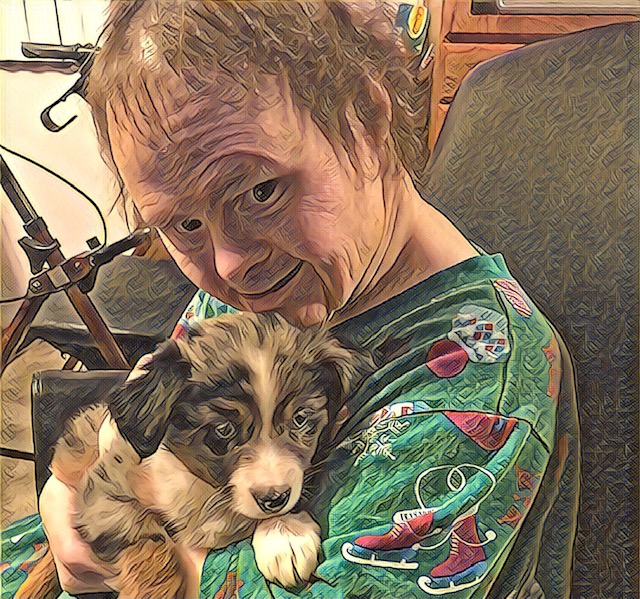
Poet...Musician...Thinker...Blogger...Teacher...Husband...Father...I'm not perfect, but I try!
Saturday, February 14, 2026
February 14, 2026: “Persephone,” Valentine’s Day, “Why?”
Wednesday, May 14, 2025
May 14, 2025: "When," Rose, "Black Coffee and Burned Toast"
by: Sharon Olds
I wonder now, only when it will happen,
when the young mother will hear the
noise like somebody's pressure cooker
down the block, going off. She'll go out in the yard,
holding her small daughter in her arms,
and there, above the end of the street, in the
air above the line of the trees,
she will see it rising, lifting up
over our horizon, the upper rim of the
gold ball, large as a giant
planet starting to lift up over ours.
She will stand there in the yard holding her daughter,
looking at it rise and glow and blossom and rise,
and the child will open her arms to it,
it will look so beautiful.
Saturday, November 25, 2023
November 25: "No Voyage," Disaster and Pain, Charmed with Happiness
Saturday, October 21, 2023
October 21: "Sleeping in the Forest," Blinders, Hatred and Cruetly
Wednesday, June 7, 2023
June 7: "When the Roses Speak, I Pay Attention," My Friend, Petals and Thorns
Roses are red
And ready for plucking,
You're sixteen,
And ready for high school.
In Oliver's poem, there's a huge difference between what the roses say versus what emotion their scent evokes. Rose words are filled with darkness, pride, and envy. Rose scents are occasions for joy. The dichotomy is sort of striking, but also in keeping with the actual flower, which has supple, red petals and biting thorns.
I had a long conversation with a close friend today. This friend has been struggling a great deal in the last month or so. It's not my place to tell my friend's story, and I won't. But I will say it involves someone my friend loves very much who is currently suffering from severe mental illness. My friend is in rough shape, shuttling between despair and anger and frustration and devotion.
Faithful disciples of this blog know that I have a lot of experience dealing with mental illness in people I love. I understand what my friend is going through, have experienced many of the same feelings over the years. I wanted to give my friend some hope or solace today, but I know too much of the reality of mental health.
I told my friend, "The most important thing to do right now is to remember to take care of yourself."
I know that sounds like pretty selfish advice, but the wrecking ball that is mental illness can destroy everything in its path. My friend needs to practice selfcare, or else my friend will end up in pieces. I've been there. I know.
Roses can make your day spin with joy, or they can leave you bleeding and in pain. Love can do the same, and my friend is learning this lesson right now. I'm not saying everyone should shut off their hearts to avoid sorrow and pain. I'm saying that if you love, you have to be prepared for petals and thorns.
Saint Marty has the scars to prove it.
Wednesday, February 1, 2023
February 1: "The First Time Percy Came Back," One Year Since, My Sister
Saturday, January 21, 2023
January 21: "The Vulture's Wings," Day Two, Icicles
Thursday, June 10, 2021
June 8-10: Impetration, Albert Einstein, Rare Steak
Saturday, January 16, 2021
January 16: Sacrifice Your Pleasures, Open Doors, My Sister
Merton learns something about sacrifice . . .
But the conversion of the intellect is not enough. And as long as the will, the domina voluntas, did not belong completely to God, even the intellectual conversion was bound to remain precarious and indefinite. For although the will cannot force the intellect to see an object other than it is, it can turn it away from the object altogether, and prevent it from considering that thing at all.
Where was my will? “Where your treasure is, there will your heart be also,” and I had not laid up any treasures for myself in heaven. They were all on earth. I wanted to be a writer, a poet, a critic, a professor. I wanted to enjoy all kinds of pleasures of the intellect and of the senses and in order to have these pleasures I did not hesitate to place myself in situations which I knew would end in spiritual disaster—although generally I was so blinded by my own appetites that I never even clearly considered this fact until it was too late, and the damage was done.
Of course, as far as my ambitions went, their objects were all right in themselves. There is nothing wrong in being a writer or a poet—at least I hope there is not: but the harm lies in wanting to be one for the gratification of one’s own ambitions, and merely in order to bring oneself up to the level demanded by his own internal self-idolatry. Because I was writing for myself and for the world, the things I wrote were rank with the passions and selfishness and sin from which they sprang. An evil tree brings forth evil fruits, when it brings forth fruit at all.
I went to Mass, of course, not merely every Sunday, but sometimes during the week as well. I was never long from the Sacraments—usually I went to confession and Communion if not every week, every fortnight. I did a fair amount of reading that might be called “spiritual,” although I did not read spiritually. I devoured books making notes here and there and remembering whatever I thought would be useful in an argument—that is, for my own aggrandizement, in order that I myself might take these things and shine by their light, as if their truth belonged to me. And I occasionally made a visit to a church in the afternoons, to pray or do the Stations of the Cross.
All this would have been enough for an ordinary Catholic, with a lifetime of faithful practice of his religion behind him: but for me it could not possibly be enough. A man who has just come out of the hospital, having nearly died there, and having been cut to pieces on an operating table, cannot immediately begin to lead the life of an ordinary working man. And after the spiritual mangle I have gone through, it will never be possible for me to do without the sacraments daily, and without much prayer and penance and meditation and mortification.
It took me time to find it out: but I write down what I have found out at last, so that anyone who is now in the position that I was in then may read it and know what to do to save himself from great peril and unhappiness. And to such a one I would say: Whoever you are, the land to which God has brought you is not like the land of Egypt from which you came out. You can no longer live here as you lived there. Your old life and your former ways are crucified now, and you must not seek to live any more for your own gratification, but give up your own judgement into the hands of a wise director, and sacrifice your pleasures and comforts for the love of God and give the money you no longer spend on those things, to the poor.
What Merton is talking about here is this: once a door opens, it's next to impossible to close it again. Merton has walked through the doors of the Catholic Church, and now either he has to change his ways, or live for the rest of his life with the knowledge that he has rejected the love of God. Not a comfortable position to find oneself.
This afternoon, I got a phone call. One of those phone calls that open a door that you can't close. It was my older sister, telling me that my sister, Rose, who has Down syndrome, suffered a grand mal seizure at home and was rushed by ambulance to the hospital. When she got to the hospital, she had another grand mal seizure.
Now, some of you may remember that this particular door opened a few weeks ago. The same thing happened. Rose had a seizure and ended up in an ambulance, then the hospital. Since we are in the middle of a pandemic, I wasn't able to see Rose or visit her in the hospital. So, all the information I got was filtered through my sister, who is Rose's durable power of attorney. From what I know, Rose came home last time on new medications with the need to follow up with her primary care provider. I'm not sure if Rose ever saw her PCP.
Back to today . . . Rose was released from the hospital this afternoon after about two hours. When she got home, as she was being helped out of the car, she suffered another grand mal seizure. An ambulance was called again. She was transported to a different hospital, and now, about three hours later, I'm still waiting for any news on her condition.
Some doors you open yourself and walk through. I did that this past October with my new job at the library. Other doors open by themselves, and you're forced through them. Addiction doors. Marital strife doors. Cancer doors. Dead car battery doors. Pandemic doors. Mental illness doors. Sick sister doors.
I am hoping for good news some time tonight. A miracle even. My sister's little body can't take much more. And, I fear that a door may be opening for her. I'm not ready for her to walk through that door. So, I'm praying for that door to close again. It's a selfish prayer, I know. I don't care.
Saint Marty is tired of unfamiliar rooms.
Saturday, May 26, 2018
May 26: Gina Myers, "Memorial," Life and Death Lessons
by: Gina Myers
for J
____________________
It has been a heck of a year so far, with my father passing in February. My mother still asks about him, talks about him as if he's out on a plumbing job. Some days, she doesn't remember what her last name is. She wants to sign her maiden name instead. Since my dad's been gone, time has sort of taken a few steps back for her.
I know that death is a part of life, just as much as births and baptisms and weddings and graduations. Believe me, I know this. I have been lucky to have family members who taught me what living a good life is all about. My sister, who's been gone almost three years now, taught me about selfless love and generosity. My father taught me about devotion and hard work and family sacrifice.
My mother, I think, is teaching me how to live out the end of life gracefully, with love and humor.
Saint Marty is thankful for these lessons.
Saturday, April 21, 2018
April 21: "To the Dead," Frank Bidart, People Who Aren't Here Anymore
by: Frank Bidart
What I hope (when I hope) is that we'll
see each other again,--
. . . and again reach the VEIN
in which we loved each other . .
It existed. It existed.
There is a NIGHT within the NIGHT,--
. . . for, like the detectives (the Ritz Brothers)
in The Gorilla,
once we'd been battered by the gorilla
we searched the walls, the intricately carved
impenetrable paneling
for a button, lever, latch
that unlocks a secret door that
reveals at last the secret chambers,
CORRIDORS within WALLS,
(the disenthralling, necessary, dreamed structure
beneath the structure we see,)
that is the HOUSE within the HOUSE . . .
There is a NIGHT within the NIGHT,--
. . . there were (for example) months when I seemed only
to displease, frustrate,
disappoint you--; then, something triggered
a drunk lasting for days, and as you
slowly and shakily sobered up,
sick, throbbing with remorse and self-loathing,
insight like ashes: clung
to; useless; hated . . .
This was the viewing of the power of the waters
while the waters were asleep:--
secrets, histories of loves, betrayals, double-binds
not fit (you thought) for the light of day . . .
There is a NIGHT within the NIGHT,--
. . . for, there at times at night, still we
inhabit the secret place together . . .
Is this wisdom, or self-pity?--
The love I've known is the love of
two people staring
not at each other, but in the same direction.
_________________________
On this big weekend for my daughter, I've been thinking a lot about people who aren't here anymore who would have really loved seeing her in her prom finery. My sister. My wife's mother and grandmother. My dad. They all would have melted seeing her looking all grown up and beautiful.
I'm not going to get all maudlin here. I just wish these people could see her today. I think Bidart has it right in this poem. Love is not about gazing into each other's eyes with adoration all the time. It's about people looking at the same thing and loving it together.
Maybe Saint Marty is being a little bit melancholy.
Saturday, February 24, 2018
February 24: Memories, Billy Collins, "Carry"
The days after my sister died three years ago, I saw and heard her everywhere. Walking across the parking lot at work. In the evening, sitting on the couch, I would hear her voice. On the anniversary of her death, I came across the holy card with her picture on it.
The same thing has been happening to me with my father. I see my dad disappearing around the corner at Walmart. I hear his gravelly whisper at night. Just yesterday, I swear I saw him at Menards when I shopping for a bathroom vanity and sink.
I carry these people around with me everywhere. Can't get away from them.
Saint Marty is thankful today for these moments when my dead are alive again.
Carry
by: Billy Collins
I want to carry you
and for you to carry me
the way voices are said to carry over water.
Just this morning on the shore,
I could hear two people talking quietly
in a row boat on the far said of the lake.
They were talking about fishing,
then one changed the subject,
and, I swear, they began talking about you.
Tuesday, October 24, 2017
October 24: Mongolian Idiot, Rights of the Intellectually Challenged, My Sister
So it goes.
She was accompanied by a doctor and a nurse. Her brother Robert was flying home from a battlefield in Vietnam. "Daddy--" she said tentatively. "Daddy--?"
But Billy was ten years away, back in 1958. He was examining the eyes of a young male Mongolian idiot in order to prescribe corrective lenses. The idiot's mother was there, acting as an interpreter.
"How many dots do you see?" Billy Pilgrim asked him.
This passage pisses me off. I know that the term "Mongolian idiot" was once acceptable, even common. "Down syndrome" didn't come into use until the early 1970s. Slaughterhouse was first published in March of 1969. Kurt Vonnegut was a product of his time. That's why he calls the young Down syndrome boy an "idiot." I notice that Vonnegut even depersonalizes the character even more by using the term "male" instead of boy. Suddenly, instead of a living, breathing human being, Billy is treating a specimen: the Mongolian idiot male.
As many of my disciples already know, I have a sister with Down syndrome. So, I have been exposed to all sorts of cruelties. My mother fought hard for my sister all her life. Fought to get her in school. Fought to keep her in school. Fought for classroom funding. Took on principals, school superintendents, and instructors who saw my sister as hopelessly unteachable. When my sister was born, the doctor told my parents to put her in an institution and forget about her.
This all happened right around the time that Vonnegut was writing Slaughterhouse, which explains a lot about the passage. Doctors, educators, and brilliant writers all saw people with Down syndrome as idiots, oddities, sideshow attractions. I don't blame Vonnegut for his ignorance. I understand it, in the social context. Vonnegut was involved in the Civil Rights Movement, the anti-war movement, the anti-nuke movement. Most of his books are thinly veiled social commentary. Yet, at the time of Slaughterhouse, he wasn't aware of the incredible insensitivity of calling someone a "Mongolian idiot."
We have come a long way since the publication of Slaughterhouse. It's now legislated that public schools must provide educations for children with mental and physical impairments (for now--the current Education Secretary, Betsy Devos, is trying to change that). However, just like the battle for Civil Rights continues, so does the battle for the rights of the intellectually challenged.
I'm ashamed to say that I don't think of this cause every day now, despite how personal it is for me. My sister has been out of the education system for over 30 years. Her current issues are health and memory. Like most older people with Down syndrome, she is developing symptoms that could be the beginning of Alzheimer's or dementia. That is her daily struggle now.
Vonnegut is not a bad person for calling his character a "Mongolian idiot." He is the product of his culture, as we all are. And, sometimes, culture needs to change.
Saint Marty is thankful tonight for his sister, who is not an idiot.
Saturday, August 19, 2017
August 19: Bombed and Burned, Two Years Ago, My Sister
Steam radiators still whistled cheerily in Dresden. Streetcars clanged. Telephones rang and were answered. Lights went on and off when switches were clicked. There were theaters and restaurants. There was a zoo. The principal enterprises of the city were medicine and food-processing and the making of cigarettes.
People were going home from work now in the late afternoon. They were tired.
Dresden is a normal city in the middle of a war. People go to work. Streetcars carry people to shop and eat. Theatrical productions at night. Phone calls from neighbors and relatives. If people get sick, there are doctors to treat them. The citizens of Dresden go about their lives, unfazed and safe. They have no worries, aside from whether they're going to have schnitzel or sauerbraten for dinner.
I think that's pretty much what everybody does, every day of their lives. We get up in the morning, make coffee, eat oatmeal, go to work, come home, watch TV. Sure, we have bills to pay, meetings to attend, birthdays and anniversaries to celebrate. That's normal life. We walk around, mostly oblivious to the bombs going off around the world, because those bombs aren't falling in our neighborhoods.
Those bombs can take many forms. Car bomb. Terrorist. Nazi. White supremacist. Job loss. Home foreclosure. Bill collector. Car accident. Alzheimer's. Appendicitis. Bombs go off in people's lives all the time. Shatter windows. Destroy homes. Wreck lives. No one is prepared for the bomb.
Today is the anniversary of my sister's death. Two years ago, she quietly stopped breathing at home, surrounded by family and friends. Lymphoma of the brain. My sister never saw that bomb coming. Just a few months before, when a doctor in the hospital asked her what her expectations were for her illness, she said that she wanted to get better and go home.
My family and my sister's friends are still dealing with that bomb. Sweeping up the glass and rubble. Our lives have returned to a new normal. Job and church and home. However, for me, I'm always looking into the clouds for a B-52 carrying the next bomb.
Today, I will go to the cemetery. Talk to my sister. Tell her how much I miss her. Leave some flowers. That's what we do. We build memorials at the sites of disasters. To remember, honor, love.
Saint Marty is thankful today for the time he had with his sister.
Wednesday, May 10, 2017
May 10: Many Marvelous Moments, Epiphanies, Joyful and Grateful and Sad
"Exactly," said the voice.
"They are telegrams?"
"There are no telegrams on Tralfamadore. But you're right: each clump of symbols is a brief, urgent message--describing a situation, a scene. We Tralfamadorians read them all at once, not one after the other. There isn't any particular relationship between all the messages, except that the author has chosen them carefully, so that, when seen all at once, they produce an image of life that is beautiful and surprising and deep. There is no beginning, no middle, no end, no suspense, no moral, no causes, no effects. What we love in our books are the depth of many marvelous moments seen all at one time."
This description of Tralfamadorian novels intrigues me. What Vonnegut has the alien describe sounds very much like poetry to me. The careful juxtaposition of brief, urgent lines, describing a situation or scene, all with the goal of producing "an image of life that is beautiful and surprising and deep." Of course, Vonnegut could also be describing Slaughterhouse, with its brief passages describing different times in Billy's life, looping back-and-forth in time and space. The result: not a plotted narrative, but a marvelous moment. An epiphany.
I love epiphanies--sudden moments of undeniable clarity. They don't happen very often in my life. When I proposed marriage to my wife, that was an epiphany. I realized that I wanted to spend the rest of my life with this person in front of me. When I held my infant daughter for the first time. I surrendered myself to this little, squirming, screaming creature. Ditto my son. Big epiphanies.
Last night, I was saying prayers with my son before he went to sleep. He was goofing around, laughing, throwing pillows. Being an eight-year-old boy. I looked at him and felt myself cracking open like a fault line. I was overwhelmed with a realization of how much I loved him. It kind of left me speechless for a few moments.
Now, that may not seem like some deep revelation--a father loving his son. Nothing surprising about that. I think what overwhelmed me last night was simply how crushing that love is. In just a few moments, my mind had a Tralfamadorian experience. I went from my son's birth to his first birthday, first day of school, first Christmas program, and beyond. I pushed forward to girlfriends and high school and graduation and college. I was joyful and grateful and sad, all at once. That was the epiphany.
It lasted only a minute or so. Then my son raised his butt and farted at me. That brought me back to Earth reality.
I'm not sure I could live in that state constantly--always aware of the vicissitudes of time and love. It was wonderful when it happened, but, for the rest of the night, I was slightly melancholy because I realized that I couldn't protect my son from the disappointment and pain that sometimes comes with growing up. That bothered me. I will not be able to protect my kids from heartbreak and illness and death.
My parents have lost two of their children in the last three years. I can't imagine that kind of grief. The day my sister died at my parents' house, my mother sat by my sister's hospital bed, held her hand after she had passed. My mother talked to her, told my sister how much she loved her. She just kept speaking quietly, sometimes touching my sister's face.
There was grace in that moment, but it's a grace I hope I never have to experience personally.
Tonight, Saint Marty is thankful for the epiphanies of his son and daughter.
Wednesday, March 8, 2017
March 8: Drove One, International Women's Day, My Sister
There was a tap on Billy's car window. A black man was out there. He wanted to talk about something. The light had changed. Billy did the simplest thing. He drove on.
Billy Pilgrim, in the middle of a ghetto days after a race riot, is confronted by a black man at a stoplight. The man isn't being angry or violent. He isn't trying to drag Billy from his car to pelt him with bricks. The man simply taps on Billy's window.
Now, Billy could roll down his window to see what the man wants. Certainly, there is the possibility that the man could spit on Billy or throw dog shit in his face. He could scream at Billy, call him a racist or fascist or Republican asshole. Or the man may just ask Billy for directions to the nearest gas station. Billy isn't willing to take any chances, though. As Vonnegut writes, Billy does the "simplest thing." When the light turns green, Billy puts his foot on the accelerator and drives on.
That's the story of most injustices in the world. The people who could actually make a difference--those is power--choose to look the other way. Ignore. Drive in the opposite direction. They choose not to roll down their car windows and listen.
Today is International Women's Day. The theme for 2017 is "Be Bold for Change." March 8 has been set aside to honor and draw attention to working women (and women, in general) all over the world. Being a white working male, I lack firsthand knowledge of gender discrimination. But I do know that, when my sister obtained her Master Plumber's license, she was one of only three women in the state of Michigan to hold that title. My 16-year-old daughter is frequently confronted at school and called names for speaking up in support of Planned Parenthood and women's rights.
My sister, Sally, was one of the smartest and most accomplished persons I've ever known. She single-handedly oversaw the planning, construction, licensing, and running of an outpatient surgery center. She could read manuals for computers and medical equipment just ONCE and have those manuals memorized. She treated all of her employees with respect and understanding. My best friend, who worked as a surgical nurse for my sister, tells me all the time, "She was the best boss I will ever have."
I don't think my sister ever thought of herself as anything special. She just did her job, worked long hours, and loved the people in her life. But Sally would never look the other way if she saw some injustice in the world.
Tonight, on International Women's Day, Saint Marty gives thanks for his big sister.
Thursday, September 1, 2016
September 1: Extravagant Landscape, New Book Bag, Abundant Grace
Dillard is talking about God's generosity, given in abundance. Sort of like asking somebody if she can float you twenty dollars, and instead she gives you two hundred. That's the way God is. As the saying goes, our cups always runneth over because God pours the drinks. And He never really asks for repayment. If we say a prayer of thanks, that's cool. If we don't, God will still keep giving.
Tonight, my sister gave me a gift. It's a new book bag. A really beautiful new book bag. Leather with a leather journal and leather pencil case. Handmade to order by a company in Washington state, I believe. It's called the daVinci bag. I know how much it cost, and, to put it simply, it wasn't cheap. I've been drooling over this bag ever since I saw it on the Internet at the beginning of July.
I'm a little humbled by the gift. My sister doesn't expect anything in return. She gave me the bag out of the goodness of her heart. It feels like I was provided a concrete example of grace this evening. Abundant grace. Not that I need an expensive present in order to experience God's love. No. In fact, the bag really isn't the point. It's the spirit in which it was given to me. Freely. Without any expectation of reciprocity. That's abundant grace.
Marty is a very humbled saint this evening.
![]() |
| It holds a lot of grace |
Friday, May 27, 2016
May 27: Daughter's Essay, Claudia Emerson, "Daybook"
Last night, she asked me to read what she had written. She'd been working on it for a couple of hours. "Exactly what do you want me to read it for?" I asked. "Content? Grammar? Spelling?" She shrugged and said, "Just tell me what you think," and flounced off to bed.
I sat reading her essay. For a half hour. By the time I was done, I was crying and ready for bed. The essay was rough but full of the kind of honesty I try to get my freshman composition students to embrace. It takes my students an entire semester to get there (if they get there at all). My daughter had it, and I couldn't have been prouder.
I have a Claudia Emerson poem for tonight that's sort of like an essay on loss and grief. Warning: it's not very happy.
Saint Marty never promised you a rose garden.
Daybook
by: Claudia Emerson
This is the season of her dying, and you
have kept it, I find, underneath the stairs
in a box filled with photographs--her daybook
of that last year, the calendar a narrative
she did not intend to write. In the grid
of days, I see her habit had been to record
in pencil what might be erased, moved, saving
the indelible black for what could not change:
your birthday, hers, your anniversary. And in
that same decisive hand, the disease began
to eclipse this order, but she erased nothing.
Now from beneath the days the hospital claimed,
her first, latent words emerge, faint but certain
as images of ribs cradling milky lungs, the flesh forgotten
as water you can see through to the bottom.
Friday, April 15, 2016
April 14: Sunlit Detail, Grand Rapids, Nostalgia
Dillard is talking about memory. Remembering the sunlit times of her life. In paragraphs before and after the above passage, she writes of oceans and space and France. Things from her past. She's flooded with nostalgia, thinking about a former place or time in her life. With nostalgia comes a certain degree of sadness, as well. Dillard is walking a tightrope. Above, moon and stars. Below, canyon and darkness.
First, I apologize for my absence these last two days. It was my mid-week blogging pause to lesson plan and grade and teach. By the time I get home after class on Wednesday night, I am usually brain dead. It takes much energy to engage a classroom full of 25 undergraduates between the ages of 18 and 23. Last night, I had enough gumption to order a pizza, eat it with my wife and daughter, and then stumble off to bed.
This weekend, I will be traveling to Grand Rapids with my family. My daughter has a dance competition. We will be leaving tomorrow morning. It's about a six- or seven-hour drive, depending on the number of stops we make. The members of our Grand Rapids landing party include myself, my wife and son and daughter, my sister, and my daughter's boyfriend. By tomorrow night at this time, I will probably be throwing my son into a swimming pool or eating McDonald's food in a room at the Ramada Inn.
On my way home from work this evening, I stopped to visit my sister's grave. I drive by the cemetery almost every day, and sometimes I just experience this urge to turn into the entrance gates. Tonight, I stayed there about ten or fifteen minutes, talking, telling my sister about the trip, work, school. I told her about her godson (my son), and how he is now sporting a Mohawk haircut. And I told her about my daughter and her boyfriend. My sister would have liked him.
Yes, like Dillard, I indulged myself in a little nostalgia. Happiness and sadness. I know that grieving is a process. Healing takes a lot of time. It has been almost eight months since my sister's death. It was sunny and warm in the cemetery this afternoon. All the snow had melted around my sister's headstone. The metal nameplate on it was warm to the touch.
I sometimes experience tremendous guilt for convincing my family to discontinue my sister's medical treatment, for bringing her home under hospice care. It's an irrational feeling. I know this. My sister's brain lymphoma was very advanced, the tumor in her head caused a debilitating stroke. She wasn't opening her eyes, barely responded to questions. She had suffered a lot and was going to die.
My family had been praying for a miracle. Our parish priest brought the stole of Bishop Baraga to bless my sister. Frederick Baraga was declared venerable by Pope Benedict XVI in 2012. That means that he's two steps away from being declared a saint. Father Larry placed the stole around my sister's head, anointed her with chrism. We recited the rosary.
Now, perhaps the miracle my sister received was an end to her pain. I remember the morning she died. One of her best friends was standing at the foot of her bed, and, as we prayed, she lifted her arms up, as if she were giving my sister up to God. It was a gesture that profoundly moved me. It was shortly after that moment that my sister breathed her last breath.
Yes, grieving is about letting go. Releasing all the pain and anger and sadness. Until I give all that up, I'm never going to be able to appreciate what I had with my sister. The jokes we shared. The long hours we worked together. The closeness and trust.
That is what Saint Marty is missing tonight. Those sunlit details.
Sunday, March 27, 2016
March 27: Hallelujah, Easter Sunday, Resurrection, Classic Saint Marty
Yes, it is Easter Sunday, and, for Christians all over the world, today is all about light and salvation. For my non-Christian disciples, I wish you all warmth, sunlight, and peace. After all, that's what it's all about, isn't it?
On Easter Sunday last year, I was visiting my sister in a nursing home. This was before she was diagnosed with lymphoma, when we all thought she would be walking out of that place on her own two legs. I remember sitting with her, watching TV. My family and I brought her some Dove chocolate eggs. She didn't eat them. She'd been throwing up all day.
I was talking to my wife this morning on the way to church. I told her that it still seems a little unreal to me--my sister being gone. I spent so much of my life with her over the last 17 years. She was my boss. She was my sister. I worked with her for eight to ten hours a day, five days a week. On weekends, I went out to eat with her. Birthday parties. Baptisms. First Communions. Christmases. Easters. We were with each other a lot.
My wife, sitting in the car beside me, nodded. "I know what you mean," she said.
I still look for her car when I go to work. Every once in a while, I think that I hear her voice singing in church when I'm playing the organ. Today, I think of her smile when we entered her room in the nursing home last year. I can still see her looking at my son (who was six at the time) and saying, "Happy Easter, little man!"
Yes, as a Christian, I believe in resurrection and salvation. I honestly believe that my sister is dancing with Jesus today. Celebrating with the angels.
That doesn't make me miss her any less.
Today's episode of Classic Saint Marty first aired around three years ago, on another Easter Sunday.
March 31, 2013: Easter
Christ is risen! Christ is risen indeed!
That was the greeting in church this morning. I was picking my way across an icy parking lot on my way to the Easter Sunrise service, and a gentleman I know called out to me, "Christ is risen!" Without missing a beat, I called back, "Christ is risen indeed!"
It's something I learned from the Methodist church. I don't recall ever hearing anyone using that particular exchange in the Catholic churches I attended as a child. I think it might sound a little too Pentecostal. Anything that even hints at arm raising and speaking in tongues is a little suspicious in Catholic circles. We're more of the candle-lighting, falling-asleep-in-the-pew brand of Christians.
One of my favorite things about Easter is the variety of worship services that take place during the week leading up to today. There's the dark and solemn (Good Friday). There's the procession from darkness to light (Easter Vigil). And then there's raucous and loud (Easter Sunday). There are many opportunities to feel the presence of the Holy Spirit during Holy Week.
The only problem is that I'm usually pretty tired come Easter Sunday afternoon. It's all the music and worship, late nights and early mornings. For instance, I got home from the Easter Vigil at around 11 p.m. last night. I got to bed around 12:30 a.m., and my alarm went off at 6:30 this morning. I was at church by 7:15 a.m. to get ready for the Easter Sunrise service at eight o'clock. This service, which I thought was going to be just left of disaster for various complicated reasons, turned out to be the most beautiful and meaningful. The readings, music, and message all rocked.
I've had a great Lenten/Easter season. Lots of surprising God moments. It's sort of been like today's weather. Cold and windy sometimes. Blue sky and sun right now. That's what it's all about. Periods of desert and periods of communion.
Christ is risen, Saint Marty. He's risen indeed.


.jpg)