Poet...Musician...Thinker...Blogger...Teacher...Husband...Father...I'm not perfect, but I try!
Friday, May 15, 2026
May 15, 2026: “Gretel, from a sudden clearing,” Rose, “On Your 61st Birthday”
Saturday, January 16, 2021
January 16: Sacrifice Your Pleasures, Open Doors, My Sister
Merton learns something about sacrifice . . .
But the conversion of the intellect is not enough. And as long as the will, the domina voluntas, did not belong completely to God, even the intellectual conversion was bound to remain precarious and indefinite. For although the will cannot force the intellect to see an object other than it is, it can turn it away from the object altogether, and prevent it from considering that thing at all.
Where was my will? “Where your treasure is, there will your heart be also,” and I had not laid up any treasures for myself in heaven. They were all on earth. I wanted to be a writer, a poet, a critic, a professor. I wanted to enjoy all kinds of pleasures of the intellect and of the senses and in order to have these pleasures I did not hesitate to place myself in situations which I knew would end in spiritual disaster—although generally I was so blinded by my own appetites that I never even clearly considered this fact until it was too late, and the damage was done.
Of course, as far as my ambitions went, their objects were all right in themselves. There is nothing wrong in being a writer or a poet—at least I hope there is not: but the harm lies in wanting to be one for the gratification of one’s own ambitions, and merely in order to bring oneself up to the level demanded by his own internal self-idolatry. Because I was writing for myself and for the world, the things I wrote were rank with the passions and selfishness and sin from which they sprang. An evil tree brings forth evil fruits, when it brings forth fruit at all.
I went to Mass, of course, not merely every Sunday, but sometimes during the week as well. I was never long from the Sacraments—usually I went to confession and Communion if not every week, every fortnight. I did a fair amount of reading that might be called “spiritual,” although I did not read spiritually. I devoured books making notes here and there and remembering whatever I thought would be useful in an argument—that is, for my own aggrandizement, in order that I myself might take these things and shine by their light, as if their truth belonged to me. And I occasionally made a visit to a church in the afternoons, to pray or do the Stations of the Cross.
All this would have been enough for an ordinary Catholic, with a lifetime of faithful practice of his religion behind him: but for me it could not possibly be enough. A man who has just come out of the hospital, having nearly died there, and having been cut to pieces on an operating table, cannot immediately begin to lead the life of an ordinary working man. And after the spiritual mangle I have gone through, it will never be possible for me to do without the sacraments daily, and without much prayer and penance and meditation and mortification.
It took me time to find it out: but I write down what I have found out at last, so that anyone who is now in the position that I was in then may read it and know what to do to save himself from great peril and unhappiness. And to such a one I would say: Whoever you are, the land to which God has brought you is not like the land of Egypt from which you came out. You can no longer live here as you lived there. Your old life and your former ways are crucified now, and you must not seek to live any more for your own gratification, but give up your own judgement into the hands of a wise director, and sacrifice your pleasures and comforts for the love of God and give the money you no longer spend on those things, to the poor.
What Merton is talking about here is this: once a door opens, it's next to impossible to close it again. Merton has walked through the doors of the Catholic Church, and now either he has to change his ways, or live for the rest of his life with the knowledge that he has rejected the love of God. Not a comfortable position to find oneself.
This afternoon, I got a phone call. One of those phone calls that open a door that you can't close. It was my older sister, telling me that my sister, Rose, who has Down syndrome, suffered a grand mal seizure at home and was rushed by ambulance to the hospital. When she got to the hospital, she had another grand mal seizure.
Now, some of you may remember that this particular door opened a few weeks ago. The same thing happened. Rose had a seizure and ended up in an ambulance, then the hospital. Since we are in the middle of a pandemic, I wasn't able to see Rose or visit her in the hospital. So, all the information I got was filtered through my sister, who is Rose's durable power of attorney. From what I know, Rose came home last time on new medications with the need to follow up with her primary care provider. I'm not sure if Rose ever saw her PCP.
Back to today . . . Rose was released from the hospital this afternoon after about two hours. When she got home, as she was being helped out of the car, she suffered another grand mal seizure. An ambulance was called again. She was transported to a different hospital, and now, about three hours later, I'm still waiting for any news on her condition.
Some doors you open yourself and walk through. I did that this past October with my new job at the library. Other doors open by themselves, and you're forced through them. Addiction doors. Marital strife doors. Cancer doors. Dead car battery doors. Pandemic doors. Mental illness doors. Sick sister doors.
I am hoping for good news some time tonight. A miracle even. My sister's little body can't take much more. And, I fear that a door may be opening for her. I'm not ready for her to walk through that door. So, I'm praying for that door to close again. It's a selfish prayer, I know. I don't care.
Saint Marty is tired of unfamiliar rooms.
Tuesday, December 8, 2020
December 7-8: The Power and Efficacy of Prayer, Praise Moments, Rose
Merton expresses admiration for Hindu monks . . .
I get this picture of the monastery: it is called Sri Angan, meaning “the Playground.” It consists of an enclosure and many huts or “cells,” to use an Occidental term. The monks are quiet, simple men. They live what we would call a liturgical life, very closely integrated with the cycle of the seasons and of nature: in fact, the chief characteristic of their worship seems to be this deep, harmonious identification with all living things, in praising God. Their praise itself is expressed in songs, accompanied by drums and primitive instruments, flutes, pipes. There is much ceremonial dancing. In addition to that, there is a profound stress laid on a form of “mental prayer” which is largely contemplative. The monk works himself into it, by softly chanting lyrical aspirations to God and then remains in peaceful absorption in the Absolute.
For the rest, their life is extremely primitive and frugal. It is not so much what we would call austere. I do not think there are any fierce penances or mortifications. But nevertheless, the general level of poverty in Hindu society as a whole imposes on these monks a standard of living which most Occidental religious would probably find unlivable. Their clothes consist of a turban and something thrown around the body and a robe. No shoes. Perhaps the robe is only for travelling. Their food—some rice, a few vegetables, a piece of fruit.
Of all that they do, they attach most importance to prayer, to praising God. They have a well-developed sense of the power and efficacy of prayer, based on a keen realization of the goodness of God. Their whole spirituality is childlike, simple, primitive if you like, close to nature, ingenuous, optimistic, happy. But the point is, although it may be no more than the full flowering of the natural virtue of religion, with the other natural virtues, including a powerful natural charity, still the life of these pagan monks is one of such purity and holiness and peace, in the natural order, that it may put to shame the actual conduct of many Christian religious, in spite of their advantages of constant access to all the means of grace.
The power and efficacy of prayer. Merton recognizes the holiness of Sri Angan's way of life. Its devotion to austere simplicity. By taking away all the simple luxuries of daily existence, these monks learn to appreciate the tiniest of things. The fact that a mosquito doesn't bite you. The fact the a mosquito does bite you. That breath you just took. The next breath. And the breath after that. Living like this, every moment becomes praise. Praise, praise, praise.
It's easy to lose sight of tiny praise moments. These last two days have been a little trying for me, filled with all kinds of struggles. Finishing up the semester's grading. Finding out that I might not get any classes to teach next semester, due to low enrollments. (How much the pandemic has to do with this fact, I'm not quite sure.) Telling my daughter that I might not be able to help with her tuition next semester. Tending to my son, who just couldn't get out of bed yesterday. He slept until well past noon. This morning, he had a low-grade fever, said he "felt funny." So, I found myself calling his pediatrician and scheduling a COVID test for him in two days.
Of course, I've also been working at home for the library. Scheduling programs. Sending out publicity. Attending Zoom meetings. Last night, I helped livestream a concert of Christmas carols as part of a month-long celebration of Charles Dickens. Tomorrow evening, I'm hosting an author chat. In short, it's been a long week, and it's only Tuesday.
However, I found out late this afternoon that I will be teaching one class next semester. Praise. I'm going to be directing the MFA thesis of a really talented grad student at the university. Praise. I'm done grading. Praise. I had Swedish meatballs for dinner. Praise. I'm writing with a good friend tomorrow night. Praise. I have a lot to be thankful for.
A little while ago, I received a phone call from my sister. She had just returned from the hospital. Our sister, Rose, has been admitted. It seems that she's been very weak recently. (I noticed this on Thanksgiving.) Today, they could barely get her to move. So, on the advice of her doctor, they took Rose to the ER.
Rose has Down syndrome. Her heart is very weak. That's not uncommon when people with Down syndrome get older. Her heartrate is in the 40s. Low blood pressure. The doctors think she may need a pacemaker. However, she needs to be transferred to another hospital for cardiac treatment. That hospital is currently all full due to COVID. So, Rose is waiting for a bed to open up. That could take a few days, if she's lucky. Unless her condition worsens and she becomes emergent.
I believe in the power and efficacy of prayer. If you send out positive energy and thoughts into the universe, they will be returned. Manifold. I am praying for Rose tonight. And I'm asking you to pray for her, too. Rose's whole life has been an act of praise. She really does appreciate every moment, from breakfast to bedtime. With each breath she takes, God smiles. (If that sounds sentimental, too bad. The universe is a better place because Rose is in it.)
At times this year, I've lost faith because of all the terrible things that have occurred. My mother is still COVID-positive in the nursing home. The pandemic has reached a crisis in my neck of the woods, and it won't be getting better any time soon. All the hospitals are at capacity. People are getting sick. People are dying. And where is God in all this?
Well, Saint Marty can tell you where He is tonight. He's sitting next to my sister Rose's bed. Holding her hand. Thanking her. For the miracle of her life.
Wednesday, May 15, 2019
May 15: Obscurity of Legend, My Sister's Birthday, Fairy Tale
Far back in the mists of ancient time, in the great and glorious days of the former Galactic Empire, life was wild, rich and largely tax free. Mighty starships plied their way between exotic suns, seeking adventure and reward among the furthest reaches of Galactic space. In those days spirits were brave, the stakes were high, men were real men, women were real women and small furry creatures from Alpha Centauri were real small furry creatures from Alpha Centauri. And all dared to brave unknown terrors, to do mighty deeds, to boldly split infinitives that no man had split before--and thus was the Empire forged.
Many men of course became extremely rich, but this was perfectly natural and nothing to be ashamed of because no one was really poor--at least no one worth speaking of. And for all the richest and most successful merchants life inevitably became rather dull and niggly, and they began to imagine that this was therefore the fault of the worlds they'd settled on. None of them was entirely satisfactory: either the climate wasn't quite right in the later part of the afternoon, or the day was half an hour too long, or the sea was exactly the wrong shade of pink.
And thus were created the conditions for a staggering form of specialist industry: custom-made luxury planet building. The home of this industry was the planet Magrathea, where hyperspecial engineers sucked matter through white holes in space to form in into dream planets--gold planets, platinum planets, soft rubber planets with lots of earthquakes--all lovingly made to meet the exacting standards that the Galaxy's richest men naturally came to expect.
But so successful was this venture that Magrathea itself soon became the richest planet of all time and the rest of the Galaxy was reduced to abject poverty. And so the system broke down, the Empire collapsed, and a long sullen silence settled over a billion hungry worlds, disturbed only the pen scratchings of scholars as they labored into the night over smug little treatises on the value of a planned political economy.
Magrathea itself disappeared and its memory soon passed into the obscurity of legend.
In these enlightened days, of course, no one believes a word of it.
This little chapter about the planet Magrathea is a fairy tale. At least that's what everyone has come to believe. Fact has slipped into history, and history has passed into myth. It happens all the time. Stories get repeated, and, over time, they are embellished until they seem too fantastic to have any basis in reality. They are, thus, relegated to the realm of bedtime or campfire tales.
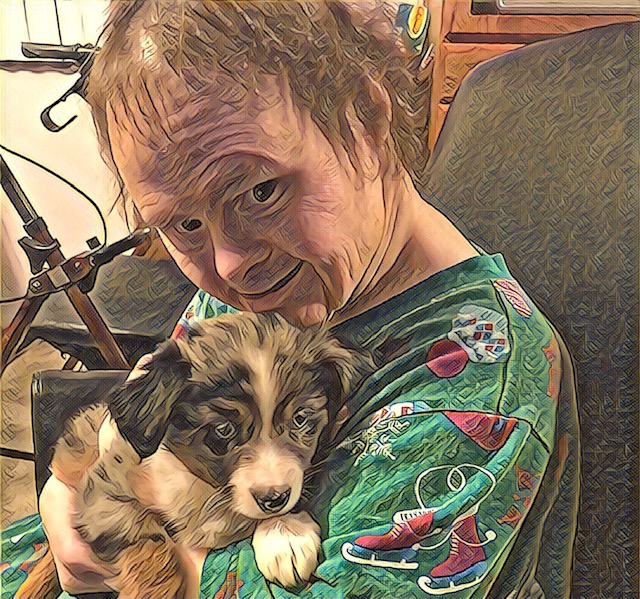
Today is my sister Rose's birthday. She turned 54. Her life is sort of a fairy tale, too. She was born in a time when doctors told parents to drop their Down Syndrome newborns off at mental institutions and forget about them. (Those were the instructions of my mother's doctor when my sister was born.) Doctors believed Down Syndrome children would never be able to walk or talk or progress much further than the diaper stage in development. (Again, that is what my mother's doctor told my parents.) Down Syndrome was seen as akin to a fatal birth defect.
My mother and father didn't listen to that doctor. They brought my sister home and began the job of parenting her. They didn't treat her as fragile or somehow disabled. Rose grew up learning her colors and alphabet and numbers. My mother became a fierce warrior to get her into the public school system. (Rose was born at a time when providing education for a child with challenges was not a legal requirement. Schools could deny education to kids like my sister.)
Rose went to school. She learned to write cursive (something that most teenagers in the 21st century can't do). She learned addition, subtraction, multiplication. She joined chorus. Rose went to the same high school as me. She got invited to go to football games while I stayed at home, reading books. (Truth be told, I preferred it that way.) If somebody gave my sister a hard time at school, I didn't have to defend her. The football team took care of it. Everybody loved Rose.
Eventually, she received a certificate of completion for high school. I think that day was one of the proudest of my parents' lives. Something that, 18 years before, was a dream or fantasy.
Yes, Rose has her struggles now. She has developed Alzheimer's. Just a couple weeks ago, she was having seizures because of new medications. Yet, when I stopped by my mother's house this evening to wish her a happy birthday, she was smiling and sweet. She asked about my son. Several times. I told her each time, "He's at his dance class right now."
My sister Rose is legend and myth and fairy tale. She has overcome every obstacle placed in her path. She is Snow White and Rapunzel. Sleeping Beauty and Princess Leia. She is a hero.
Tonight, Saint Marty thanks God for the birth and life of his sister.
Saturday, April 27, 2019
April 27: Every Point in the Universe, Coincidence, Rose
"Listen," she said, "we picked up those couple of guys . . ."
"What couple of guys?"
"The couple of guys we picked up."
"Oh, yeah," said Zaphod, "those couple of guys."
"We picked them up in Sector ZZ, Plural Z Alpha."
"Yeah?" said Zaphod, and blinked.
Trillian said quietly. "Does that mean anything to you?"
"Mmmm," said Zaphod, "ZZ, Plural Z. Alpha ZZ, Plural Z Alpha?"
"Well?" said Trillian.
"Er . . . what does the Z mean?" said Zaphod.
"Which one?"
"Any one."
One of the major difficulties Trillian experienced in her relationship with Zaphod was learning to distinguish between him pretending to be stupid just to get people off their guard, pretending to be stupid because he couldn't be bothered to think and wanted someone else to do it for him, pretending to be outrageously stupid to hide the fact that he actually didn't understand what was going on, and really being genuinely stupid. He was renowned for being amazingly clever and quite clearly was so--but not all the time, which obviously worried him hence the act. He preferred people to be puzzled rather than contemptuous. This above all appeared to Trillian to be genuinely stupid, but she could no longer be bothered to argue about it.
She sighed and punched up a star map on the visiscreen so she could make it simple for him, whatever his reasons for wanting it to be that way.
"There," she pointed, "right there."
"Hey . . . yeah!" said Zaphod.
"Well," she said.
"Well what?"
Parts of the inside of her head screamed at other parts of the inside of her head. She said, very calmly, "It's the same sector you originally picked me up in."
He looked at her and then looked back at the screen.
"Hey, yeah," he said, "now that is wild. We should have zapped straight into the middle of the Horsehead Nebula. How did we come to be there? I mean, that's nowhere."
She ignored this.
"Improbability Drive," she said patiently. "You explained it to me yourself. We pass through every point in the Universe, you know that."
I am not a believer in coincidence. I don't think seemingly random extraordinary things occur without reason. For example, several years ago, B. C. (that's Before Children), my wife and I were at Walt Disney World on vacation. We were shopping in a place called Disney Village, which was a collection of stores and restaurants. We ran into cousins from Wisconsin who were in the same store, and we had a little family reunion. On that same vacation, a week or so before, my wife and I were at an attraction at one of the parks, and there was a child at the same attraction whom my wife had as a student when she was doing her student teaching. Those kinds of things happened through that whole vacation. I started to believe that we had fallen into some kind of weird wormhole in the universe.
Looking back at that vacation now, I have this feeling that all that was meant to be for some reason. It was one of the last vacations when almost all of my family (siblings and parents) were together. The Wisconsin cousins hadn't seen my parents in years. We took a family picture with them, just to prove that it happened.
So, in my mind, there's no such thing as coincidence. There's order in the universe. Just because something is improbable doesn't mean that it's random. I'm sure my science friends would argue with me on this point, but it would simply be a battle of beliefs or philosophies. I'm a Christian, and I believe in a Higher Power. A guiding force. Everything has a reason.
Now, at this point in this rather long discussion of coincidence versus order, you're probably thinking, "What is his point? What's he getting at?"
I do have a point. Or maybe it's a question. I spend a lot of time wondering why things happen in my life. Recently, it's been the closure of the surgery center where I've worked for over 20 years, and all that change that has accompanied this event. At this point, I don't understand the reason for this, aside from a healthcare system that is inherently broken and places more value on money over people. I'm waiting for the dust to settle on that one so that I can see the larger picture.
The thing that is preoccupying my thoughts at the moment involves my sister, Rose, who has Down syndrome. In the last few days, she has started having episodes that resemble seizures. Five or six in a day. She's fallen and injured herself. Now, Rose is suffering from Alzheimer's. It happens to a majority of people with Down syndrome when they get older. My sister is 53 years old now. She asks the same questions over and over. Spends a good deal of her day running to the bathroom. And she sleeps. A lot.
What is happening with my sister is not unusual. In fact, it's to be expected. The episodes/seizures could be related to medications she's taking, or they could simply be a part of her progressing illness and aging. She will be checked by doctors. But I am truly questioning the reasons behind Rose's struggles. My medical friends would probably say that there isn't really a metaphysical reason behind her condition. It's physiological. Changes in her brain due to age and her Down syndrome. I understand that. Really, I do.
Yet, I see meaningless suffering, and I try to make meaning out of it. Since the onset of her dementia, Rose's personality has changed. She's become argumentative and stubborn and obsessive. Gone is the sister who spent most of her days writing long, discursive, handwritten letters to aunts and uncles and cousins and friends. Gone is the sister who would jump on her three-wheeled bike and go for long rides around the neighborhood. Gone is the sister that I remember.
And I'm left wondering why. I don't know if I'll ever answer that question satisfactorily. It's sort of an ageless question: why does God allow suffering in the world? The answer to that question, I guess, would be that God doesn't allow suffering. The suffering is part of living in a broken world. What God does is give us the strength and wisdom and love to deal with the brokenness.
My sister, Rose, has Down syndrome. My sister, Rose, has Alzheimer's. My sister, Rose, is having seizures. Nothing in that is random coincidence. Perhaps I just need to stop asking "Why?" I'll probably never understand the answer to that question.
Perhaps the question Saint Marty needs to ask is "How do I deal with this with compassion and love?"
Friday, March 2, 2018
March 2: Pagan Ways, Rose, Defying Expectations
Bildad does not give up on trying to save Queequeg's pagan soul. Of course, Queequeg has no intention of abandoning his god for Bildad's. Queequeg knows his worth, and Ishmael and Peleg accept him for everything that he is: cannibal, pagan, tattooed, harpooner. In fact, Peleg fears that converting Queequeg to Christianity may ruin him. As Peleg says, "Pious harpooneers never make good voyagers--it takes the shark out of 'em."
As many of you may be aware, my sister, Rose, was taken by ambulance to the hospital yesterday morning. She was diagnosed with double pneumonia and a severe asthma attack. Her oxygen saturation levels were down in the low fifties. When she got to the ER, they assessed her situation. Within a few hours, she was sedated and on a ventilator in the ICU.
Now, for those of you who don't know Rose, let me tell you that she has a lot of shark in her, like Queequeg. That is to say, she's pretty salty. Rose is the second youngest in my family. I am the baby, even though she frequently tries to steal that title from me. Rose has Down Syndrome. She was born in a time when doctors told parents who had Down Syndrome babies basically to institutionalize and forget about them. That was the advice my mom and dad received.
Of course, my parents were pretty stubborn people. They brought Rose home and loved her no differently than they loved any of their children. My mother fought for Rose her whole life. Fought to get her into school. Fought teachers who underestimated her abilities. Fought school board members who told her, "We have to take care of our kids before we take care of yours."
Rose was more popular than I was in school. Got invited to sporting events. Had the entire football team as her bodyguards. She graduated from high school two years after me. Basically, she defied all expectations. Think of her as Qeequeg with his harpoon.
Yesterday, in her hospital room, she looked tiny to me. Shrunken. Her face was pasty, and her chest moved rhythmically with the ventilator. She was alive, and, yet, as I stood by her bed, I had this vision of her not being there. Letting go. Drifting away from the very sick shell of her body. It was pretty sobering. The doctors said she would have to be intubated for a couple of days.
Again, Rose is defying expectations. They took her off the ventilator this morning. She woke up, terrified and confused. Yet, she was breathing on her own. For a while, her doctors thought she was suffering from sepsis, as well. The blood tests came back negative. This afternoon, when I visited her, she was tired and disoriented. I spoke to her, She opened her eyes, looked at me. I said, "It's okay, Rose. I know you're tired. You can sleep." She nodded and closed her eyes. She never said a word.
Rose is going to be alright, I think. Tomorrow, she's going to be moved out of ICU if she continues to improve. She still has plenty of shark left in her.
Saint Marty is thankful tonight for the health of his sister.
Tuesday, March 21, 2017
March 21: Crippled Man, Mongolian Idiot, Power of Language
Another cripple was ringing a doorbell across the street. He was on crutches. He had only one leg. He was so jammed between his crutches that his shoulders hid his ears.
Billy knew what the cripples were up to. They were selling subscriptions to magazines that would never come. People subscribed to them because the salesmen were so pitiful. Billy had heard about this racket from a speaker at the Lions Club two weeks before--a man from the Better Business Bureau. The man said that anybody who saw cripples working a neighborhood for magazine subscriptions should call the police.
Billy looked down the street, saw a new Buick Riviera parked about half a block away. There was a man in it, and Billy assumed correctly that he was the man who had hired the cripples to do this thing. Billy went on weeping as he contemplated the cripples and their boss. His doorchimes clanged hellishly.
He closed his eyes and opened them again. He was still weeping, but he was back in Luxembourg again. He was marching with a lot of other prisoners. It was a winter wind that was bringing tears to his eyes.
I have to admit that, when Vonnegut starts using the terms "crippled" and "cripples," it makes me cringe. When Slaughterhouse Five first came out, however, those words were completely acceptable to use in polite conversation among people who knew nothing about living with physical challenges. Vonnegut isn't trying to shock or demean. He's just telling a story using the language of the time.
Of course, now, if an author described a character with a disability as a "cripple" (unironically and without attempting to capture some kind of social context), that author would most certainly be the target of justifiable criticism. Regardless of the current trend against political correctness, words can really harm and injure.
When I was in high school, I was in a world history class. The teacher--a nice man, full of progressive ideas--made a comment during a class discussion about a "mongolian idiot." I'm not even sure of the context of the conversation anymore. All I remember is being really shocked by his comment.
My older sister has Down Syndrome, and she was a student at the school. My mother had been fighting for my sister all my life. She fought to get my sister into a classroom. Fought principals and superintendents who didn't want to spend school funds to educate "retarded" children. Fought for other children with various disabilities. My mother was an activist for the rights of kids with mental and physical challenges.
So, when my history teacher talked about a "mongolian idiot," I took it very personally. It made me sad. It pissed me off. After class, I spoke to the instructor, told him how hurtful his language had been. He apologized to me, said that he never intended to offend. I accepted his apology.
Words can be very harmful. My mother taught me to speak against oppressive speech. Taught me to lift people up with my words.
Saint Marty is thankful for his mother's language lessons.