Showing posts with label Mary Oliver. Show all posts

Friday, January 24, 2025

January 24, 2025: "The Departure," Oppositions, "Twins"

Most relationships are a complicated mix of love and anger, respect and jealousy, joy and grief.  In order to define what joy is, you need to know grief.  To feel love, you have to have some acquaintance with anger or hatred.  That's how the universe works--it's defined by oppositions.

I'm not being profound here.  Many people a lot smarter and more eloquent than me have made the same observation.  You can't have light without darkness.  Sunrise without sunset.  Cold without warm.  Music without silence.  That's how it all works.

Sharon Olds addresses her father . . . 

The Departure

by: Sharon Olds

(to my father)

Did you weep like the Shah when you left?  Did you forget
the way you had had me tied to a chair, as
he forgot the ones strapped to the grille
in his name?  You knew us no more than he knew them,
his lowest subjects, his servants, and we were
silent before you like that, bowing
backwards, not speaking, not eating unless we were
told to eat, the glass jammed to our
teeth and tilted like a brass funnel in the 
soundproof cells of Teheran.  Did you forget
the blood, blinding lights, pounding on the door, as
he forgot the wire, the goad,
the stone tables?  Did you weep as you left
as Reza Pahlevi wept when he rose
over the gold plain of Iran, did you
suddenly want to hear our voices, did you
start to rethink the darkness of our hair,
did you wonder if perhaps we had deserved to live,
did you love us, then?


Sharon Olds' relationship with her father was obviously fraught, as evidenced by this poem.  There was physical and emotional abuse layered on top of alcoholism.  Yet, after her father died, she wrote a collection of poems titled The Father that was all about her love and acceptance of him, recognizing the cycle of drinking and violence that formed him as a person.

I love my wife, but we have struggled a great deal in our time together.  I love my son and daughter, but I haven't always agreed with the life choices they've made.  My dad and I had a complex bond, filled with both love and confusion--me not getting him sometimes, and vice versa.  I love my close friends, but that doesn't mean we see eye-to-eye on every subject.  Far from it.

Yet, if the basis of a relationship is mutual respect and affection, that relationship will thrive.  I will do anything for my family and loved ones.  They know that.  I don't hold grudges.  Life is too short, and, in the end, all the anger and resentment only harms myself.  If the biggest mistake I ever make in my life is loving someone who harms me in some way, I'd count that as a win.

Saint Marty wrote a poem about joy and grief tonight, based on the following prompt from The Daily Poet:

Write a poem about twins where the first and last lines are the same line.  Have the poem be about two of something or two similar events.  As you continue to write, consider objects that come in pairs or images that have something to do with twins (Doublemint gum, pairs of socks, hot and cold faucet handles, etc.)  Write your poem in couplets or have stanzas mirror each other, such as two stanzas of three lines, then two stanzas of five lines.  Feel free to title the poem "Twins" even if your poem isn't directly about two people.

Twins

by: Martin Achatz

for Mary Oliver

You wrote we shake with joy and grief,
both inside us like lungs doing

their sustaining work.  Perhaps they do
eat at the same dinner table, one

liking biscuits and gravy, the other
preferring ham and eggs.  And maybe

they even go for walks, morning, evening,
holding hands, high school sweethearts,

bodies so perfectly suited to each other
they nest in bed at night

like just-washed spoons in a drawer,
still smelling of lemony soap.

I bet they lived next to you, Mary,
neighbors who came over for wine

on New Year's Eve, when everyone
is Janus, gazing backward and forward,

and, at midnight, raised glasses, toasted
all that was, all that is to come.

As they left, trooping through snow
toward home, you watched them from

a window, marveled how you
couldn't tell them apart in the bright

moonlight, then took out your notebook where
you wrote about shaking with joy and grief.

Wednesday, December 18, 2024

December 18, 2024: "The Deep," Hope and Joy, Window

Well, I'm semi-recovered from the start of the week. Still feeling a little . . . hungover from end-of-semester stress, among other things. When my mind is engaged for such an extended period of time, without breaks or rest, it takes me a while to recover. Plus, with the headspace I've been in recently (still am), I'm floating in a world that doesn't make a whole lot of sense. The holidays are supposed to be filled with hope and joy.

Billy Collins studies a map . . .

The Deep

by: Billy Collins

Here on this map of the oceans everything is reversed—
the land all black except for the names of the continents
whereas the watery parts, colored blue,
have topographical features and even place names

like the Bermuda Rise, which sounds harmless enough
as does the Cocos Ridge, but how about exploring
The Guafo Fracture Zone when you're all alone?
And from the many plateaus and seamounts—

the Falkland, the Manning, the Azores—
all you could see is water and if you're lucky
a big fish swallowing a school of smaller ones
through the bars of your deep-sea diver's helmet.

And talk about depth: at 4,000 feet below the surface,
where you love to float on your back all summer,
we enter the Midnight Zone where the monkfish
quietly says his prayers in order to attract fresh prey,

and drop another couple of miles and you
have reached The Abyss where the sea cucumber
is said to undulate minding its own business
unless it's deceiving an attacker with its luminescence

before disappearing into the blackness.
What attacker, I can hear you asking,
would be down there messing with the sea cucumber?
And that is exactly why I crumpled the map into a ball

and stuffed it in a metal wastebasket
before heading out for a long walk along a sunny trail
in the thin, high-desert air, accompanied
by juniper trees, wildflowers, and that gorgeous hawk.


I think everyone harbors a certain fear of deep things--water, caverns, tunnels, conversations, therapy.  It's very human to avoid places or circumstances that force you to confront the sea cucumbers or monkfish of your life.  Not to mention those large, dark shapes so far away that you can't even identify them.

Most people retreat to the familiar and comfortable.  A sunny trail lined with juniper trees and wildflowers.  I just finished teaching a Good Books class at the university.  All of the memoirs, novels, and graphic memoirs we read this semester dealt in some way with forms of mental illness.  In several of the works, when the authors are dealing with deep depressions, they begin reading books they loved as a child, which makes complete sense to me.

Think about it.  You feel yourself floating in an abyss of darkness, where you can't seem to find any light whatsoever.  Then you start reading Charlotte's Web or Charlie and the Chocolate Factory or Island of the Blue Dolphins--stories that are so familiar you can almost recite them from memory.  It's like draping yourself in a warm quilt.  For a short while, you gain a miniscule sense of control over your life.  

I've been swimming in the deep for a while now.  What have I been doing for comfort?  Reading poets I love.  Mary Oliver, in particular.  Watching movies I've seen a hundred times.  White Christmas starring Bing Crosby and Danny Kaye is my current jam.  I still cry, but the tears are familiar to me.  I expect to get choked up when I read "Wild Geese" by Oliver or watch the final scene in White Christmas when it starts to snow on Christmas Eve.  I guess that's my version of crumpling up my map of the deep, scary oceans, throwing it out, and going for a sunny walk.  

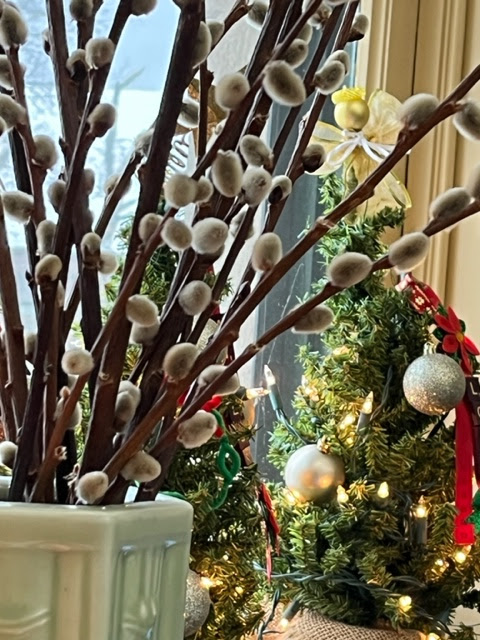
Sometimes, even looking out a window you've looked out thousands of times can be a form of therapy.  From my office at the library, I can see the church across the street, a tree that's still retaining fragments of autumn in its branches, and falling snow.  Three small, lit Christmas trees line the windowsill.  On the tree are Bigfoot ornaments, adorned with the word "Believe."

Saint Marty needs that reminder on a daily basis right now.


Tuesday, December 10, 2024

December 10, 2024: "The Music of the Spheres," Busy Mind, "Orient"

I know y'all are probably getting tired of my posts about the struggle of sadness.  It's difficult to write happy or funny things when you're in the doldrums.  So, if need be, let my words become white noise--constantly present, but easily ignored.

Billy Collins on background sounds . . . 

The Music of the Spheres

by: Billy Collins

The woman on the radio
who was lodging the old complaint
that her husband never listens to her

reminded me of the music of the spheres,
that chord of seven notes,
one for each of the visible planets,

which has been sounding
since the beginning of the universe,
and which we can never hear,

according to Pythagoras
because we hear it all the time
so it sounds the same as silence.

But let’s say the needle were lifted
from the spinning grooves
of those celestial orbs--

then people would stop
on the streets and look up,
and others would stop in the fields

and hikers would stop in the woods
and look this way and that
as if they were hearing something

for the first time,
and that husband would lower
the newspaper from his face

look at his wife
who has been standing in the doorway
and ask Did you just say something, dear?


When I woke this morning, I knew today was going to be rough.  Tears were just behind my eyes like a headache, and they remained there all day.  A couple of times, I couldn't hold them back.  A friend stopped by my office to give me a card and a hug, and I cried.  A Doris Day Christmas song started playing on the radio, and I cried.  (Doris Day was my mom's favorite singer.)  I read a poem by Mary Oliver, and I cried.

When my mind is busy with work, my blueness fades a little.  I don't give myself time to feel.  That might not be the healthiest method of coping with depression, but it works for me.  However, when I experience some downtime (like right now, when everyone is in bed, the TV is dark, and silence hums in my ears like a furnace), I feel myself spiraling.

It's like how Collins describes the music of the spheres--so constant it becomes invisible to the naked ear.  (Yes, I'm conflating two senses in that previous statement.  So sue me.)  When the planets stop singing, that's when everyone notices the silence.

If I stay busy, I can hold the darkness at bay.  Not notice its music.  When I sit down and allow myself to "rest" (if you can call it that), the sadness roosts like a flock of crows in the trees outside my window, cawing and coughing.

So, I try to keep myself moving and thinking, all the time.  It's kind of exhausting, but it beats the alternative, which would be balling myself into a fetal position and weeping.  That's also why I write these posts so late--a busy mind is a happy mind.  Or at least a not-so-sad mind.

Saint Marty will take the music of the spheres (or ACDC or Metallica) over peace and quiet right now.

Another poem from Collins--about being self aware . . . 

Orient

by: Billy Collins

You are turning me
like someone turning a globe in her hand,
and yes, I have another side
like a China no one,
not even me, has ever seen.

So describe to me what’s there,
say what you are looking at
and I will close my eyes
so I can see it too,
the oxcarts and all the lively flags.

I love the sound of your voice
like a little saxophone
telling me what I could never know
unless I dug a hole all the way down
through the core of myself.


Sunday, November 10, 2024

November 10: "My Hero," Hero Worship, First Saint Marty

I think hero worship is a dangerous thing. Hero worship of movie stars leads to negative body image and eating disorders in young people. Hero worship of professional athletes leads to unrealistic expectations in college athletes. Hero worship of politicians leads to tyrants and dictators. I can vouch for the fact that hero worship of poets can lead to writer's block.

Billy Collins worships a terrapin . . .

My Hero

by: Billy Collins

Just as the hare is zipping across the finish line,
the tortoise has stopped once again
by the roadside,
this time to stick out his neck
and nibble a bit of sweet grass,
unlike the previous time
when he was distracted 
by a bee humming in the heart of a wildflower.


I understand Collins's admiration of the tortoise.  The hare is all about crossing the finish line, winning the race.  The tortoise, on the other hand, is more about being in the moment.  Stopping to find joy in sweet grass and a bee dancing in the heart of a daisy or rose.  In other words, the tortoise is a poet.

Don't get me wrong.  I've been given and won my share of accolades and awards, and it felt great.  Everyone loves to be recognized for their hard work and talents.  It doesn't ever feel great to finish last.  I used to run 5K and 10K races.  I never came in first.  (Okay, I did take first or second place in my age group a couple times.  Often, however, there were only one of two other men my age running in those races, so I was guaranteed to win some kind of prize.)

There are some poets whom I admire greatly, almost bordering on hero worship.  Sharon Olds is at the top of that list.  Mary Oliver and Galway Kinnell.  However, my admiration never crosses into hero worship territory.  Rather, these writers teach me how to be a better writer and person.  I don't want to be the next Sharon Olds or Galway Kinnell or Mary Oliver.

I want to be the first Saint Marty.

Saint Marty's moment of hope today:  putting up his Christmas tree with his wife.


Friday, September 13, 2024

September 13: "Building with Its Face Blown Off," Aunt Marian, Joy and Grief

When looking on a scene of devastation--say a car accident or burned building--I always find myself meditating on the victims and their lives.  How they probably woke up in the morning, just like me, thinking it was going to be a normal day.  Maybe they had oatmeal for breakfast and were planning on returning some books to the library on their way home from work.  Perhaps they made dinner plans with some friends.  Ordinary, boring, everyday stuff.

Until it's not.

Billy Collins writes about heartbreak and loss . . .

Building with Its Face Blown Off

by: Billy Collins

How suddenly the private
is revealed in a bombed-out city,
how the blue and white striped wallpaper

of a second story bedroom is now
exposed to the lightly falling snow
as if the room had answered the explosion

wearing only its striped pajamas.
Some neighbors and soldiers
poke around in the rubble below

and stare up at the hanging staircase,
the portrait of a grandfather,
a door dangling from a single hinge.

And the bathroom looks almost embarrassed
by its uncovered ochre walls,
the twisted mess of its plumbing,

the sink sinking to its knees,
the ripped shower curtain,
the torn goldfish trailing bubbles.

It’s like a dollhouse view
as if a child on its knees could reach in
and pick up the bureau, straighten a picture.

Or it might be a room on a stage
in a play with no characters,
no dialogue or audience,

no beginning, middle and end-
just the broken furniture in the street,
a shoe among the cinder blocks,

a light snow still falling
on a distant steeple, and people
crossing a bridge that still stands.

And beyond that- crows in a tree,
the statue of a leader on a horse,
and clouds that look like smoke,

and even farther on, in another country
on a blanket under a shade tree,
a man pouring wine into two glasses

and a woman sliding out
the wooden pegs of a wicker hamper
filled with bread, cheese, and several kinds of olives.


Billy Collins captures the two sides of tragedy pretty well in this poem.  While he's anatomizing the site of the bombed-out building, a man and woman in another country are sitting down for a romantic picnic.  Life just goes on.

My day was pretty normal.  I worked at the library, worked on my Bigfoot manuscript some, and picked up Border Grill for dinner on the way home.  My wife and I watched an episode of The Crown.  As I was leaving the house to take my puppy for a walk, I got a text from my sister, informing me that our Aunt Marian, my mother's youngest sister, had just died.

I can't say that I was shocked by the news.  A little over a week ago, she suffered a stroke, and then, while she was in the hospital for treatment, the doctors discovered that her body was full of metastatic cancer.  There was really nothing that could be done for her.

Suddenly, my boring evening became a building with its face blown off, if you get my meaning.  For the last few hours, all I've been thinking about is my aunt and what a wonderful, loving person she was.  One of my most vivid memories of her is from a New Year's Eve party at my parents' house, all of us sitting around the dining room table, playing board games into the wee hours of January 1st.  And then I thought of her at home this evening, in bed, breathing those agonal breaths.

Poet Mary Oliver once wrote this:

We shake with joy, we shake with grief.
What a time they have, these two
housed as they are in the same body.

Tonight, Saint Marty is shaking with joy and grief, giving thanks for his Aunt Marian, mourning her loss.


Saturday, November 4, 2023

November 4: "Entering the Kingdom," Transparent Eyeball, ER Visit

Mary Oliver has a dream of being nothing . . .

Entering the Kingdom

by:  Mary Oliver

The crows see me.
They stretch their glossy necks
In the tallest branches
Of green trees.  I am
Possibly dangerous, I am
Entering the kingdom.
 
The dream of my life
Is to lie down by a slow river
And stare at the light in the trees--
To learn something by being nothing
A little while but the rich
Lens of attention.
 
But the crows puff their feathers and cry
Between me and the sun,
And I should go now.
They know me for what I am.
No dreamer,
No eater of leaves.


What Oliver is talking about here is retreating from the world a little while.  Reducing herself to nothing more than an eyeball floating above a slow river beside trees flickering with sunlight.  For you transcendentalists out there, think Ralph Waldo Emerson's transparent eyeball--the peace of seeing beyond the world in front of your face to something deeper.

I would love to claim that is the reason why I have been absent so long from blogging, that I've been transformed into that giant, floating eyeball, receiving sacred enlightenment by evaporating from the struggles of life.  That I've been sitting on a mountaintop, communing with trees and crows and stars.

That would be bullshit.  (That was for my dear friend, Gloria, who enjoys my occasional use of profanity.)

The truth of the matter is a little less metaphysical, I'm afraid.  I've simply been too fucking busy and too fucking tired.  (Everything occurs in threes, including profanity.)  I've been teaching and planning a surprise 50th birthday party for my wife and revising a poetry manuscript and hosting concerts/author readings/workshops for the library where I work and recording/editing podcasts.

If all that sounds like too much for one person, it is.  Something had to give, and, unfortunately, for a while it has been blogging.  I got out of the habit of writing.  Period.  Life got complicated, and carving out time for a little self care became necessary.  (And by "self care" I mean sleep.)

I suppose that revelation is sort of like getting in touch with my transparent eyeball, finding that little particle of God in me, listening to Oliver's crow in the tree--eyeball and particle and crow telling me the world was spinning a little too fast.

Another clue that my life was out-of-control:  I was at a medical appointment a week or so ago and ended up in the ER with a blood sugar that wouldn't register.  That means it was around 20 or less.  (Normal is between 70 and 110.)  I don't think I had a seizure, but I was pretty damn close.

So, all these things--eyeball, crows, God particle, my body--were saying,  "Let go, dumb ass."  That's what I did.

I'm fine.  Still insanely busy, but trying to be kinder to myself.  Please forgive my absence, and know that I care about you all.  Wish you peace and love and chocolate.

Saint Marty just needed to . . . fucking . . . slow . . . down . . .


Tuesday, September 12, 2023

September 12: "Roses, Later Summer," Unstinting Happiness, My Car

Mary Oliver wants another life . . . 

Roses, Late Summer

by:  Mary Oliver

What happens
to the leaves after
they turn red and golden and fall
away?  What happens

to the singing birds
when they can't sing
any longer?  What happens
to their quick wings?

Do you think there is any
personal heaven
for any of us?
Do you think anyone,

the other side of that darkness,
will call to us, meaning us?
Beyond the trees
the foxes keep teaching their children

to live in the valley,
so they never seem to vanish, they are always there
in the blossom of light
that stands up every morning

in the dark sky.
And over one more set of hills,
along the sea,
the last roses have opened their factories of sweetness

and are giving it back to the world.
If I had another life
I would want to spend it all on some
unstinting happiness.

I would be a fox, or a tree
full of waving branches.
I wouldn't mind being a rose
in a field full of roses.

Fear has not yet occurred to them, nor ambition.
Reason they have not yet thought of.
Neither do they ask how long they must be roses, and then what.
Or any other foolish question.


Unstinting happiness.  That's Oliver's only condition if she had another life.  She doesn't care whether she's a fox or a tree or a single rose in a field choked with roses.  As long as she's happy, Oliver will take whatever second life she's given.

I know yesterday's post was not very happy.  In fact, I would go so far as to describe what I wrote as a little depressing.  I couldn't help it.  I wasn't feeling the whole Pollyanna vibe last night.  Or the Mary Oliver vibe.  Nope.  I was feeling the Holden Caufield, the-world's-full-of-phonies vibe.  And my mood hasn't changed much today.  I'm still not sure what's wrong with my car, or how much it will cost to fix.  

Life would be simpler if I were a rose in a field of roses.  You see, human beings are the only living creatures on this planet who worry about things like car repairs or the future or death.  On the other hand, flowers need just a couple things for happiness:  sunlight and water,  That's it.

So, I understand Oliver's inclination to life as a rose.  No foolish questions or ambitions to screw things up.  Just unstinting sweetness and beauty.

And Saint Marty wouldn't mind a little more of that in his life right about now.


Saturday, September 2, 2023

September 2: "Rice," Take It for Granted, Black-Eyed Susans

Mary Oliver enjoys some . . . 

Rice

by:  Mary Oliver

It grew in the black mud.
It grew under the tiger's orange paws.
Its stems thinner than candles, and as straight.
Its leaves like the feathers of egrets, but green.
The grains cresting, wanting to burst.
Oh, blood of the tiger.

I don't want you just to sit down at the table.
I don't want you just to eat, and be content.
I want you to walk out into the fields
where the water is shining, and the rice has risen.
I want you to stand there, far from the white tablecloth.
I want you to fill your hands with the mud, like a blessing.


We don't always think about the food on our plates.  How it's planted or raised.  Where it's planted or raised.  Who planted or raised it.  We simply take it for granted--the way we take clean water or electricity or shoes for granted.  These daily luxuries (yes, they are luxuries) are just part of our daily existences.  Until they're not.

If there's one thing I've learned from Mary Oliver, it's this:  don't take even the smallest gifts, like a grain of rice, for granted.  Think about it.  We don't meditate on the black mud, the candle-thin stems, or egret-feather leaves of rice.  We just load up our plates, slop on some butter or mix in vegetables, and call it good.

But everything has a story, including the food on our dinner tables.  I went for a few walks with my puppy today.  The day was brilliantly warm and blue, and my puppy chased after a couple bunnies, barked at cars, and rolled on her back to let some kids scratch her belly.  Nobody who saw or encountered her knew her story,  How, just a few months ago, she nearly died.  How we weren't even sure she would walk normally again.  All the people saw today was a cute little miniature Australian shepherd, full of energy and love.

That's what I'm talking about.  Every time my puppy goes for a stroll, every step she takes, is a blessing, just like the mud where the rice grows.  I used to take these walks for granted.  Now, I realize that each and every one of them is miraculous.  Like the eggs in my refrigerator or the cold water that cascades from my faucet every time I turn the handle.  I don't have to raise chickens or walk 20 miles to the nearest well to have these things in my life.

Outside of church tonight, after I was done playing the pipe organ for Mass, I stopped at the flower gardens.  There was a riot of black-eyed Susans blooming.  They stole my breath.  I've the watched the people tending the flowers all summer long.  Weeding.  Watering,  Deadheading.  I've watched bees flitting from blossom to blossom, doing their pollination dance.

Even these flowers have stories.

So, tonight's post is a narrative of blessings, small and large.

And Saint Marty gives thanks for each and every one of them.

Wednesday, August 30, 2023

August 30: "White Flowers," First Week, Super Blue Moon

Mary Oliver blossoms in a field . . . 

White Flowers

by:  Mary Oliver

Last night
in the fields
I lay down in the darkness
to think about death,
but instead I fell asleep,
as if in a vast and sloping room
filled with those white flowers
that open all summer,
sticky and untidy,
in the warm fields.
When I woke
the morning light was just slipping
in front of the stars,
and I was covered
with blossoms.
I don't know
how it happened--
I don't know
if my body went diving down
under the sugary vines
in some sleep-sharpened affinity
with the depths, or whether
that green energy
rose like a wave
and curled over me, claiming me
in its husky arms.
I pushed them away, but I didn't rise.
Never in my life had I felt so plush,
or so slippery,
or so resplendently empty.
Never in my life
had I felt myself so near
that porous line
where my own body was done with
and the roots and the stems and the flowers
began.


I totally understand Oliver lying down in a dark field to meditate on death.  In case you haven't noticed, thinking about mortality is something I do frequently.  I excel at it.  However, when Oliver wakes up, she finds herself covered in white blossoms, as if her body has either taken root or the green world has risen up and claimed her.  Either way, she's transformed.

It is mid-week.  Hump day, as they say.  I've taught three classes so far, with one left to teach tomorrow morning.  I haven't made a fool of myself.  Yet.  The students seem to like me, although maybe I should substitute the verb "tolerate" for "like."  In any case, Friday is fast approaching, and I've survived the first week of the semester.

Tonight, a Super Blue Moon rises in the heavens.  Now, a blue moon usually refers to a second full moon appearing within a calendar month, and a supermoon means that the moon is closer to the Earth, making it appear slightly larger in the sky.  The next time a Super Blue Moon will appear, according to astronomers, is the year 2037.  

So, what do all these things have to do with each other--death, teaching, little white flowers, and Super Blue Moons?  I'll tell you . . . I don't really know.  It's a confluence of happenings, perhaps related, perhaps unrelated.  I often look for meaning in simply random events that occur simultaneously, and I rarely discover that meaning.

One of my best friends texted me this evening.  She sent a beautiful photo of the moon rising over Lake Superior.  It's huge, with a finger of light stretching across the waves to the shore.  She sent it to me because she knows that I've been struggling for a while with darkness.  She sent it to me because we're both Mary Oliver fans, and Oliver would have loved the image.  And she sent it because she's my friend and wanted to share something beautiful with me.

And maybe that's all the meaning I need tonight.  The fact that there are amazing things happening in the world, even with all the darkness.  That fact that my friend and I love the same poet who falls asleep in a dark field and wakes to white summer flowers blossoming from her body.  The fact that, no matter what I say to my students, they have to discover their own paths to light and meaning.  And the fact that someone in this world loves me enough to send me a Super Blue Moon to carry around in my pocket, in case I stumble in the night.

And Saint Marty is transformed by all this.

Photo by Gala Mahlerbe

Thursday, April 6, 2023

April 6: "Swan," Struck Mute, Wonder and Beauty

Mary Oliver on beauty . . . 

Swan

by:  Mary Oliver

Did you too see it, drifting, all night on the black river?
Did you see it in the morning, rising into the silvery air,
an armful of white blossoms,
a perfect commotion of silk and linen as it leaned
into the bondage of its wings:  a snowbank, a bank of lilies,
biting the air with its black beak?
Did you hear it, fluting and whistling
a shrill dark music, like the rain pelting the trees,
     like a waterfall
knifing down the black ledge?
And did you see it, finally, just under the clouds--
a white cross streaming across the sky, its feet
like black leaves, its wings like the stretching light
     of the river?
And did you feel it, in your heart, how it pertained to everything?
And have you too finally figured out what beauty is for?
And have you changed your life?


This poem is all about being struck mute because of beauty.  For Mary Oliver, it's a swan gliding in a river or lake, taking wing into morning light, its body a rising cross in the silvery sky.  That's what stops Oliver in her tracks, makes her reflect on the meaning of beauty.

Holy Thursday today.  The beginning of the Easter Triduum.  For most of this weekend, I will be a Lutheran celebrating Easter.  I will be playing tomorrow evening for my home parish--a Catholic celebration of Good Friday.  Then two Easter Sunday morning Lutheran services.  

I've always struggled during Holy Week, from Palm Sunday to Easter Sunday.  I think it's the retelling, again and again, of the narrative of Christ's Passion.  I get swept up (or along) in the pathos of the whole story--the extreme humanity of the main actors.  Judas.  Peter.  Mary.  Pontius Pilate.  Jesus.  There's something quite beautiful (and heartbreaking) in all of the brokenness.

When you reach my age, you've experienced betrayal.  You've probably betrayed someone, as well.  And denied someone.  Lost someone.  Grieved for someone.  It's all there.  For me, this week is all about the beauty of being human.  In the gospel narratives of the Passion, humankind at its very worst and very best is on full display.  

My favorite moments in the gospels are when Jesus is at his most human.  When he gets pissed or sad, feels bereft or frightened.  That's the Jesus that interests me.  Because I understand that Jesus.  Yes, I get the whole Son of God part of Christ's DNA, but there's the whole Mary (Oliver) side that watched sunrises, picked flowers, admired swans, fell in love, wept for dead friends.

Maybe Jesus was a poet.  I mean, he's a descendant of King David, author of the psalms.  That means that poetry was in his blood.  It also means that Jesus was stopped dead in his tracks every once in a while by the beauty of the world.  

I think, in a lot of ways, seeing the universe through the eyes of a poet is sort of like having a divine point of view.  I'm not saying poets are gods.  I'm saying that poets recognize the importance of the small, insignificant, gorgeous things that stitch together this life.  Now, what does a person do with that recognition?

I do what Mary Oliver did:  I write poems.  That's how I change my life, sentence by sentence, word by word.

When I got home tonight after church, I led a poetry workshop.  It was a perfect way to end Maunday Thursday--with wonder and beauty.

Saint Marty wrote this:

I Came Home this Afternoon

by:  Martin Achatz

after Diane Seuss

I came home this afternoon to an extra garbage
can blown into my yard by a spring wind
so strong it brought down pine branches,
dug up Taco Bell bags, rolled an empty can
of Miller Lite down the street as if it was
late for a party, the snow banks dwindled
into piles of striated sand, an archeology
of the entire winter of storms and melts,
blizzards and reprieves  It is Holy
Thursday, when the church is stripped,
reds and purples paraded out by serious
parishioners intent on plucking the place
bare, until the world is just a knuckle, raw
and bleeding from hitting the wall too many times.


Sunday, January 15, 2023

January 15: "Franz Marc's Blue Horses," Helen's Birthday, Piece of God

Mary Oliver and my friend Helen . . . 

Franz Marc's Blue Horses

by:  Mary Oliver

I step into the painting of the four blue horses.
I am not even surprised that I can do this.

One of the horses walks toward me.
His blue nose noses me lightly.  I put my arm
over his blue mane, not holding on, just 
     commingling.
He allows me my pleasure.
Franz Marc died a young man, shrapnel in his brain.
I would rather die than try to explain to the blue horses
     what war is.
They would either faint in horror, or simply
     find it impossible to believe.
I do not know how to thank you, Franz Marc.
Maybe our world will grow kinder eventually.
Maybe the desire to make something beautiful
     is the piece of God that is inside each of us.
Now all four horses have come closer,
     are bending their faces toward me
          as if they have secrets to tell.
I don't expect them to speak, and they don't.
If being so beautiful isn't enough, what
     could they possibly say?


Today is my friend Helen's birthday.  Helen loved Mary Oliver, would hand copy whole poems by Oliver in her journals and the cards she sent to close friends.  I will always associate Helen with the things that fill Oliver's poems--bears and herons and ponds and snow geese and ocean waves and honey.  Oliver embraces the wild world, and so did Helen.

The very first line of today's poem could have been written by Helen.  Helen did things like that all the time--step into paintings, dance on words, fly with starlings, hike 200 miles to the shores of a blue sea.  You think I'm waxing poetic.  I'm not.  Helen was this combination of Mary Poppins, Mary Oliver, Glinda the Good Witch, and Bruce Springsteen groupie, with some Leonard Cohen darkness thrown in for good measure. 

My beautiful friend loved beautiful things--poems and paintings and tapestries and desserts.  I can actually see Helen with Franz Marc's blue horses.  She sizzles with joy as she pets their Cubist necks and tangles her fingers in the waves of their manes.  Helen grew up on the coast of the Atlantic Ocean.  She was part saltwater.  Climbing on the back of one of those blue horses is like going home for her.  Together, they gallop and crest and leap in the bright spray of sun and surf. 

That is how I think of Helen on this day of her birth.  She was always filled with the desire to make things beautiful, and she didn't just enjoy beauty.  Helen indulged in it.  Gulped it.  Gorged it.  Mary Oliver is right.  That desire for beauty is the piece of God that is inside all of us.

Saint Marty celebrates his friend Helen tonight.  A piece of God who made this world more beautiful every day of her life.


Monday, January 9, 2023

January 9: "The Pond," Returned to Work. Happiness and Shadow

Mary Oliver wants to sing . . . 

The Pond

by:  Mary Oliver

August of another summer, and once again
I am drinking the sun
and the lilies again are spread across the water.
I know now what they want is to touch each other.
I have not been here for many years
during which time I kept living my life.
Like the heron, who can only croak, who wishes he
       could sing,
I wish I could sing.
A little thanks from every throat would be appropriate.
This is how it has been, and this is how it is:
All my life I have been able to feel happiness,
except whatever was not happiness,
which I also remember.
Each of us wears a shadow.
But just now it is summer again
and I am watching the lilies bow to each other,
then slide on the wind and the tug of desire,
close, close to one another.
Soon now, I'll turn and start for home.
And who knows, maybe I'll be singing.


It's a gentle thing that Mary Oliver describes here.  Summer.  Sun.  Lilies in a pond, tugging and dancing with each other.  Happiness and the shadow of unhappiness.

I returned to work this morning after having ten days off.  I rarely get that much personal time without pressing obligations.  Either I'm hosting an event, teaching a class, or finishing a project.  The last ten days, however, have been gentle and quiet, for the most part.

Happiness, I think, should be that way--like floating in a pond with people you care about, enjoying their warmth and closeness.  But you can't have happiness without shadow.  They kind of define each other.  Shadow is the outline of happiness.  In order to feel truly happy, you have to know what it means to be truly sad.  There's no way around that.

I think of my son who is 14-years-old.  Young people are invincible.  At least, that's what they believe.  Mortality is an alien concept for them, akin to the monsters in their closets or under their beds.  They just don't think, on any kind of regular basis, about the fact that, one day, they will stop breathing and cease to exist.  And that's good.  Young people shouldn't worry about the shadow of death breathing down their necks.

So I let my son go along, being invincible, a superhero whose skin deflects bullets and blades.  Who can eat anything he wants without the specters of diabetes or heart disease or cancer slapping that pizza out of his hands.  He should feel safe in the universe.  Protected.  Loved.

I was a strange child.  Obsessed with shadow.  From a very young age, I thought about my own death.  Reading my diaries and journals through the years, you would find several detailed drafts of my funeral plans, including music choices, seating plans, and menus.  (For the record, there must be beef stroganoff and a chocolate fountain.)  Death has been a part of my life and thoughts for as long as I can remember.  

I think, in a weird way, I have benefitted from this relationship with impermanence.  It reminds me really to cherish everything that brings joy into my life.  To appreciate the day-to-dayness of things.  Four years ago, I was at Walt Disney World for a two-week vacation.  Recently, every morning, my Facebook feed has been filled with photos from that time.  Lots of smiling and fruity alcoholic drinks and fireworks.  It was a lovely period of respite.

However, looking back on those pictures now, I see shadows.  Things have changed drastically since that trip.  Loved ones have died.  Relationships have ended.  Life has changed.  I write that without any kind of judgement.  I know that the only constant in the universe is change.

But, taking a page from Mary Oliver's book (literally), I embrace the pond of today--the friends I laughed with, the food I ate, the tasks I did.  The now-ness of everything.  

Saint Marty could sing a song about all that.


Sunday, January 1, 2023

January 1: New Year, New Book, Same Ole Me

Greetings, faithful disciples!

Welcome to a new year of Saint Marty.  My goal for the next 365 days is to remain a faithful, daily blogger.  I'm not sure how realistic that goal is.  However, since this is a day of new beginnings, let's give it a whirl.

Now, I know you're all wondering what the new book will be for the year 2023.  Leaving Ernest Hemingway behind, I have considered a number of options.  As you know, I started this little tradition near the beginning of this blog.  I believe the first book was Charles Dickens' A Christmas Carol.  I have cycled through a lot of texts in the ensuing years--Moby-Dick, Charlotte's Web, The Hitchhiker's Guide to the Galaxy, and The Old Man on the Sea, to name a few.  However, I have never chosen a collection of poems, unless you count Maggie Nelson's Bluets (which toes that fine line between prose and poetry).

This year, I've decided to focus on a book by one of my favorite poets--Mary Oliver.  The title of the book is Devotions:  The Selected Poems of Mary Oliver.  I made this choice for a few reasons.  First, Mary Oliver is just plain amazing.  Each one of her poems leaves me breathless with its beauty.  Second, Oliver was one of my friend Helen's favorite poets.  In honoring Mary Oliver, I'm also honoring the memory of my friend.  Third, because I wanted to.  My blog, my rules.

So, Day One of the Year of Mary Oliver:

I Wake Close to Morning

by:  Mary Oliver

Why do people keep asking to see
          God's identity in papers
when the darkness opening into morning
          is more than enough?
Certainly any god might turn away in disgust.
Think of Sheba approaching
          the kingdom of Solomon.
Do you think she had to ask,
          "Is this the place?"

Mary Oliver saw grace in every tiny moment she lived.  She saw it in the darkness of death as well as the coming light of a new day.  Think of that.  Living each day of your life staring into the face of God.  I think that's what Mary Oliver did.

Of course, we all struggle.  We all have times that leave us sapped and unwilling to face the blizzard of another 24 hours.  That pretty much describes my life for the last eight or nine months.  

Yet, God is out there.  We just have to peel the scales away from our stupid eyes in order to see Him.  Most of the time, we're just like kids, sitting in the backseat of the car, whining and asking, "Are we there yet?"

So, on this first day of a new year, I embrace the fact that, when I want a face-to-face with the Almighty, all I have to do is go outside and watch the sunset.  Or reach over and scratch my puppy's belly and watch her bask in the pure contentment of my attention.

Saint Marty is happy to be with Saint Mary Oliver tonight.


Monday, November 25, 2019

November 25: End in Tears, Saying Goodbye, Hand Turkeys

"It'll all end in tears, I know it," shouted Eddie [the Heart of Gold's on board computer] after them, and closed the hatchway again.

Eddie is learning something pretty human at this moment.  That is, saying goodbye is never easy.  Whether to a supercomputer.  Or a friend getting on an airplane.  A daughter getting married.  A couple getting uncoupled.  A parent dying.  A door closing.  Goodbyes, in my experience, are heavy on the "bye," very light on the "good."

Today, I had a doctor's appointment.  Just a routine, six-month diabetic check.  This doctor has been taking care of my health for close to 34 years.  That's a long time.  He's watched me grow up, get married, have kids, and acquire gray hair.  This afternoon, we had to say goodbye.  He's retiring after a very long career.

Now, my doctor and I haven't been best friends or anything.  We rarely saw each other outside of my regular semi-annual exams.  Once, he attended a poetry reading I gave, and we went out for beer with a group of people.  He bought me a drink, and we talked about poetry.  (I had no idea he knew anything about poetry.  Go figure.)  After almost four decades of blood and urine tests, pokings and proddings, cold stethoscopes and one sigmoidoscopy (if you don't know what that is, count yourself lucky), I learned that he read Mary Oliver and Wendell Berry.

I liked this doctor, understood where he was coming from.  Granted, his bedside manner was not the most comforting.  He wasn't a teddy bear.  Yet, I never questioned that he cared about me and my well being.  So, my appointment with him today was bittersweet.  I will miss having him as a constant in my life.  We spent most of my appointment trying to think of the name of an Irish-American poet from the Seattle area.  (Neither of us could come up with his name.)  At the end, he handed me a route slip, shook my hand, said something like "It's been a pleasure taking care of you," and then he was gone.

That's what most goodbyes are like.  They happen quickly and are over before you've had a chance to really comprehend them.  The person walks out of the room and disappears forever from your life, with barely a glance backward.

I have had to contemplate a lot of goodbyes this year, and I'm still contemplating a few more.  This evening, all I can think about is parting ways with people I care about and trust and, to a greater or lesser extent, love.  These thoughts have been keeping me awake at night.  They are keeping me awake right now.

I did one thing this evening that provided a little relief from goodbye reflections.  I decorated a hand turkey.  For those of you who don't know what I'm talking about, it's pretty simple.  You trace the outline of your hand on a sheet of paper.  Then, you decorate this tracing to make it look like a Thanksgiving turkey.  I remember doing hand turkeys in first and second grades.  This particular turkey is for a contest at the cardiology office where I work.  Whoever submits the best hand turkey wins a $10 Starbucks gift card.  (I will not be in the competition since I organized it.  I am submitting a turkey simply for the fun of it.)

Sometimes the only way to take your mind off your goodbyes is silliness.  Or art.

Saint Marty did a little of both this evening.


Sunday, February 24, 2019

February 24: All Work and No Play, Mary Oliver, "White-Eyes"

The day is beginning to darken.  It's about 6 p.m., and the wind and snow have been screaming outside all day long.  This weekend's weather has piled white again my kitchen windows.  One more storm like this, and they will be completely buried.  If I were a less stable, grounded person, I would be sitting in my kitchen "office" typing "All work and no play make Marty a dull boy" over and over and over.

In the midst of blizzards, it's difficult to appreciate their fierce beauty.  It's like the world is reminding us who really is in charge.  I must remind myself tonight that this snow is a gift.  A really heavy, wet, impossible gift.

Saint Marty is not snow complaining this evening.  He's snow meditating, like Mary Oliver . . .

White-Eyes

by:  Mary Oliver

In winter
     all the singing is in
          the tops of the trees
               where the wind-bird

with its white eyes
     shoves and pushes
          among the branches.
               Like any of us

he wants to go to sleep,
     but he's restless--
          he has an idea,
               and slowly it unfolds

from under his beating wings
     as long as he stays awake.
          But his big, round music, after all,
               is too breathy to last.

So it's over.
     In the pine-crown
          he makes his nest,
               he's done all he can.

I don't know the name of this bird.
     I only imagine his glittering beak
          tucked in a white wing
               while the clouds--

which he has summoned
     from the north--
          which he has taught
               to be mild, and silent--

thicken and begin to fall
     into the world below
          like stars, or the feathers
               of some unimaginable bird

that loves us,
     that is asleep now, and silent--
          that has turned itself
               into snow.


Thursday, January 17, 2019

January 17: Pan Galactic Gargle Blaster, Mary Oliver, Ducks and Blue Irises

A new chapter from Hitchhiker's, as Ford and Arthur make their way to the pub . . .

Here's what the Encyclopedia Galactica has to say about alcohol.  It says that alcohol is a colorless volatile liquid formed by the fermentation of sugars and also notes its intoxicating effect on certain carbon-based life forms.

The Hitchhiker's Guide to the Galaxy also mentions alcohol.  It says that the best drink in existence is the Pan Galactic Gargle Blaster.

It says that the effect of a Pan Galactic Gargle Blaster is like having your brains smashed out by a slice of lemon wrapped round a large gold brick.

The Guide also tells you on which planets the best Pan Galactic Gargle Blasters are mixed, how much you can expect to pay for one and what voluntary organizations exist to help you rehabilitate afterward.  

The Guide even tells you how you can mix one yourself.

Take the juice from one bottle of that Ol' Janx Spirit, it says.

Pour into it one measure of water from the sea of Santraginus V--Oh, that Santraginean sea water, it says.  Oh, those Santraginean fish!

Allow three cubes of Arcturan Mega-gin to melt into the mixture (it must be properly iced or the benzine is lost).

Allow four liters of Fallian marsh gas to bubble through it, in memory of all those happy hikers who have died of pleasure in the Marshes of Fallia.

Over the back of a silver spoon float a measure of Qualactin Hypermint extract, redolent of all the heady odors of the dark Qualactin Zones, subtle, sweet and mystic.

Drop in the tooth of an Algolian Suntiger.  Watch it dissolve, spreading the fires of the Algolian Suns deep into the heart of the drink.

Sprinkle Zamphuor.

Add an olive.

Drink . . but . . . very carefully . . .

The Hitchhiker's Guide to the Galaxy sells rather better than the Encyclopedia Galactica.

Sounds like an amazing drink to forget all your troubles.  Or to commit suicide with.

One of the issues that I'm having with the choice of Hitchhiker's as the book of the year is that there really isn't any serious moments in it.  I would call it sci-fi farce.  It revels in the ridiculous.  So, when I want to discuss something a little more somber, I struggle.

I just learned a little while ago that one of my favorite poets died today.  Mary Oliver.  She'd been battling lymphoma since 2015.  I knew that.  However, I never really thought that Mary Oliver would disappear from this planet.

Granted, that sounds ridiculous.  But her books are so full of life--snakes and sea water and geese and deer and otters.  Her pages are like poetic National Geographic specials.  I didn't think anything could stop Mary Oliver.  Of course, I thought the same thing about my sister, who also died of lymphoma.

I'm deeply saddened by this news, as I am when any positive force in the world vanishes.  Yet, as a poet, she lives and will continue to live.  Through her words and images and ideas.  Through striped sparrows and diving cormorants.  Black ducks and blue irises.

Saint Marty raises a Pan Galactic Gargle Blaster in honor of the life of Mary Oliver tonight.


January 17: Mary Oliver, "The Uses of Sorrow," Let the Perpetual Light Shine Upon Her

In the Catholic Church, there is a prayer that is said for a person who has recently died.

Tonight, Saint Marty says it for poet Mary Oliver:

Eternal rest grant to her, O Lord; and let the perpetual light shine upon her.  May her soul, and the souls of all the faithful departed, through the mercy of God, rest in peace.  Amen.

The Uses of Sorrow

by:  Mary Oliver

(In my sleep I dreamed this poem)

Someone I loved once gave me
a box full of darkness.

It took me years to understand
that this, too, was a gift.


Sunday, December 23, 2018

December 23: Mary Oliver, "Christmas Poem," Tips Toward Christmas

Christmas Poem

by:  Mary Oliver

Says a country legend told every year:
Go to the barn on Christmas Eve and see
what the creatures do as that long night tips over.
Down on their knees they will go, the fire
of an old memory whistling through their minds!
[So] I went. Wrapped to my eyes against the cold
I creaked back the barn door and peered in.
From town the church bells spilled their midnight music,
and the beasts listened –
yet they lay in their stalls like stone.

Oh the heretics!
Not to remember Bethlehem,
or the star as bright as a sun,
or the child born on a bed of straw!
To know only of the dissolving Now!
Still they drowsed on –
citizens of the pure, the physical world,
they loomed in the dark: powerful
of body, peaceful of mind,
innocent of history.
Brothers! I whispered. It is Christmas!
And you are no heretics, but a miracle,
immaculate still as when you thundered forth
on the morning of creation!
As for Bethlehem, that blazing star
still sailed the dark, but only looked for me.
Caught in its light, listening again to its story,
I curled against some sleepy beast, who nuzzled
my hair as though I were a child, and warmed me
the best it could all night.
_______________________________________

A poem from Mary Oliver as the world is tips toward Christmas.

I am trying to prepare, to fill my heart with anticipation and joy instead of worry and stress.  It's a struggle this year.  I've caught myself up in the frenzy.  It doesn't help that, in a little over a week, I'm getting on an airplane and heading to Florida for ten days.  I'm totally unprepared for that, as well.

Saint Marty has failed Advent 101 this year.


Saturday, November 11, 2017

November 11: Veterans Day Sacrifices, Mary Oliver, "Gethsemane"

I will never know the feeling of being in a strange place, defending freedom, keeping peace.  It takes special, brave people.

However, I know that my right to write, express myself, criticize, worship, praise is not protected by the people sitting in Washington, D. C.  That work is done by people in uniform.

Saint Marty give thanks this Veterans Day for sacrifices.

Gethsemane

by:  Mary Oliver

The grass never sleeps.
Or the roses.
Nor does the lily have a secret eye that shuts until morning.

Jesus said, wait with me.  But the disciples slept.

The cricket has such splendid fringe on its feet,
and it sings, have you noticed, with its whole body,
and heaven knows if it ever sleeps.

Jesus said, wait with me.  And maybe the stars did, maybe
the wind wound itself into a silver tree, and didn't move,
     maybe
the lake far away, where once he walked as on a
     blue pavement,
lay still and waited, wild awake.

Oh the dear bodies, slumped and eye-shut, that could not
keep that vigil, how they must have wept,
so utterly human, knowing this too
must be a part of the story.


Friday, November 10, 2017

November 10: Great News, Mary Oliver, "The Poet Thinks about the Donkey"

So, I had great news last night about the teaching award from the university.  Unbelievable news.

I sort of feel like the donkey in the poem below.  The donkey wasn't special, didn't know he was going to play such a significant role in the universe.  He was just small, dark, and obedient, moving forward, hoof step by hoof step.

I think the world would be a much better place if there were more donkeys in the world, just doing their jobs, not looking for recognition or glory.

A lot of people think that Saint Marty is a jackass.

The Poet Thinks about the Donkey

by:  Mary Oliver

On the outskirts of Jerusalem
the donkey waited.
Not especially brave, or filled with understanding,
he stood and waited.

How horses, turned out into the meadow,
     leap with delight!
How doves, released from their cages,
     clatter away, splashed with sunlight!

But the donkey, tied to a tree as usual, waited.
Then he let himself be led away.
Then he let the stranger mount.

Never had he seen such crowds!
And I wonder if he at all imagined what was to happen.
Still, he was what he had always been:  small, dark, obedient.

I hope, finally, he felt brave.
I hope, finally, he loved the man who rode so lightly upon him,
as he lifted one dusty hoof and stepped, as he had to, forward.