Showing posts with label poetry reading. Show all posts

Friday, December 6, 2024

December 6, 2024: "Lines Written at Flying Point Beach," the Soo, Ace

A good portion of today, I was traveling for Sault Ste. Marie, Michigan, to do a poetry workshop and reading at Bayliss Library.  I didn't have to drive at all.  One of my best poet friends drove the entire way there and back.  He co-led the workshop and co-read with me.

I'm not particularly fond of long car rides, especially during the winter in the Upper Peninsula.  In the past couple weeks, the "Soo," as Yoopers affectionally call Sault Ste. Marie, got over three feet of snow.  That might seem like a lot to non-Yoopers, but a lot of snow doesn't slow us down for very long.

Billy Collins writes about a favorite place . . . 

Lines Written at Flying Point Beach

by: Martin Achatz

or at least in the general vicinity
of Flying Point Beach,
certainly closer than I normally am

to that beach where the ocean
crests the dunes at high tide
spilling tons of new salt water into Mecox Bay,

and probably closer to Flying Point Beach
than you are right now
or I happen to be as you are reading this.

but how close do I really need to be
to Flying Point Beach
or to any beach in order to write these lines?

Oh, Flying Point Beach,
I love all three words in your name,
not to mention the deep, white sand

and the shorebirds on their thin legs
facing into the wind
along that low stretch between the ocean and the bay.

How satisfying it is to be
even within bicycling distance of you,
though it's dangerous to ride at the edge of these roads.

Thoreau had a cabin near his pond.
Virginia Woolf stood on the shore of the River Ouse,
and here I am writing all this down

not very far at all--maybe 20 minutes by taxi
if the driver ever manages to find this place--
from the many natural wonders of Flying Point Beach.


The Soo is a beautiful town, even when it's buried under 36+ inches of white stuff.  When I visited close to ten years ago, I remember watching ships pass through the locks on the St. Mary's River.  I can't say it's one of my favorite places, but Yoopers are a hardy lot, but, to be honest, I wasn't sure if poetry was enough to lure people to brave the elements.  My gut told me that we were going to have a very small audience.  But you know that old saying from the Bible, where two or three are gathered, there shall be poetry.  (Okay, I made that last bit up.)

For our reading, I was convinced nobody was going to show up.  (Ronnie and I led a poetry workshop earlier, and only one person attended--and he worked for the library.)  Two people came to the reading:  a young woman and her third-grade son whose name was Ace.  Neither were very interested in poetry.  They came to get a selfie with Bigfoot.

Ace was an amazing little guy.  Full of energy and kindness, he got his picture with Bigfoot, but he also sat and listened to me read poems and Ronnie sing songs.  After I read one particular poem, Ace said to me, "That was the best poem I've ever heard.  And I'm not just saying that."  You don't often encounter that kind of emotional intelligence in a young person.

Speaking with Ace's mother, I learned of his struggles in a schoolroom with inattentive teachers and bullies.  He hasn't had an easy time of things, and his story reminded me so much of my own son's issues in elementary and middle school.  At the end of the reading, I told Ace how awesome he was, and I encouraged him to continue to be kind and curious.

On the drive home from the Soo, Ronnie said to me, "Ace made this whole trip worth it."

Ace gave Saint Marty hope for the future today.


Tuesday, August 13, 2024

August 13: "Silence," Complete Silence, Poetry Reading

I generally don't do well with silence.  In the car, I usually have a podcast or audiobook playing.  In my office, I play music or read things aloud or have lengthy conversations with coworkers, musicians, writers, and presenters.  At home, the sound of the TV is a constant presence, like the smell of ham on Christmas morning.  At night, I listen to my son swearing at his gaming friends in his attic room as I drift into slumber.

I know what you're thinking:  don't you need silence when you try to write a poem or essay or story?  The simple answer to that question is "yes."  The more complete answer to that question is that there's no such thing as complete silence in my life.  If I'm typing a blog post, there's the tap-tap-tap of my fingers on the keyboard.  If I'm working on a poem, there's the scratch of the pen nib on paper and (sometimes) me quietly reading lines to an invisible audience, testing the poetic waters, if you will.

Every once in a while, I do need to remove myself from the loudness of life.  This past summer, I had no classes to teach at the university, and I had PTO I needed to use or lose at the library.  So, I've had a lot of time to enjoy a less noisy existence.  

Billy Collins meditates on . . . 

Silence

by: Billy Collins

There is the sudden silence of the crowd
above a motionless player on the field,
and the silence of the orchid.

The silence of the falling vase
before it strikes the floor,
the silence of the belt when it is not striking the child.

The stillness of the cup and the water in it,
the silence of the moon
and the quiet of the day far from the roar of the sun.

The silence when I hold you to my chest,
the silence of the window above us,
and the silence when you rise and turn away.

And there is the silence of this morning
which I have broken with my pen,
a silence that had piled up all night

like snow falling in the darkness of the house--
the silence before I wrote a word
and the poorer silence now.


Poets need silence in order to create the noise of poetry.  That's right, I said noise.  Poetry is an oral art form.  In order to fully engage in a poem, you must read it aloud.  Feel it on your tongue, in your ears.  Until you do that, you haven't truly experienced poetry.

Tonight, I traveled to a nearby town to participate in a reading at a local bookstore.  From 6 p.m. to 8 p.m., I listened to poetry and music by some of my closest friends.  The place was crowded, but not with literary fans.  Everyone was stopping by the store to pick up some hand-dipped ice cream, and they lingered to listen to a few songs and poems while they were eating.  I sold a couple books and read a few poems.

I just got back home a little while ago.  I'm beat.  Tomorrow, I perform again at another venue.  

In the meantime, Saint Marty is going to enjoy a little silence right now.  Or he might watch a movie.


Tuesday, June 18, 2024

June 18: "Cornish," Pasties, "Heat Wave"

Billy Collins must not be a fan of pasties . . . 

Cornish

by: Billy Collins

Would someone
please translate
her long memoir

into a language
almost no one speaks
or understands anymore?


The Upper Peninsula of Michigan, where I live, is a place where a lot of Cornish families settled, mainly because of the mining industry.  During the 18th century, the Cornish were considered to be the best hard rock miners in the world (Cornwall being the global hub of mining at the time), so it's no surprise that they came to this region to work in the copper and iron mines.  

Hence the fact that the U.P. is also famous for, among other things, its pasties (a Cornish specialty).  Because these meat pies were portable and provided a full meal (bread, meat, potatoes, vegetables), Cornish miners packed them in their lunch buckets as they headed belowground to work.  Nowadays, you can't drive through a city, village, or town in the Upper Peninsula without finding at least one pasty shop.

So, the heritage of Cornwall, if not the language, is alive and well in my neck of the woods.  I am not of Cornish stock.  I'm a mixture of English and German, mostly.  My sister worked for the mines, but my ancestors did not.  However, I grew up eating pasties and hearing stories of mining disasters like the Barnes-Hecker collapse.  

Today was the first really hot day of the summer, with high temperatures and humidity.  Stepping outside, I almost felt like a baking pasty.  I'm not complaining.  Given the choice between 20 below zero and 90 degrees, I'll take 90 any day.  I love hot weather.  Of course, I was in an air-conditioned library most of the time.

I hosted a poetry reading at the library this evening for three poet friends who've recently released books.  It was a wonderful event, full of great poetry.  And a ton of people showed up.  If I sound surprised, I was.  Usually, poetry doesn't garner all that much enthusiasm from the general public.  Yet, there were only a few empty seats in the audience tonight, and, afterward, everyone just hung around, talking, laughing, and buying books.  I almost felt bad rushing people out the door into the heat at 8:30 p.m. when the library closed.

Now, I'm sitting on my couch at around 11:30 p.m., unable to sleep, thinking of those Cornish miners riding those elevators down into the mine shafts.  How, even at the height of summer, they were surrounded by the cool and damp of the earth.  I wonder if it felt like being buried alive every day.  Maybe, as they worked, they sang Cornish songs or recited Cornish poems and nursery rhymes.

And now Saint Marty is hungry for one of his mother's pasties.

Heat Wave

by: Martin Achatz

A wasp nest nestles
under the eave of my garage,
a paper fist clenched so tightly
its gray knuckles sizzle
in the frying pan of June.


Monday, July 11, 2022

July 11: As Desperate as I Am, 1985, Cindy Hunter Morgan

Santiago is desperate . . . 

During the night two porpoise came around the boat and he could hear them rolling and blowing. He could tell the difference between the blowing noise the male made and the sighing blow of the female.

"They are good," he said. "They play and make jokes and love one another. They are our brothers like the flying fish."

Then he began to pity the great fish that he had hooked. He is wonderful and strange and who knows how old he is, he thought. Never have I had such a strong fish nor one who acted so strangely. Perhaps he is too wise to jump. He could ruin me by jumping or by a wild rush. But perhaps he has been hooked many times before and he knows that this is how he should make his fight. He cannot know that it is only one man against him, nor that it is an old man. But what a great fish he is and what he will bring in the market if the flesh is good. He took the bait like a male and he pulls like a male and his fight has no panic in it. I wonder if he has any plans or if he is just as desperate as I am?

I wrote last night about being in a blue funk.  These moods sort of come out of nowhere, and they hang on for quite some time.  They've been a constant in my life since I was a teenager.  The first one was in 1985, after my high school graduation.  I lost someone I dearly loved, and I spent that June, July, and August in my bedroom, shades pulled, lights off, face pressed into my pillow.  I barely held on that summer.  I was just as desperate as Santiago facing that unseen fish after months of failure.

The most difficult part of these funks is making it through a day.  It takes so much more effort to appear normal and happy.  To do everyday tasks.  By nighttime, after teaching and emailing and event hosting, I'm pretty exhausted.

Now, I know that I'm a very lucky person.  My struggles are tiny compared to the current struggles of some people in my life.  Really tiny.  Please know that I am aware of all of the blessings I possess, but I'm seeing those blessings through a fog right now.  A thick fog.

Here is what I'm going to do until I reach the other side this canyon:  I'm going to talk about one blessing from each day.

Tonight's blessing was poet Cindy Hunter Morgan.  I hosted a reading by her at the library this evening.  Her poems were haunting.  Beautiful.  Heartbreaking.  They filled me with . . . love for a broken world.  I forgot to be sad for a while, and that was worth the price of admission.

Saint Marty is going to read a poem now and go to bed.

Tuesday, April 12, 2022

April 12: Not an Accident, Thomas Lynch, Teeth

Santiago has an enemy . . . 

The shark was not an accident. He had come up from deep down in the water as the dark cloud of blood had settled and dispersed in the mile deep sea. He had come up so fast and absolutely without caution that he broke the surface of the blue water and was in the sun. Then he fell back into the sea and picked up the scent and started swimming on the course the skiff and the fish had taken.

Sometimes he lost the scent. But he would pick it up again, or have just a trace of it, and he swam fast and hard on the course. He was a very big Mako shark built to swim as fast as the fastest fish in the sea and everything about him was beautiful except his jaws.

His back was as blue as a sword fish's and his belly was silver and his hide was smooth and handsome. He was built as a sword fish except for his huge jaws which were tight shut now as he swam fast, just under the surface with his high dorsal fin knifing through the water without wavering. Inside the closed double lip of his jaws all of his eight rows of teeth were slanted inwards. They were not the ordinary pyramid-shaped teeth of most sharks. They were shaped like a man's fingers when they are crisped like claws. They were nearly as long as the fingers of the old man and they had razor-sharp cutting edges on both sides. This was a fish built to feed on all the fishes in the sea, that were so fast and strong and well armed that they had no other enemy. Now he speeded up as he smelled the fresher scent and his blue dorsal fin cut the water.

Poet Thomas Lynch read at the library this evening, along with my friend Kathleen Heideman.  It was a glorious night, capped off with some drinks and conversation about death at Kathleen's house.

Saint Marty koan for tonight:  beauty is in the teeth.


Wednesday, December 29, 2021

December 29: Pure Franciscan Ideal, Creative Urge, Poetry Reading

Merton meets someone living a real Franciscan . . . 

When she was working in that laundry, down somewhere near Fourteenth Street, and sitting on the kerbstone eating her lunch with the other girls who worked there, the sense of her own particular vocation dawned upon her. It was the call to an apostolate, not new, but so old that it is as traditional as that of the first Christians: an apostolate of a laywoman in the world, among workers, herself a worker, and poor: an apostolate of personal contacts, of word and above all of example. There was to be nothing special about it, nothing that savored of a religious Order, no special rule, no distinctive habit. She, and those who joined her, would simply be poor—there was no choice on that score, for they were that already—but they would embrace their poverty, and the life of the proletariat in all its misery and insecurity and dead, drab monotony. They would live and work in the slums, lose themselves, in the huge anonymous mass of the forgotten and the derelict, for the only purpose of living the complete, integral Christian life in that environment—loving those around them, sacrificing themselves for those around them, and spreading the Gospel and the truth of Christ most of all by being saints, by living in union with Him, by being full of His Holy Ghost, His charity. 

As she spoke of these things, in that Hall, and to all these nuns and clerics, she could not help but move them all deeply, because what they were hearing—it was too patent to be missed—was nothing but the pure Franciscan ideal, the pure essence of the Franciscan apostolate of poverty, without the vows taken by the Friars Minor. And, for the honor of those who heard her, most of them had the sense and the courage to recognize this fact, and to see that she was, in a sense, a much better Franciscan than they were. She was, as a matter of fact, in the Third Order, and that made me feel quite proud of my own scapular, which was hiding under my shirt: it reminded me that the thing was not altogether without meaning or without possibilities! 

So the Baroness had gone to Harlem. She stepped out of the subway with a typewriter and a few dollars and some clothes in a bag. When she went to one of the tenements, and asked to look at a room, the man said to her: 

“Ma’am, you all don’t want to live here!” 

“Yes, I do,” she said, and added, by way of explanation: “I’m Russian.” 

“Russian!” said the man. “That’s different. Walk right in.” 

In other words, he thought she was a Communist.... 

That was the way Friendship House had begun. Now they were occupying four or five stores on both sides of 135th Street, and maintained a library and recreation rooms and a clothing room. The Baroness had an apartment of her own, and those of her helpers who lived there all the time also had a place on 135th Street. There were more girls than men staying with her in Harlem. 

When the meeting was over, and when the Baroness had answered all the usual objections like “What if some Negro wanted to marry your sister—or you, for that matter?” I went up and spoke to her, and the next day I ran into her on the path in front of the library, when I was going, with an arm full of books, to teach a class on Dante’s Divine Comedy. These two times were the only chance I had to speak to her, but I said: 

“Would it be all right if I came to Friendship House, and did a little work with you, there, after all this is over?” 

“Sure,” she said, “come on.” 

But seeing me with my arms full of all those books, maybe she didn’t believe me.

Merton's been struggling with his call.  Eventually, he will become a Trappist monk.  However, the Baroness Catherine de Hueck is a Franciscan in every sense of the word.  Living with the poor.  Serving the poor.  Sacrificing everything with a pure heart, guided not by any human law.  Following the whisper of the Holy Spirit in her heart.

I use the word "whisper," but for a person like the Baroness or Mother Teresa or Saint Francis, the Holy Spirit's voice was probably more than a quiet breeze.  It was a blizzard roaring in their ears.  Something that couldn't be ignored.  Certainly, Merton can't ignore it.

I'm not sure that I've every heard the Holy Spirit that loudly in my life.  The closest I come is when I'm writing something--usually a poem or essay.  When the creative urge overtakes over my mind, I can't think of anything else until I'm done with whatever I'm working on.  It's nothing like caring for AIDS sufferers in Calcutta or the poor in the streets of Harlem.  However, I know that the words I write come from some source other than myself.

Tonight, I gave a reading at the library in my hometown.  I grew up in this building.  Spent many a summer day there, combing through biographies and poetry collections and novels.  Every time I give a reading there, I feel that magic again.  I'm always surrounded by friends and family.

This evening, I read, among other things, the essay I wrote about my mother for Christmas.  As I read, I could actually feel my mom there with me.  I know that she was always proud of my accomplishments as a writer.  I remember her in the front row at the first poetry reading I ever gave.  She sat there, beaming.  Nodding and laughing.

I know a poem doesn't put food in the mouths of the hungry.  An essay doesn't clothe the naked.  But I like to think that my writing does fill a certain emptiness that exists in the human spirits I encounter.  Perhaps that's ego talking.  But there's nothing, for me, more fulfilling than making someone smile or laugh.  Maybe brush away a tear at the memory of a lost loved one.  I like to think that's my gift.  My version of multiplying loaves and fishes.

Saint Marty gives thanks for the miracle of words in his life.


Tuesday, December 15, 2020

December 15: Physical Push, Poetry Reading, Hunger

 Merton begins writing his thesis  . . , 

When I got back to New York, one of the first things I did was to break away, at last, from the household in Douglaston. The family had really practically dissolved with the death of my grandparents, and I could get a lot more work done if I did not have to spend so much time on subways and the Long Island train. 

One rainy day in June, then, I made a bargain with Herb, the colored taximan at Douglaston, and he drove me and all my bags and books and my portable vie and all my hot records and pictures to put on the wall and even a tennis racquet which I never used, uptown to a rooming-house on 114th Street, just behind the Columbia library. 

All the way up we discussed the possible reasons for the mysterious death of Rudolph Valentino, once a famous movie star: but it was certainly not what you would call a live issue. Valentino had died at least ten years before. 

“This is a nice spot you got here,” said Herb, approving of the room I was renting for seven-fifty a week. It was shiny and clean and filled with new furniture and had a big view of a pile of coal, in a yard by the campus tennis courts, with South Field and the steps of the old domed library beyond. The panorama even took in a couple of trees. 

“I guess you’re going to have a pretty hot time, now you got away from your folks,” Herb remarked, as he took his leave. 

Whatever else may have happened in that room, it was also there that I started to pray again more or less regularly, and it was there that I added, as Bramachari had suggested, The Imitation of Christ to my books, and it was from there that I was eventually to be driven out by an almost physical push, to go and look for a priest. 

July came, with its great, misty heats, and Columbia filled with all the thousands of plump, spectacled ladies in pink dresses, from the Middle-West, and all the grey gents in seersucker suits, all the dried-up high-school principals from Indiana and Kansas and Iowa and Tennessee, with their veins shriveled up with positivism and all the reactions of the behaviorist flickering behind their spectacles as they meditated on the truths they learned in those sweltering halls. 

The books piled higher and higher on my desk in the Graduate reading room and in my own lodgings. I was in the thick of my thesis, making hundreds of mistakes that I would not be able to detect for several years to come, because I was far out of my depth. Fortunately, nobody else detected them either. But for my own part, I was fairly happy, and learning many things. The discipline of the work itself was good for me, and helped to cure me, more than anything else did, of the illusion that my health was poor.

Merton is really on his own for the first time in his life.  Free to make his own decisions, follow his own heart.  So, in the midst or writing his graduate thesis on William Blake, Merton also begins to pray, explore Christian writings, and, eventually, feels a strong urge to seek out a priest.  A "physical" urge, as he describes it.  Something from deep inside him.

As you all can probably tell, I've felt quite reflective these last several days.  In a season that, in many major religions, is dedicated to light and hope, my little family unit has been the recipient of much love and help from friends.  I haven't had to look very far to see grace at work in my life.  (This is saying quite a lot, as I tend toward a darker view of the universe a lot of the time.  I'm a poet,  What can I say?)

Tonight, I gave a Zoom poetry reading for my local library in the town where I grew up.  I do it every year--Christmas-themed poems, stories, and essays.  I spent most of the late afternoon and evening preparing for it, after working eight hours for the library (a different one--yes, I know this is getting confusing).  I guess you could say that my whole day was dedicated to libraries and books and literature.  Not a bad gig.

The way I prepare for events like this is fairly intuitional.  I start reviewing poems and essays, reading and rereading what I've written.  And, like Merton, if I feel a kind of physical push, I print out what I'm reading.  I usually end up with 15 to 18 pages worth of material.  Once I have that pile, I start rereading it all again.

I've been using this process for years, and it never fails that a theme starts emerging as I review everything that I've selected.  A strong metaphysical current, if you will.  I can't explain how this happens.  Perhaps it's my subconscious at work, as I've usually been thinking about the reading for days.  Or perhaps--just perhaps--it is something stronger, deeper.  Something outside of myself, telling me what I need to say.

Either way, the theme that emerged tonight was "hunger."  During this pandemic, I think we all are experiencing various forms of hunger.  Hunger for friends and family.  For food from a favorite restaurant.  The ability to walk into a theater, sit down, eat popcorn, and watch the latest Tom Hanks movie.  Or go to a library for a live poetry reading, with musicians singing Christmas carols.  The whole world is hungry for this kind of normalcy.

So, I spoke to that hunger tonight.  Tried to address those kinds of urges we all have in our lives for what gives us comfort, feeds our souls.  The holiday season sort of lends itself to this kind of meditation, as much of it centers around the concept of hope.  

And, as I read, looked into the faces of all the people on my computer screen, I felt hope.  Yes, I'm stuck in COVID isolation.  Yes, my daughter has lost her ability to smell or taste anything.  And yes, my normal frenzy of Christmas preparation is greatly curtailed.  Yet, hope was present tonight.  

I have no idea if anybody else felt it, this thing with feathers, perching in their souls, as Emily Dickinson described it.  But I did.  I felt its wings beating against my ribcage.  Its plumes were all the people who were at the reading tonight. who have dropped off groceries these last few days, who have reached out by phone or text or email to express concern and love.  

Human beings are driven their whole lives by hunger for various things.  Hamburgers.  Poetry.  Sex.  Love.  Wine.  Friendship.  Art.  Cheetos.  God.  It's what gets us up in the morning, keeps us moving throughout the day.  Each 24 hours are an exercise in chasing and finding hope.  Filling the emptiness around and inside ourselves.  

I am filled up tonight.  Satisfied.  However, I will certainly wake up hungry again tomorrow morning.  That's the way it works.  Nobody throughout human history has escaped this cycle.  Even Jesus Christ.  Buddha.  Mohammed.  They may all have been incarnations of the Creator.  God made flesh.  But, they were still fully human. subject to all the same pulls and urges and hungers.

Some snapshots from my day:

  • My beautiful daughter is still achy and tired.  She has fully lost her sense of smell and taste.  
  • My beautiful puppy was my office mate all day, coming over to my chair every once in a while when I needed a break to pet her.
  • My beautiful wife made dinner tonight.  Hamburger Helper.  Delicious.
  • I had a beautiful phone conversation with my writer friend, Ronnie, about art and faith and music and poetry.
  • I gave a Christmas poetry reading to a group of beautiful people.
  • I played a game of Trivial Pursuit with my beautiful family, as we watched Ratatouille.
  • The bottom element inside my stove burned out tonight as I was trying to cook a pizza for my handsome son.  I have to call an appliance repair place tomorrow.  I have a feeling nobody will step foot in our house until after we are done quarantining.
As you can tell from those snapshots, my day was filled with things that nourished my soul and things that left me craving more.  That is the nature of the universe.

Saint Marty gives thanks tonight for the miracle of hunger.


Monday, December 30, 2019

December 30: Vogon Poetry, Three Wise Guys, Irving Berlin Kind of Night

Vogon poetry is of course the third worst in the Universe.  The second worst is that of the Azgoths of Kria . . . The very worst poetry of all perished with its creator, Paula Nancy Millstone Jennings of Greenbridge, Essex, England, in the destruction of the planet Earth.

This is Douglas Adams' take on intergalactic poetry culture.  It ain't a pretty picture.

Greetings, loyal disciples!

I am home, in the midst of a New Year's Eve eve snowstorm.  It blew in this morning and is supposed to last until the wee hours of tomorrow morning.  Predicted accumulations range anywhere from eight inches to 15 inches.  I'll be honest--I was hoping for 2019 going out quietly, like melting snow.  Instead, it's putting up quite a fight.  I should have expected that.  This year has been anything but friendly and cooperative.  It's like that person who shows up early for a party you're throwing and then just stays and stays and stays, making racist jokes and inappropriate comments about your daughter until every other guest leaves is disgust or embarrassment.

This evening, I'm supposed to be doing a poetry reading at my home church.  A little something I cooked up at the beginning of Advent because I love Christmas and have never read at an event for my parish family.  Despite the snowstorm, the show will go on.  There will be food and different wines to sample.  Plus, some good friends of mine who just happen to be fabulous musicians and singers are going to perform, as well.  Out of all the things I've done this Christmas season, I think I've been looking forward to this night the most.  (I like to think my poetry wouldn't make Douglas Adams' list of the worst poetry in the Universe.  After a few glasses of wine, I may even sound pretty good.)

Now, some of you out there may think that Christmas is over at the stroke of midnight on December 25.  Not so.  In Christian denominations, Christmas ain't over until the three wise guys show up.  So, if Larry, Moe, and Curly aren't at the manger, then crank up a little Bing Crosby "White Christmas" on the tunebox and suck down some more eggnog.  'Cuz the Nativity narrative isn't quite done yet.

I am about to whip up some queso dip for tonight's poetry shindig at the rectory.  I have a bottle of wine chilling in the fridge.  It's going to be a good night, whether four people or forty people show up.  Poetry, good music, and lots of Christmas cheer.  The snow just adds to the ambiance.  Now if I could only get Santa Claus to make an appearance.

Saint Marty is having an Irving Berlin kind of night.


Sunday, December 29, 2019

December 29: Utter Blackness, New Year's Eve Party, Snowstorm

Out of the utter blackness stabbed a sudden point of blinding light.  It crept up by slight degrees and spread sideways in a thin crescent blade, and within seconds two suns were visible, furnaces of light, searing the black edge of the horizon with white fire.  Fierce shafts of color streaked through the thin atmosphere beneath them.

Douglas Adams is describing the twin sunrises on the planet of Magrathea.  It's all about light piercing through the darkness, burning away night.  It's an image that is quite moving, especially for a book that, for the most part, is all farce.  Something is on the horizon.  Something bright and clear.

I have spent most of today preparing for the coming new year, which is on the horizon in about two days.

Every December 31st, since I was in sixth grade, I have organized a New Year's Eve party at my parents' house.  I started the tradition because, as a child,  I was jealous of my mother and father and older siblings going out for New Year's Eve, returning home in the wee morning hours, slightly inebriated and sporting party hats and noisemakers.  I started collecting their party favors until, one year, I had enough supplies to throw my own Auld Lang Syne get-together.  Eventually, all of my family decided that my party, with its games and food and prizes, was better than the drunken debauches of the outside world.  Thus, the annual Saint Marty Family New Year's Eve Bash was born.

We've had balloon drops at midnight, featuring about three hundred balloons.  One year, we had a pina colada bar.  (Just one year.  I got so drunk that year that I still can't smell coconut with getting nauseated.)  The guest list has grown and shrunk, expanded and contracted.  Family members have died and married and moved away.  Boyfriends have come and gone.  Close friends have migrated to places like Florida and New Zealand.  Yet, the party goes on, every year.

I am excited to be out of 2019, which has not been kind to me, as most of you know.  There are no guarantees that 2020 will be any better, but there is the possibility of more joy than heartache.  Possibly even a happily ever after.   Who knows?

In the mean time, tomorrow, December 30, my little corner of the Upper Peninsula of Michigan is bracing for a winter storm.  If the National Weather Service predictions are accurate, by tomorrow night at this time, there may be an additional ten to twelve inches of snow on the ground.  I am praying that is not the case.  In my old(er) age, I have grown to dislike most winter weather events, unless they involve warming trends and lots of melting.

And tomorrow evening, I'm doing a poetry reading at my home church, if the weather cooperates.  I think it's going to be wonderful.  Lots of food and wine.  Music provided by some friends of mine.  And Christmas poems and a Christmas essay.  As the song goes, these are a few of my favorite things, minus the impending snowstorm.  Any day that involves poetry is a good day.

In these waning days of 2019, Saint Marty has been pretty blessed.


Friday, December 14, 2018

December 14: Too Much Thunder, Perfect Storm, Close to My Heart

"Um, um, um.  Stop that thunder!  Plenty too much thunder up here.  What's the use of thunder?  Um, um, um.  We don't want thunder; we want rum, give us a glass of rum.  Um, um, um!"

Tashtego commenting on an approaching storm as he lashes up the main-top-sail yard.  (I have no idea what that means, but it seems like it would be difficult to do in the middle of a thunderstorm.)

I know that I've been gone for quite some time.  Four days of grading and teaching and writing and working.  I'm a little exhausted.  Still have a ton of grading to do.  Papers and final exams.  I'm almost at the end.  Tomorrow, a poetry reading in the afternoon.  Playing the pipe organ for Mass in the afternoon.  A graduation party for my niece, nephew, and my nephew's fiancee.  Then, in the evening, a benefit poetry reading that I organized for the local homeless shelter.  Six or seven of my good writer friends and some live music.  In between all of that, grading, grading, grading.  At the end, collapse.

I often wonder how this perfect storm of obligations always seems to happen at the end of a semester.  Everything coming together for one great weekend of celebration, poetry, and stress.  Don't get me wrong.  I'm not complaining.  I love giving poetry readings, and I love raising funds and collecting donations for a cause that's really close to my heart.  If I could cut out the grading, I'd be in really good shape right now.  Can't do that, however.

I have to ride this storm out.  My goal is to have all of my work done by Monday.  I'm not sure if that is realistic.  However, I find that I work better under deadlines.  For example, yesterday morning, I was struggling with the ending of my Christmas essay, and I had to record it for the local public radio station at four in the afternoon.  ( I also had to attend my son's Christmas program and register/assemble and scan records/enter charges for about 16 surgical patients.  Another perfect storm.)  I'll spare you the details, but I can say that I had an essay to record at 4 p.m.  I also recorded an interview about the benefit poetry reading while I was there.

So, you see, my faithful disciples.  I have not forgotten or abandoned my blogging duties.  They have simply taken a back seat for a while.  I have nothing profound to say this evening, aside from a little advice:  make sure, at the end of the semester, that you have plenty of gin in the liquor cabinet.

Saint Marty is thankful this evening for his loving and supportive family.  He wouldn't survive weeks like this without them.


Saturday, November 3, 2018

November 3: The Chase--The Second Day, McDonald's Republicans, Poetry Reading

At day-break, the three mast-heads were punctually manned afresh.

"D'ye see him?" cried Ahab after allowing a little space for the light to spread.

"See nothing, sir."

"Turn up all hands and make sail! he travels faster than I thought for;- the top-gallant sails!- aye, they should have been kept on her all night. But no matter- 'tis but resting for the rush."

Here be it said, that this pertinacious pursuit of one particular whale, continued through day into night, and through night into day, is a thing by no means unprecedented in the South sea fishery. For such is the wonderful skill, prescience of experience, and invincible confidence acquired by some great natural geniuses among the Nantucket commanders; that from the simple observation of a whale when last descried, they will, under certain given circumstances, pretty accurately foretell both the direction in which he will continue to swim for a time, while out of sight, as well as his probable rate of progression during that period. And, in these cases, somewhat as a pilot, when about losing sight of a coast, whose general trending he well knows, and which he desires shortly to return to again, but at some further point; like as this pilot stands by his compass, and takes the precise bearing of the cape at present visible, in order the more certainly to hit aright the remote, unseen headland, eventually to be visited: so does the fisherman, at his compass, with the whale; for after being chased, and diligently marked, through several hours of daylight, then, when night obscures the fish, the creature's future wake through the darkness is almost as established to the sagacious mind of the hunter, as the pilot's coast is to him. So that to this hunter's wondrous skill, the proverbial evanescence of a thing writ in water, a wake, is to all desired purposes well nigh as reliable as the steadfast land. And as the mighty iron Leviathan of the modern railway is so familiarly known in its every pace, that, with watches in their hands, men time his rate as doctors that of a baby's pulse; and lightly say of it, the up train or the down train will reach such or such a spot, at such or such an hour; even so, almost, there are occasions when these Nantucketers time that other Leviathan of the deep, according to the observed humor of his speed; and say to themselves, so many hours hence this whale will have gone two hundred miles, will have about reached this or that degree of latitude or longitude.  But to render this acuteness at all successful in the end, the wind and the sea must be the whaleman's allies; for of what present avail to the becalmed or wind-bound mariner is the skill that assures him he is exactly ninety-three leagues and a quarter from his port? Inferable from these statements, are many collateral subtile matters touching the chase of whales.

The ship tore on; leaving such a furrow in the sea as when a cannonball, missent, becomes a plough-share and turns up the level field.

"By salt and hemp!" cried Stubb, "but this swift motion of the deck creeps up one's legs and tingles at the heart. This ship and I are two brave fellows!- Ha, ha! Some one take me up, and launch me, spine-wise, on the sea,- for by live-oaks! my spine's a keel. Ha, ha! we go the gait that leaves no dust behind!"

"There she blows- she blows!- she blows!- right ahead!" was now the mast-head cry.

"Aye, aye!" cried Stubb, "I knew it- ye can't escape- blow on and split your spout, O whale! the mad fiend himself is after ye! blow your trump- blister your lungs!- Ahab will dam off your blood, as a miller shuts his watergate upon the stream!"

And Stubb did but speak out for well nigh all that crew. The frenzies of the chase had by this time worked them bubblingly up, like old wine worked anew. Whatever pale fears and forebodings some of them might have felt before; these were not only now kept out of sight through the growing awe of Ahab, but they were broken up, and on all sides routed, as timid prairie hares that scatter before the bounding bison. The hand of Fate had snatched all their souls; and by the stirring perils of the previous day; the rack of the past night's suspense; the fixed, unfearing, blind, reckless way in which their wild craft went plunging towards its flying mark; by all these things, their hearts were bowled along. The wind that made great bellies of their sails, and rushed the vessel on by arms invisible as irresistible; this seemed the symbol of that unseen agency which so enslaved them to the race.

They were one man, not thirty. For as the one ship that held them all; though it was put together of all contrasting things- oak, and maple, and pine wood; iron, and pitch, and hemp- yet all these ran into each other in the one concrete hull, which shot on its way, both balanced and directed by the long central keel; even so, all the individualities of the crew, this man's valor, that man's fear; guilt and guiltiness, all varieties were welded into oneness, and were all directed to that fatal goal which Ahab their one lord and keel did point to.

The rigging lived. The mast-heads, like the tops of tall palms, were outspreadingly tufted with arms and legs. Clinging to a spar with one hand, some reached forth the other with impatient wavings; others, shading their eyes from the vivid sunlight, sat far out on the rocking yards; all the spars in full bearing of mortals, ready and ripe for their fate. Ah! how they still strove through that infinite blueness to seek out the thing that might destroy them!

"Why sing ye not out for him, if ye see him?" cried Ahab, when, after the lapse of some minutes since the first cry, no more had been heard. "Sway me up, men; ye have been deceived; not Moby Dick casts one odd jet that way, and then disappears."

It was even so; in their headlong eagerness, the men had mistaken some other thing for the whale-spout, as the event itself soon proved; for hardly had Ahab reached his perch; hardly was the rope belayed to its pin on deck, when he struck the key-note to an orchestra, that made the air vibrate as with the combined discharge of rifles. The triumphant halloo of thirty buckskin lungs was heard, as- much nearer to the ship than the place of the imaginary jet, less than a mile ahead- Moby Dick bodily burst into view! For not by any calm and indolent spoutings; not by the peaceable gush of that mystic fountain in his head, did the White Whale now reveal his vicinity; but by the far more wondrous phenomenon of breaching. Rising with his utmost velocity from the furthest depths, the Sperm Whale thus booms his entire bulk into the pure element of air, and piling up a mountain of dazzling foam, shows his place to the distance of seven miles and more. In those moments, the torn, enraged waves he shakes off, seem his mane; in some cases, this breaching is his act of defiance.

"There she breaches! there she breaches!" was the cry, as in his immeasurable bravadoes the White Whale tossed himself salmon-like to Heaven. So suddenly seen in the blue plain of the sea, and relieved against the still bluer margin of the sky, the spray that he raised, for the moment, intolerably glittered and glared like a glacier; and stood there gradually fading and fading away from its first sparkling intensity, to the dim mistiness of an advancing shower in a vale.

"Aye, breach your last to the sun, Moby Dick!" cried Ahab, "thy hour and thy harpoon are at hand!- Down! down all of ye, but one man at the fore. The boats!- stand by!"

Unmindful of the tedious rope-ladders of the shrouds, the men, like shooting stars, slid to the deck, by the isolated backstays and halyards; while Ahab, less dartingly, but still rapidly was dropped from his perch.

"Lower away," he cried, so soon as he had reached his boat- a spare one, rigged the afternoon previous. "Mr. Starbuck, the ship is thine- away from the boats, but keep near them. Lower, all!"

As if to strike a quick terror into them, by this time being the first assailant himself, Moby Dick had turned, and was now coming for the three crews. Ahab's boat was central; and cheering his men, he told them he would take the whale head-and-head,- that is, pull straight up to his forehead,- a not uncommon thing; for when within a certain limit, such a course excludes the coming onset from the whale's sidelong vision. But ere that close limit was gained, and while yet all three boats were plain as the ship's three masts to his eye; the White Whale churning himself into furious speed, almost in an instant as it were, rushing among the boats with open jaws, and a lashing tail, offered appalling battle on every side; and heedless of the iron darted at him from every boat, seemed only intent on annihilating each separate plank of which those boats were made. But skilfully manoeuvred, incessantly wheeling like trained chargers in the field; the boats for a while eluded him; though, at times, but by a plank's breadth; while all the time, Ahab's unearthly slogan tore every other cry but his to shreds.

But at last in his untraceable evolutions, the White Whale so crossed and recrossed, and in a thousand ways entangled the slack of the three lines now fast to him, that they foreshortened, and, of themselves, warped the devoted boats towards the planted irons in him; though now for a moment the whale drew aside a little, as if to rally for a more tremendous charge. Seizing that opportunity, Ahab first paid out more line; and then was rapidly hauling and jerking in upon it again- hoping that way to disencumber it of some snarls- when lo!- a sight more savage than the embattled teeth of sharks!

Caught and twisted- corkscrewed in the mazes of the line, loose harpoons and lances, with all their bristling barbs and points, came flashing and dripping up to the chocks in the bows of Ahab's boat. Only one thing could be done. Seizing the boat-knife, he critically reached within- through- and then, without- the rays of steel; dragged in the line beyond, passed it, inboard, to the bowsman, and then, twice sundering the rope near the chocks- dropped the intercepted fagot of steel into the sea; and was all fast again. That instant, the White Whale made a sudden rush among the remaining tangles of the other lines; by so doing, irresistibly dragged the more involved boats of Stubb and Flask towards his flukes; dashed them together like two rolling husks on a surf-beaten beach, and then, diving down into the sea, disappeared in a boiling maelstrom, in which, for a space, the odorous cedar chips of the wrecks danced round and round, like the grated nutmeg in a swiftly stirred bowl of punch.

While the two crews were yet circling in the waters, reaching out after the revolving line-tubs, oars, and other floating furniture, while aslope little Flask bobbed up and down like an empty vial, twitching his legs upwards to escape the dreaded jaws of sharks; and Stubb was lustily singing out for some one to ladle him up; and while the old man's line- now parting- admitted of his pulling into the creamy pool to rescue whom he could;- in that wild simultaneousness of a thousand concreted perils,- Ahab's yet unstricken boat seemed drawn up towards Heaven by invisible wires,- as, arrow-like, shooting perpendicularly from the sea, the White Whale dashed his broad forehead against its bottom, and sent it turning over and over, into the air; till it fell again- gunwale down- and Ahab and his men struggled out from under it, like seals from a sea-side cave.

The first uprising momentum of the whale- modifying its direction as he struck the surface- involuntarily launched him along it, to a little distance from the centre of the destruction he had made; and with his back to it, he now lay for a moment slowly feeling with his flukes from side to side; and whenever a stray oar, bit of plank, the least chip or crumb of the boats touched his skin, his tail swiftly drew back, and came sideways smiting the sea. But soon, as if satisfied that his work for that time was done, he pushed his pleated forehead through the ocean, and trailing after him the intertangled lines, continued his leeward way at a traveller's methodic pace.

As before, the attentive ship having descried the whole fight, again came bearing down to the rescue, and dropping a boat, picked up the floating mariners, tubs, oars, and whatever else could be caught at, and safely landed them on her decks. Some sprained shoulders, wrists, and ankles; livid contusions; wrenched harpoons and lances; inextricable intricacies of rope; shattered oars and planks; all these were there; but no fatal or even serious ill seemed to have befallen any one. As with Fedallah the day before, so Ahab was now found grimly clinging to his boat's broken half, which afforded a comparatively easy float; nor did it so exhaust him as the previous day's mishap.

But when he was helped to the deck, all eyes were fastened upon him; as instead of standing by himself he still half-hung upon the shoulder of Starbuck, who had thus far been the foremost to assist him. His ivory leg had been snapped off, leaving but one short sharp splinter.

"Aye, aye, Starbuck, 'tis sweet to lean sometimes, be the leaner who he will; and would old Ahab had leaned oftener than he has."

"The ferrule has not stood, sir," said the carpenter, now coming up; put good work into that leg."

"But no bones broken, sir, I hope," said Stubb with true concern.

"Aye! and all splintered to pieces, Stubb!- d'ye see it.- But even with a broken bone, old Ahab is untouched; and I account no living bone of mine one jot more me, than this dead one that's lost. Nor white whale, nor man, nor fiend, can so much as graze old Ahab in his own proper and inaccessible being. Can any lead touch yonder floor, any mast scrape yonder roof?- Aloft there! which way?"

"Dead to leeward, sir."

"Up helm, then; pile on the sail again, ship keepers! down the rest of the spare boats and rig them- Mr. Starbuck away, and muster the boat's crews."

"Let me first help thee towards the bulwarks, sir."

"Oh, oh, oh! how this splinter gores me now! Accursed fate! that the unconquerable captain in the soul should have such a craven mate!"

"Sir?"

"My body, man, not thee. Give me something for a cane- there, that shivered lance will do. Muster the men. Surely I have not seen him yet. By heaven it cannot be!-missing?- quick! call them all."

The old man's hinted thought was true. Upon mustering the company, the Parsee was not there.

"The Parsee!" cried Stubb- "he must have been caught in-"

"The black vomit wrench thee!- run all of ye above, alow, cabin, forecastle- find him- not gone- not gone!"

But quickly they returned to him with the tidings that the Parsee was nowhere to be found.

"Aye, sir," said Stubb- "caught among the tangles of your line- I thought I saw him dragging under."

"My line! my line? Gone?- gone? What means that little word?- What death-knell rings in it, that old Ahab shakes as if he were the belfry. The harpoon, too!- toss over the litter there,- d'ye see it?- the forged iron, men, the white whale's- no, no, no,- listered fool! this hand did dart it!- 'tis in the fish!- Aloft there! Keep him nailed-Quick!- all hands to the rigging of the boats- collect the oars- harpooneers! the irons, the irons!- hoist royals higher- a pull on all the sheets!- helm there! steady, steady for your life! I'll ten times girdle the unmeasured globe; yea and dive straight through it, but I'll slay him yet!

"Great God! but for one single instant show thyself," cried Starbuck; "never, never wilt thou capture him, old man- In Jesus' name no more of this, that's worse than devil's madness. Two days chased; twice stove to splinters; thy very leg once more snatched from under thee; thy evil shadow gone- all good angels mobbing thee with warnings:- what more wouldst thou have?- Shall we keep chasing this murderous fish till he swamps the last man? Shall we be dragged by him to the bottom of the sea? Shall we be towed by him to the infernal world? Oh, oh,- Impiety and blasphemy to hunt him more!"

"Starbuck, of late I've felt strangely moved to thee; ever since that hour we both saw- thou know'st what, in one another's eyes. But in this matter of the whale, be the front of thy face to me as the palm of this hand- a lipless, unfeatured blank. Ahab is for ever Ahab, man. This whole act's immutably decreed. 'Twas rehearsed by thee and me a billion years before this ocean rolled. Fool! I am the Fates' lieutenant; I act under orders. Look thou, underling! that thou obeyest mine.- Stand round men, men. Ye see an old man cut down to the stump; leaning on a shivered lance; propped up on a lonely foot. 'Tis Ahab- his body's part; but Ahab's soul's a centipede, that moves upon a hundred legs. I feel strained, half-stranded, as ropes that tow dismasted frigates in a gale; and I may look so. But ere I break, yell hear me crack; and till ye hear that, know that Ahab's hawser tows his purpose yet. Believe ye, men, in the things called omens? Then laugh aloud, and cry encore! For ere they drown, drowning things will twice rise to the surface; then rise again, to sink for evermore. So with Moby Dick- two days he's floated- to-morrow will be the third. Aye, men, he'll rise once more,- but only to spout his last! D'ye feel brave men, brave?"

"As fearless fire," cried Stubb.

"And as mechanical," muttered Ahab. Then as the men went forward, he muttered on: "The things called omens! And yesterday I talked the same to Starbuck there, concerning my broken boat. Oh! how valiantly I seek to drive out of others' hearts what's clinched so fast in mine!- The Parsee- the Parsee!- gone, gone? and he was to go before:- but still was to be seen again ere I could perish- How's that?- There's a riddle now might baffle all the lawyers backed by the ghosts of the whole line of judges:- like a hawk's beak it pecks my brain. I'll, I'll solve it, though!"

When dusk descended, the whale was still in sight to leeward.

So once more the sail was shortened, and everything passed nearly as on the previous night; only, the sound of hammers, and the hum of the grindstone was heard till nearly daylight, as the men toiled by lanterns in the complete and careful rigging of the spare boats and sharpening their fresh weapons for the morrow. Meantime, of the broken keel of Ahab's wrecked craft the carpenter made him another leg; while still as on the night before, slouched Ahab stood fixed within his scuttle; his hid, heliotrope glance anticipatingly gone backward on its dial; sat due eastward for the earliest sun.

On the second day, Ahab loses three boats, one man, and half of his ivory leg.  Melville imbues Moby Dick with a kind of intelligence that is almost human in its anger and vengeance.  Maybe it's self-preservation, but the White Whale seems almost to know Ahab's intentions.  He goes after the boats like a lion goes after wounded water buffalo.  Yet, Ahab, battered and wet and limping, will not give up.  Remains crazy and driven, thirsty for death--his own or Moby Dick's.

Every Saturday morning, I go to McDonald's for breakfast with members of my family.  It's a tradition started by my sister, Sally, many years ago, when my daughter was still crawling through the slides and tubes of the play structure.  She's 17 now, will be 18 in December.  She missed the cut-off for voting in the Midterm elections by one month.

These days, as I sit at a table, eating my sausage biscuit and typing a blog post, there's always a pack of old men, Trump Republicans, sitting in the corner solving the problems of the world with xenophobia, Islamophobia, homophobia, and isolationism.  They're loud about it, too.  They seem to think that any person who steps through the doors, looking for McMuffins, is just like them.

This morning, I heard them declaring in high decibels, "Well, you know, we'll become just like them Canadians if we go toward socialized medicine.  Everybody looking for free handouts all the time.  Them Canadians . . ."  (At this point, I had to force myself to stop listening.)

I am tempted to walk up to this group of "patriots" and say, "You don't believe in socialized medicine?"

And when every one of them responds with "Hell, no!" and "Fuck, no!" or however they express their dissent, I would say, "Could you all take your wallets out of your pockets and hand over your Medicare cards then?"

Of course, I'm not going to do this.  These guys don't understand the damage they are doing with their beliefs and rhetoric, their support of President Ahab who has been chasing white whales the entire time he's been sitting in the Oval Office.  They are monomaniacal in their support of this man who talks and Tweets hate and violence every day of his life.

And these McDonald's Republicans think they are morally and ethically sound in their support of Donald Trump.  Some of them go to my church.  They say prayers on Saturday night, listen to sermons about feeding the hungry, clothing the naked, loving our enemies.  They see no hypocrisy in themselves.

This afternoon, I'm giving a poetry reading at my local library with two of my best friends who are musicians.  I'm reading Bigfoot poems and autumn poems.  I'm also reading one poem that I wrote when George W. Bush was in office, right after we invaded Iraq.  It's about fear and darkness.  But it's also about light in that darkness.  It's a lesson in hope, taught to me by my three-year-old daughter.

Saint Marty is thankful to young people for taking control of the future.


Friday, November 2, 2018

November 2: Apology, Poetry Reading, "An American in Paris"

I find myself apologizing a lot recently for prolonged absences from posting, and it bothers me.

Perhaps it's simply my crazy schedule this semester.  Or my crazy life.  Or my kids' crazy lives.  I can't figure out the exact cause for these extended vacations from blogging.  Some nights, it's exhaustion.  After working and teaching and Poet Laureating, I find that I have just enough energy to change into my pajamas and collapse on the couch.  Other nights, it's a pile of papers that needs attention or lesson plans or American Horror Story.

I don't mind being busy.  In fact I don't know what I would do with myself if I wasn't.  Even when I'm supposed to be relaxing or vacationing or sleeping, I find it difficult to shut my mind down.  I lie awake in bed for a good half hour every night before my brain realizes it's time to power down. The work I really enjoy usually happens on weekends, when I have a few minutes to sit down with a book or my journal and pen. 

Tomorrow, I'm giving a poetry reading at my local library with a couple of my musician friends.  I spent a couple hours this afternoon with my friends, pairing poems and songs.  It was wonderful.  Something that I would do all day, every day, if I could.  Yes, I work in a medical office.  Teach college English courses.  Play the pipe organ at church.  That's what pays the bills.  Well, almost pays the bills.  But poetry and writing and music.  These things feed something deeper in me.

I am thankful that I can steal a few hours a week to do things that I really love, even if I'm exhausted the rest of the week.  It's what makes everything else I do bearable.

Now, forgive Saint Marty for this shortened post.  There are books to read.  Poems to write.  An American in Paris on Public TV.


Thursday, July 26, 2018

July 26: Schools and Schoolmasters, Poetry Reading, Old Bull

The previous chapter gave account of an immense body or herd of Sperm Whales, and there was also then given the probable cause inducing those vast aggregations.

Now, though such great bodies are at times encountered, yet, as must have been seen, even at the present day, small detached bands are occasionally observed, embracing from twenty to fifty individuals each. Such bands are known as schools. They generally are of two sorts; those composed almost entirely of females, and those mustering none but young vigorous males, or bulls as they are familiarly designated.

In cavalier attendance upon the school of females, you invariably see a male of full grown magnitude, but not old; who, upon any alarm, evinces his gallantry by falling in the rear and covering the flight of his ladies. In truth, this gentleman is a luxurious Ottoman, swimming about over the watery world, surroundingly accompanied by all the solaces and endearments of the harem. The contrast between this Ottoman and his concubines is striking; because, while he is always of the largest leviathanic proportions, the ladies, even at full growth, are not more than one-third of the bulk of an average-sized male. They are comparatively delicate, indeed; I dare say, not to exceed half a dozen yards round the waist. Nevertheless, it cannot be denied, that upon the whole they are hereditarily entitled to embonpoint.

It is very curious to watch this harem and its lord in their indolent ramblings. Like fashionables, they are for ever on the move in leisurely search of variety. You meet them on the Line in time for the full flower of the Equatorial feeding season, having just returned, perhaps, from spending the summer in the Northern seas, and so cheating summer of all unpleasant weariness and warmth. By the time they have lounged up and down the promenade of the Equator awhile, they start for the Oriental waters in anticipation of the cool season there, and so evade the other excessive temperature of the year.

When serenely advancing on one of these journeys, if any strange suspicious sights are seen, my lord whale keeps a wary eye on his interesting family. Should any unwarranted pert young Leviathan coming that way, presume to draw confidentially close to one of the ladies, with what prodigious fury the Bashaw assails him, and chases him away! High times, indeed, if unprincipled young rakes like him are to be permitted to invade the sanctity of domestic bliss; though do what the Bashaw will, he cannot keep the most notorious Lothario out of his bed; for alas! all fish bed in common. As ashore, the ladies often cause the most terrible duels among their rival admirers; just so with the whales, who sometimes come to deadly battle, and all for love. They fence with their long lower jaws, sometimes locking them together, and so striving for the supremacy like elks that warringly interweave their antlers. Not a few are captured having the deep scars of these encounters,- furrowed heads, broken teeth, scolloped fins; and in some instances, wrenched and dislocated mouths.

But supposing the invader of domestic bliss to betake himself away at the first rush of the harem's lord, then is it very diverting to watch that lord. Gently he insinuates his vast bulk among them again and revels there awhile, still in tantalizing vicinity to young Lothario, like pious Solomon devoutly worshipping among his thousand concubines. Granting other whales to be in sight, the fisherman will seldom give chase to one of these Grand Turks; for these Grand Turks are too lavish of their strength, and hence their unctuousness is small. As for the sons and daughters they beget, why, those sons and daughters must take care of themselves; at least, with only the maternal help. For like certain other omnivorous roving lovers that might be named, my Lord Whale has no taste for the nursery, however much for the bower; and so, being a great traveller, he leaves his anonymous babies all over the world; every baby an exotic. In good time, nevertheless, as the ardor of youth declines; as years and dumps increase; as reflection lends her solemn pauses; in short, as a general lassitude overtakes the sated Turk; then a love of ease and virtue supplants the love for maidens; our Ottoman enters upon the impotent, repentant, admonitory stage of life, forswears, disbands the harem, and grown to an exemplary, sulky old soul, goes about all alone among the meridians and parallels saying his prayers, and warning each young Leviathan from his amorous errors.

Now, as the harem of whales is called by the fishermen a school, so is the lord and master of that school technically known as the schoolmaster. It is therefore not in strict character, however admirably satirical, that after going to school himself, he should then go abroad inculcating not what he learned there, but the folly of it. His title, schoolmaster, would very naturally seem derived from the name bestowed upon the harem itself, but some have surmised that the man who first thus entitled this sort of Ottoman whale, must have read the memoirs of Vidocq, and informed himself what sort of a country-schoolmaster that famous Frenchman was in his younger days, and what was the nature of those occult lessons he inculcated into some of his pupils.

The same secludedness and isolation to which the schoolmaster whale betakes himself in his advancing years, is true of all aged Sperm Whales. Almost universally, a lone whale- as a solitary Leviathan is called- proves an ancient one. Like venerable moss-bearded Daniel Boone, he will have no one near him but Nature herself; and her he takes to wife in the wilderness of waters, and the best of wives she is, though she keeps so many moody secrets.

The schools composing none but young and vigorous males, previously mentioned, offer a strong contrast to the harem schools. For while those females are characteristically timid, the young males, or forty-barrel-bulls, as they call them, are by far the most pugnacious of all Leviathans, and proverbially the most dangerous to encounter; excepting those wondrous grey-headed, grizzled whales, sometimes met, and these will fight you like grim fiends exasperated by a penal gout.
The Forty-barrel-bull schools are larger than the harem schools. Like a mob of young collegians, they are full of fight, fun, and wickedness, tumbling round the world at such a reckless, rollicking rate, that no prudent underwriter would insure them any more than he would a riotous lad at Yale or Harvard. They soon relinquish this turbulence though, and when about three-fourths grown, break up, and separately go about in quest of settlements, that is, harems.

Another point of difference between the male and female schools is still more characteristic of the sexes. Say you strike a Forty-barrel-bull- poor devil! all his comrades quit him. But strike a member of the harem school, and her companions swim around her with every token of concern, sometimes lingering so near her and so long, as themselves to fall a prey.

Interesting description of a sort of whale mob mentality.  The bulls protect their harems.  The young bulls travel the ocean like aquatic Hell's Angels, looking for trouble.  And, of course, Melville depicts the female whales as docile, subservient concubines, waiting on the needs of the old bull.  It's a fairly typical depiction of women's roles in the 19th century.  Melville is not breaking new ground here.

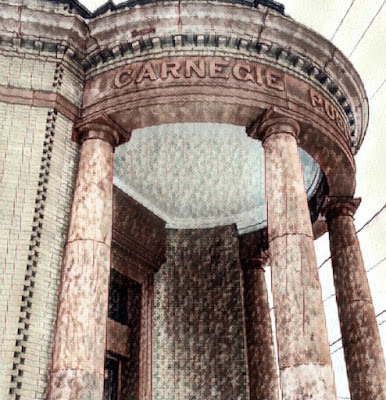
This evening, I gave a poetry reading at the Carnegie Library.  There were not that many people in the audience, which did not surprise me.  The detail that stuck with me was the fact that, aside from my daughter's boyfriend (and he was sort of forced to attend), there were no other men in the audience.  I'm not sure if this fact reflects a general attitude toward poetry (that it's a fairly feminine pursuit), or that most men are intimidated by the open, raw, emotional nature of poetry.

I was raised by a father who wasn't warm and fuzzy.  I know he loved me, but he didn't express that love to me very often.  He was part of a generation of men who were hard-drinking, flag-waving, John Wayne types.  These guys showed love by working long hours for their families, ushering at church, spending weekends mowing lawns and fixing leaky pipes.

That was my dad.  He was an old bull.  Life of the party.  Fiercely protective of his wife and kids.  And he tried to instill these same virtues in me.  I did pick up a few things from him.  I think I'm a hard worker.  As a father, I can be a little too strict at times.  Get that from my old man, as well.  I push my kids to try to do their best at everything--school, sports, dance, church.  If my daughter comes home with 5 A's and one A-, I ask her what happened with the A- class.

I'm not proud of these behaviors, but I come by them naturally.  Strangely, I am no longer the young bull, riding my motorcycle through the ocean.  I am the old bull now, and my kids remind me of this fact on a daily basis.  I'm not old-fashioned.  In fact, I'm almost the exact opposite of my father when it comes to politics and social issues.  But there's still a very 1950s streak in my mind. 

I don't like it when my daughter questions my decisions, even though she's 17 years old.  Almost an adult.  One of my standard answers has become, "Because I said so."  I HATED it when my father said that to me.  Of course, I rarely had the courage to question his authority.  That would have been like calling John Wayne a coward and slapping him in the face.  Never went there.

So, this old bull still has some learning to do.  Every day, I feel like I've just been handed my newborn daughter, and I'm scared shitless that I might drop her.  I wonder if my father ever felt that way with me.

Saint Marty is thankful tonight for kids and poetry.


Tuesday, April 10, 2018

April 10: Wild Logan, Poetry Reading, Inner Bigfoot

Another thing. Flask was the last person down at the dinner, and Flask is the first man up. Consider! For hereby Flask's dinner was badly jammed in point of time. Starbuck and Stubb both had the start of him; and yet they also have the privilege of lounging in the rear. If Stubb even, who is but a peg higher than Flask, happens to have but a small appetite, and soon shows symptoms of concluding his repast, then Flask must bestir himself, he will not get more than three mouthfuls that day; for it is against holy usage for Stubb to precede Flask to the deck. Therefore it was that Flask once admitted in private, that ever since he had arisen to the dignity of an officer, from that moment he had never known what it was to be otherwise than hungry, more or less. For what he ate did not so much relieve his hunger, as keep it immortal in him. Peace and satisfaction, thought Flask, have for ever departed from my stomach. I am an officer; but, how I wish I could fish a bit of old-fashioned beef in the fore-castle, as I used to when I was before the mast. There's the fruit of promotion now; there's the vanity of glory: there's the insanity of life! Besides, if it were so that any mere sailor of the Pequod had a grudge against Flask in Flask's official capacity, all that sailor had to do, in order to obtain ample vengeance, was to go aft at dinnertime, and get a peep at Flask through the cabin sky-light, sitting silly and dumfoundered before awful Ahab.

Now, Ahab and his three mates formed what may be called the first table in the Pequod's cabin. After their departure, taking place in inverted order to their arrival, the canvas cloth was cleared, or rather was restored to some hurried order by the pallid steward. And then the three harpooneers were bidden to the feast, they being its residuary legatees. They made a sort of temporary servants' hall of the high and mighty cabin.

In strange contrast to the hardly tolerable constraint and nameless invisible domineerings of the captain's table, was the entire care-free license and ease, the almost frantic democracy of those inferior fellows the harpooneers. While their masters, the mates, seemed afraid of the sound of the hinges of their own jaws, the harpooneers chewed their food with such a relish that there was a report to it. They dined like lords; they filled their bellies like Indian ships all day loading with spices. Such portentous appetites had Queequeg and Tashtego, that to fill out the vacancies made by the previous repast, often the pale Dough-Boy was fain to bring on a great baron of salt-junk, seemingly quarried out of the solid ox. And if he were not lively about it, if he did not go with a nimble hop-skip-and-jump, then Tashtego had an ungentlemanly way of accelerating him by darting a fork at his back, harpoon-wise. And once Daggoo, seized with a sudden humor, assisted Dough-Boy's memory by snatching him up bodily, and thrusting his head into a great empty wooden trencher, while Tashtego, knife in hand, began laying out the circle preliminary to scalping him. He was naturally a very nervous, shuddering sort of little fellow, this bread-faced steward; the progeny of a bankrupt baker and a hospital nurse. And what with the standing spectacle of the black terrific Ahab, and the periodical tumultuous visitations of these three savages, Dough-Boy's whole life was one continual lip-quiver. Commonly, after seeing the harpooneers furnished with all things they demanded, he would escape from their clutches into his little pantry adjoining, and fearfully peep out at them through the blinds of its door, till all was over.

It was a sight to see Queequeg seated over against Tashtego, opposing his filed teeth to the Indian's; crosswise to them, Daggoo seated on the floor, for a bench would have brought his hearse-plumed head to the low carlines; at every motion of his colossal limbs, making the low cabin framework to shake, as when an African elephant goes passenger in a ship. But for all this, the great negro was wonderfully abstemious, not to say dainty. It seemed hardly possible that by such comparatively small mouthfuls he could keep up the vitality diffused through so broad, baronial, and superb a person. But, doubtless, this noble savage fed strong and drank deep of the abounding element of air; and through his dilated nostrils snuffed in the sublime life of the worlds. Not by beef or by bread, are giants made or nourished. But Queequeg, he had a mortal, barbaric smack of the lip in eating- an ugly sound enough- so much so, that the trembling Dough-Boy almost looked to see whether any marks of teeth lurked in his own lean arms. And when he would hear Tashtego singing out for him to produce himself, that his bones might be picked, the simple-witted steward all but shattered the crockery hanging round him in the pantry, by his sudden fits of the palsy. Nor did the whetstone which the harpooneers carried in their pockets, for their lances and other weapons; and with which whetstones, at dinner, they would ostentatiously sharpen their knives; that grating sound did not at all tend to tranquillize poor Dough-Boy. How could he forget that in his Island days, Queequeg, for one, must certainly have been guilty of some murderous, convivial indiscretion. Alas! Dough-Boy! hard fares the white waiter who waits upon cannibals. Not a napkin should he carry on his arm, but a buckler. In good time, though, to his great delight, the three salt-sea warriors would rise and depart; to his credulous, fable-mongering ears, all their martial bones jingling in them at every step, like Moorish scimetars in scabbards.

But, though these barbarians dined in the cabin, and nominally lived there; still, being anything but sedentary in their habits, they were scarcely ever in it except at mealtimes, and just before sleeping-time, when they passed through it to their own peculiar quarters.

In this one matter, Ahab seemed no exception to most American whale captains, who, as a set, rather incline to the opinion that by rights the ship's cabin belongs to them; and that it is by courtesy alone that anybody else is, at any time, permitted there. So that, in real truth, the mates and harpooneers of the Pequod might more properly be said to have lived out of the cabin than in it. For when they did enter it, it was something as a streetdoor enters a house; turning inwards for a moment, only to be turned out the next; and, as a permanent thing, residing in the open air. Nor did they lose much hereby; in the cabin was no companionship; socially, Ahab was inaccessible. Though nominally included in the census of Christendom, he was still an alien to it. He lived in the world, as the last of the Grisly Bears lived in settled Missouri. And as when Spring and Summer had departed, that wild Logan of the woods, burying himself in the hollow of a tree, lived out the winter there, sucking his own paws; so, in his inclement, howling old age, Ahab's soul, shut up in the caved trunk of his body, there fed upon the sullen paws of its gloom!

Once more in this passage, we have some comedy mixed, at the end, with a fairly harrowing description of Ahab's soul as a wild creature, trapped in the trunk of his body.  It's not a pleasant ending to the chapter.  It's like Melville, amid the hilarity and comic hyperbole, has to remind his reader of the specter of Ahab, which looms almost as large as the white whale itself on the page.  "Don't forget," Melville seems to be saying, knocking his knuckles on the wooden dinner table.

I just finished a poetry reading a little over an hour ago.  Bigfoot poems, which have become somewhat of an obsession with me--the same way that Dickinson wrote about death or Whitman about the Civil War and spears of grass. The event took place at the university where I teach.  It was the first time that I had been invited to read on-campus.

It took place in the atrium of the the university's library.  The rear wall of the room is floor-to-ceiling windows, and a beautiful April sun was filling the room with warmth and light.  I had a pretty good sized crowd--students and friends and poets and professors.  All come to see and hear my big hairy alter ego (or is that altar ego, since Bigfoot approaches myth?).

I have to admit that I was quite nervous before it all began.  I have done dozens of poetry readings, but never in front of a "home" crowd like this.  And certainly never as a solo act.  Everything rested on the wild creature, trapped inside the trunk of my body.  I had to let my inner Bigfoot loose to howl.  And that's what I did.  For thirty or forty minutes, I let Sassy (my name for my Bigfoot self) roam the university library, barking and coughing poetry at people.

I think it worked.  People were laughing and clapping.  At the end, when I asked if there were any questions, people actually raised their hands, something that usually doesn't happen at my poetry readings.  I talked for another ten or 15 minutes, and everyone seemed genuinely interested in what I was saying.

I'm not a person that basks in the limelight, which is a strange thing for me to say since I'm a poet.  Poets are supposed to love reading poems to groups of people, and part of me does.  However, my inner Bigfoot is truly a shy, retiring animal.  More comfortable in a cave than in a Speedo on a beach.  Preferring to order pizza than drive to a restaurant.  My Bigfoot is an introvert.

Saint Marty is thankful today for all of his friends who came to hear him howl this afternoon.


Sunday, April 8, 2018

April 8: Sunday Again, Classic Saint Marty, "Shepherds Watching"

It is Sunday, once again the end of the weekend.  It always amazes me how quickly these two days seem to pass.  Now, I'm preparing for another five days of work and teaching and stress, interspersed with a poetry reading, a radio interview, and a poetry workshop.  Lots of stuff happening this week,

I know that I'm a blessed person.  Regardless of the long hours and indifferent students, I have a pretty good life.  I simply need to remind myself of this every once in a while.

Saint Marty's Classic Saint Marty is almost eight years old, and it's about everyday miracles . . .

April 15, 2010:  Blessed Cesar de Bus

It never fails to amaze me that on Manly Man Poetry Night, the patrons always have some indirect or direct connection to art, writing, or poetry. I made no attempt to include Cesar de Bus in the poem I wrote tonight, and yet, when I read his biography, it says, "After his war service he wrote poetry, tried his hand at painting, and led a worldly life in Paris for three years." I have no idea what leading a worldly life encompasses, but I would assume it involves a good amount of alcohol and indiscriminate sex. That the book lumps writing poetry with being a drunk and a man whore I find a little insulting, but I can live with that. The thing I appreciate about Cesar is that not only did he write verse, but, after he became a priest, he also established religious orders of priests and nuns whose primary jobs were to be teachers. Teacher. Poet. Drunk. Man whore. I love this guy.

Currently, in one of my classes, I'm teaching a section on poetry. It's my favorite part of this semester. I wish I could say the same for my students. When I start getting excited by a Richard Wilbur poem, my students' faces take on the expression my nine-year-old daughter reserves for a PBS documentary on the effects of New Zealand oceanic paramecium on global warming--a mixture of boredom and dread. We were finishing up our second week of poetry today, and I found myself scanning a Shakespearean sonnet for rhythm and rhyme and rhetoric. It was great fun, and by the time I had finished, several students had their heads on their desks and were drooling. "There goes teacher of the year again," I thought.

Then one of my students raised his hand and said, "I googled your name last night."

"Okay," I said slowly.

"I found your book on Amazon," he said.

People started perking up. They had no idea their instructor had an actual life outside of the walls of the classroom, let alone done something as interesting as publish a book.

"Okay," I repeated even more slowly.

"Why didn't you make us buy your book for this class?" my student said.

I considered my answer. I could have made a joke about being rich enough already. I could have said that the book was old, and I'd written much better. But I told the truth, which has to do with ego. "Because," I said, "that would be like Robert Deniro teaching a class on the best movies of Robert Deniro." I received blank stares. "My ego is already the size of Alaska, minus Sarah Palin," I added. No response. Finally, I said, "I just don't do that."

I have a feeling that even if I had used my book, my students would still be hating poetry. Poetry these days is associated with college classrooms, wine and cheese events, and textbooks that students sell back to the college bookstore as soon as they can. Poetry is no longer Cesar's domain of drunks, man whores, and dissolute soldiers. Too bad.

Anyway, my friend and I celebrated Manly Man Poetry Night, and I have a poem to share. As I said before, I did not include Cesar de Bus in it. I do mention Saint John, and I'm sure that Cesar read John's gospel. So there is a tangential connection, but that's it. That's all I have. The onion rings were good, as usual; the Diet Pepsi flowed freely; and by the end of the evening, I had the poem that follows. It's decent, I think, but I doubt it would wake up any student of mine. Short of getting drunk, stripping, and dancing to "Telephone" by Lady Gaga, nothing is going to tear them away from texting and Facebook. However, I still have faith that some of you, my readers, aren't drooling asleep or already moving on with your blog stalking. Some of you still look for miracles in everyday life. That gives me hope.

Shepherds Watching

In Detroit, my brother raised angelfish.
The 40-gallon tank bubbled
In our bedroom, all night, all day.
At least nine or ten creatures
Filled the tropical water, some
The size of my eight-year-old hand.
They hovered, delicate, quiet,
Striped spirits, placid guardians
Of pillow, blanket, sheet,
Dirty underwear, balled socks,
Jethro Tull on the eight track.

One morning, a man snatched
Maggie, a neighbor girl,
In the alley behind our house.
A couple years older than me,
She was the blond star
At Assumption Grotto School,
Everyone's sister or virgin daughter.
When the nuns heard the news,
They made us stop reciting
The Apostles Creed, get on our knees,
Pray for Maggie's deliverance.

Police searched all the houses
In the neighborhood, from attic
To basement. When the two officers
Got to our bedroom, they stood
In front of the aquarium, stared
At the fish as if witnessing
Gabriel appearing to Mary
Or hosts singing "Gloria in excelsis."
When they left the room, one cop
Said, "Those are big fish,"
In a way that sounded
Like he was quoting Saint John:
"In the beginning..."

I sat on my bed, watched
The angelfish drift, glide.
I thought about Maggie,
Hoped she was some place safe,
That she felt something watching
Over her. Something big. Floating.
Something beautiful.