Showing posts with label Flannery O’Connor. Show all posts

Sunday, February 1, 2026

February 1, 2026: “Reincarnation,” Someone Else, “In Response to a Stanza from ‘A Prayer for Old Age’ by William Butler Yeats”

When I was in middle and high school, I wanted to be the reincarnation of Flannery O’Connor.  As an undergrad, I switched to Robert Frost and Walt Whitman.  In grad school, I branched out a little—I wanted to be Mozart 2.0 or van Gogh 2.0.  

I hail from a family of plumbers, and I always wanted to know from whom my artistic abilities came.  I love writing, drawing, acting, singing, playing music.  My father was a great plumber; that was his art.  My mother loved singing and reading and, occasionally, doodling, but she was a pretty common sense lady.  No flights of fancy for her.  My siblings were/are pretty brilliant, as well.  My sister Sally had a photographic memory; she was one of the smartest people I will ever know.  My sister, Rose, who had Down Syndrome, was a genius of love; she could make anyone feel like the most important person in the world.  My brothers (all three of them) have/had innate skills with plumbing and electricity.  I could go on, but you get the idea.

Marie Howe contemplates past lives . . . 

Reincarnation

by: Marie Howe

Sometimes when I look at our dog Jack I think

he might be my radical American History professor come back

to make amends—he gazes at me so sorrowfully.


What is it Jack, I say, why do you look like that?  But Jack

doesn’t answer; he lies down and rests his head on his paws.


Black hair covered nearly all of that man’s body, thick 

under his blue oxford shirt when I put my hand there.

Perhaps that accounted for the bow tie,

the pipe, the tweed cap.


This time I can teach him to sit and to stay.

Stay, I say to Jack who looks at the treat in my hand

and then at me, and at the treat and then at me, and he stays.


Come, I say to Jack, but Jack does not always come.

Sometimes he waits and looks at me a long time,

as when my professor would lean back in his chair

draw on his pipe and gaze at me.


But when I hold a treat Jack comes, and I remember how

the professor would lick dripping honey from the jar

lick peanut butter from the knife.


A little stubborn, our dog Jack,

shy we thought,

until the morning my daughter jumped on my bed

and Jack sprang at her growling,


and the next morning when he rushed towards her growling

and bit her skirt and tore it, and bit her and broke her skin,

and when I went to collar him, bit me, snarling and bit and bit.


That’s when I was pretty sure he was my history professor.

The vet said this happens more often than you’d imagine.

He must always be tethered, she said, until he can be trusted.

He must learn that you and your daughter come first.

And no more couch and no more sleeping in the bed with you Mama,

not ever.


I finally left him so late at night it was nearly dawn—

picking up my boots by the door,

stepping down the two flights, then running towards the car.


What can I say?  Jack may be my American History professor come back.

After all these years to make amends,


or Jack may be actually himself—a dog.


It’s a funny poem, but it sort of touches upon the same question that I started this post with:  from where do talents, gifts, and personalities come?  Howe attributes Jack’s aggression to her former American History professor.  Jack has the same stubbornness, same hunger for food and attention.

I don’t think I carry the spiritual or artistic DNA of Flannery O’Connor or Walt Whitman.  I will never reach the elevated status of Robert Frost or William Butler Years.   Most readers of this blog will agree that those writers were head and shoulders above.  They had gifts that the world will never see again.

I think all artists stand on the shoulders of the greats, from poets to painters to composers to actors.  I know I do.  If I get stuck when I’m writing a poem, I immediately turn to writers who inspire me.  When I go anywhere, I always carry books by favorite poets.  Currently, in my shoulder bag, I have collections by Jonathan Johnson and Ross Gay (plus Marie Howe, of course).  Before I started writing this little reflection, I sat and read some poems from Catalog of Unabashed Gratitude.  Doing that cleared my head, emptied it of noise, and I was able to start writing.

Each time I scribble in my journal or tap away on my laptop, I always feel like I’m a conduit.  I can even tell when it happens—the world suddenly fades away, and I’m can feel someone/something else take over.  Images and words and language flow easily, and, when I’m done, I’ve got a new poem or essay or blog post.  I guess you could call it inspiration, but who knows the true origins of inspiration?  It might God or luck.  Or it might be Flannery O’Connor’s ghost.

I have learned it’s not wise to question the divine spark when it appears.  You just simply accept it and say “thanks.”

Saint Marty wrote a poem for today, inspired by the ghost of William Butler Yeats . . . 

In Response to a Stanza from ‘A Prayer for Old Age’ by William Butler Yeats

by: Martin Achatz

Grant me, God, snow on my tongue
Impossible to ignore;
They who winter the air with words
Cool the July of war.


Wednesday, May 7, 2025

May 7, 2025: "On the Subway," Different Lives, "When I Come Back"

Well, I'm done teaching for a little while.  Submitted my final grades for the semester yesterday at around 11:58 a.m.  (They were due at noon.)  Then I sat and just breathed for a little while, thinking of the last four or so months--teaching and the NEA Big Read and the Great Lakes Poetry Festival and the death of a pope and my sisters moving and my daughter moving and my son finishing up his junior year in high school.  I'm not even going to get into politics.  The beginning of 2025 has literally felt like a couple centuries long.

I've been evaluating my life a lot since January.  Thinking about jobs and family and friends and death and failure and success.  What makes me happy and sad.  What my dreams and hopes are.  Even when I was a kid, I wanted to make a difference in the world somehow.  Cure something incurable.  Discover something undiscovered.  Write something heretofore unwritten.

Now that I'm old(er), I'd be happy just knowing that I made someone smile on a bad day.

Sharon Olds confronts the racial divide while . . . .

On the Subway

by: Sharon Olds

The boy and I face each other.
His feet are huge, in black sneakers
laced with white in a complex pattern like a
set of intentional scars. We are stuck on
opposite sides of the car, a couple of
molecules stuck in a rod of energy
rapidly moving through darkness. He has the
casual cold look of a mugger,
alert under lowered eyelids. He is wearing
red, like the inside of the body
exposed. I am wearing old fur, the
whole skin of an animal taken
and used. I look at his unknown face,
he looks at my grandmother's coat, and I don’t
know if I am in his power —
he could take my coat so easily, my
briefcase, my life —
or if he is in my power, the way I am
living off his life, eating the steak
he may not be eating, as if I am taking
the food from his mouth. And he is black
and I am white, and without meaning or
trying to I must profit from our history,
the way he absorbs the murderous beams of the
nation’s heart, as black cotton
absorbs the heat of the sun and holds it. There is
no way to know how easy this
white skin makes my life, this
life he could break so easily, the way I
think his own back is being broken, the
rod of his soul that at birth was dark and
fluid, rich as the heart of a seedling
ready to thrust up into any available light.


This poem is not easy.  It's confronting racism--the life of a wealthy white woman versus the life of a poor black young man.   The white woman feels threatened by the young man's presence, even though she has no reason to.  Through her words, Olds is trying to put a face on prejudice, make it not about ideologies but about real people.

That's what all poets do--speak truth, even when that truth is difficult.  Truth can open people's eyes (unless you own a MAGA hat).  That's why Stalin imprisoned poets and writers in gulags.  It's also why dictators do things like ban books and attack journalists and arrest protestors.  Truth is the greatest weapon against tyranny.

So, I'm going to share some of my truths tonight, even though my words are not going to stop the war in Ukraine or make the current President of the United States sane.

Currently, in Rome, around 130 some Catholic cardinals are conclaving in the Sistine Chapel to choose the next pope.  Around 1:30 p.m., black smoke came pouring out of the chimney, indicating that no pontiff had been selected.  Voting begins again tomorrow.

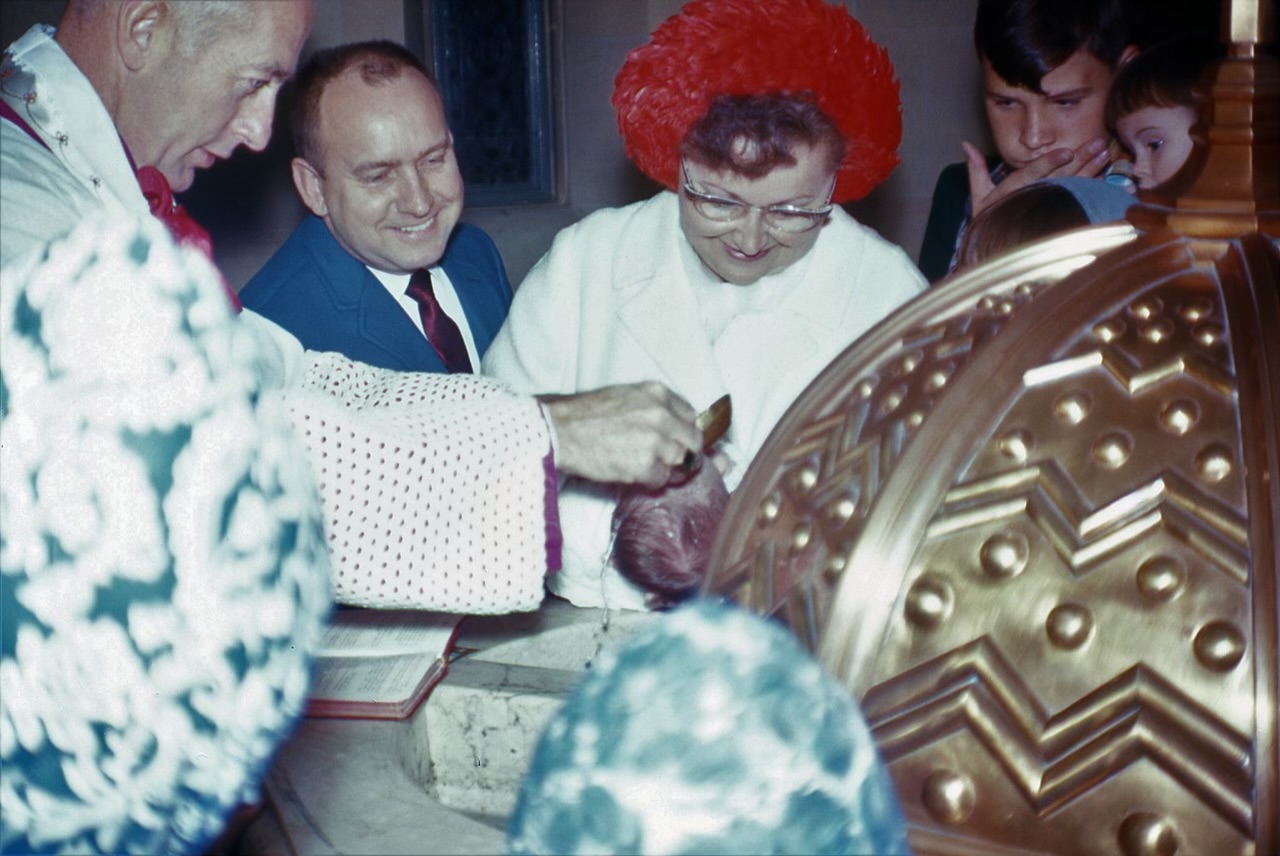
I was baptized by a bishop.  His name was Joseph M. Breitenbeck.  I never met the man, but I did see him on TV serving Mass with Pope John Paul II at the Pontiac Silverdome in 1987.  I think my mom thought I was her best shot at having a priest son.  However, I never felt that call.  The best I could do was become a church organist.

Except for a few years (high school into college) when I avoided religion, I've been a pretty faithful churchgoer most of my life.  I find the history of the Catholic church fascinating, especially the highly secretive process of selecting popes.  So, for the last couple weeks (ever since the funeral of Pope Franics), I've been reading up on the rules of a conclave and the names of the papabile (favored cardinals).

I'm sure the mothers of each of those cardinals had dreams of their sons becoming pope.  Perhaps, as Bishop Breitenbeck was drowning me with holy water, my mom had some thought about me becoming the first pope from the United States.  (The first of many disappointments she experienced because of me.)  

Maybe I was a pope in a former life.  Personally, I’d prefer to be the reincarnation of Robert Frost or Flannery O’Connor or Sylvia Plath (without the mental illness, I’ve already got daddy issues).  Of course, before Pope Francis was pope, he was just Jorge from Buenos Aires, and before Flannery O’Connor was THE Flannery O’Connor, she was just Mary from Savannah.  Fame is an artificial construct.  It can change people, sure, but, for the most part, I’d bet Pope Francis still felt like that little Argentinian boy even while blessing the crowds from the balcony of Saint Peter’s.  

I will never be a priest or bishop or cardinal or pope.  I will never be a Southern gothic writer from Georgia.  As Popeye says, “I yam what I yam.”  I’m a poet from the Upper Peninsula of Michigan.  I’m also a husband, father, teacher, friend, church musician, and library programmer.  In a year’s time, I might be something else.

Whether I like it or not, life is about change and reinvention.  I will not be the same person tomorrow that I am today.  Yes, a bishop baptized me—the same bishop who served Communion with Pope John Paul II over 40 years ago in Detroit.  That doesn’t mean the cardinals are going to elect me the first pope from North America.

Saint Marty wrote a poem tonight about reincarnation, based on the following prompt from The Daily Poet:

On this day in 1977, Seattle Slew won the Kentucky Derby.  Since racehorses have the most interesting names, look up the names of horses (they don’t have to be famous) and use ten to fifteen of them in a poem.  Or make a list of your own made-up humorous, poignant, or whimsical racehorse names.  Write a poem about something other than a horse race using either list of names.

When I Come Back

by: Martin Achatz

it will be as a flower
with a name like Charismatic
or American Pharoah or Tim Tam.
My petals will be striped purple,
my stem laced with thorns
to discourage being plucked for vases.

Or I will find myself buried
in a field of goldenrod, nestled
in the rib cage of a long-dead 
moose or sealed in a tomb 
of sun-baked manure—yes, I will
be a stone so precious it defies
words, begs to be placed on
the tongue and sucked until
it’s smooth as a frozen
tear or frog belly.  At night,
the moon will call me, sing
out my name:  Sunday Silence.

Or maybe I’ll sprout as a feather
in a peacock tail, ride all day
behind her until she shivers
herself into glory at dusk, a pleasant
colony of eyes blinking at the heavens.

A field of Ferdinand grass, swale
crowded with cattails, flash
flood in Thunder Gulch where
unbridled waters swallow
rock, mesa, saguaro in one
big brown gulp—I could be
all of these when I come back.

Or just maybe I’ll be a word or breath
in a poem that makes everyone 
say Damn! then Damn! again,
as if they’ve just found twenty dollars
in an old coat pocket or been kissed
hard by an old lover they haven’t seen
since high school or college.