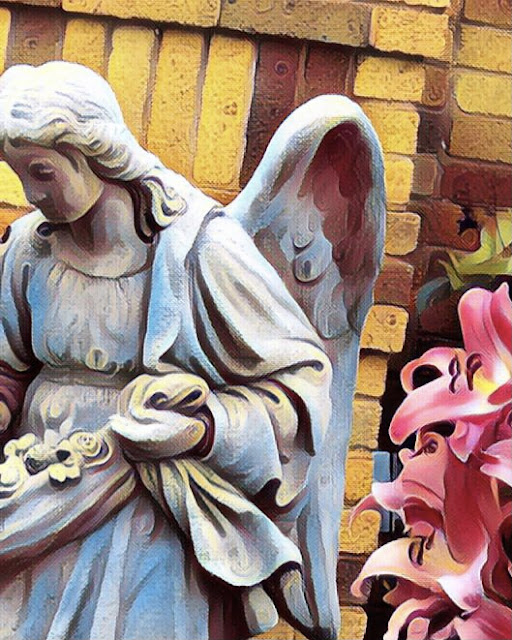
Showing posts with label funeral. Show all posts

Friday, January 21, 2022

January 21: If You Said a Good Thing, Mixed Bag, "Family Picture"

Santiago engages in a little magical thinking . . . 

He was happy feeling the gentle pulling and then he felt something hard and unbelievably heavy. It was the weight of the fish and he let the line slip down, down, down, unrolling off the first of the two reserve coils. As it went down, slipping lightly through the old man's fingers, he still could feel the great weight, though the pressure of his thumb and finger were almost imperceptible.

"What a fish," he said. "He has it sideways in his mouth now and he is moving off with it."

Then he will turn and swallow it, he thought. He did not say that because he knew that if you said a good thing it might not happen. He knew what a huge fish this was and he thought of him moving away in the darkness with the tuna held crosswise in his mouth. At that moment he felt him stop moving but the weight was still there. Then the weight increased and he gave more line. He tightened the pressure of his thumb and finger for a moment and the weight increased and was going straight down.

Santiago will not say his hopes aloud because doing so will jinx him.  The fish won't take the bait, and he will return home for the 85th day without a catch.  Another example of the spoken word somehow having the power of a spell or hex.  Good or bad luck.  Blessing or curse.

This day has been an emotional mixed bag.  At my office, I would find myself staring at the wall in front of me for ten minutes, thinking of my sister, Rose.  Then I would snap back to reality and the task at hand, which happens to be a huge grant.  I'd be fine one moment and crying the next.

Death and funerals tend to raise the bar when it comes to emotions, bringing out the best and worst in family.  Small grudges that have simmered for years become Olympic triathlons.  Large hurts transform into Herculean labors of spite.  Family members are grieving, going through all the normal stages--denial, anger, bargaining, depression, and acceptance--and they get stuck.  They remain angry or sad, and they take it out on everyone around them.  Instead of coming together to help each other deal with the loss, families splinter and fight.

I'm trying to avoid stoking the fires.  At the moment, the wound of my sister Rose's death is raw and open.  I am going to allow myself to just . . . feel.  I refuse to let anyone turn this time into a blood sport.  For me, these next couple weeks are about Rose and honoring her spirit and memory properly.  That means loving even the most difficult people.  Because that's what Rose did her whole life.  Loved unconditionally.

I will probably fail at this.  I'm human and imperfect.  I admit that freely.  My hope is that, by the day of Rose's funeral, nobody is dead, bleeding, or on a suicide watch.

Saint Marty is only half-joking.  

A poem about the last time my whole family was together, before death entered the scene . . .

Family Picture

by:  Martin Achatz

All of us together for the first time in about ten years and the cameras crack like machine guns and people yell, "Wait, just one more!" as my nine-month-old daughter screams in my wife's arms, wanting DOWN and AWAY, insistent, and my wife paces back-and-forth because we've been waiting all day for everybody to be here, Fred from L.A., Kevin from across town, Paul from Iron Mountain, Mary from her five kids, on and on:  Fred's new wife Diane, blonde and loud with laughter, herself an only child, glows in this roomful of family, family, family--so much family that the windows are sweating with breath and everyone is itching for the Pizza Hut guy to show up to feed us, so hungry from being together we could eat each other.


Friday, November 26, 2021

November 26: In the Midst of This Conflict, Funeral, One of the Most Decent Men

Merton searches for an answer . . . 

The fight went on in my mind. 

By now, the problem had resolved itself into one practical issue: why don’t I consult somebody about the whole question? Why don’t I write to the abbot of Gethsemani, and tell him all about my case, and ask him his opinion? 

More practical still, here at St. Bonaventure’s there was one priest whom I had come to know well during this last year, a wise and good philosopher, Father Philotheus. We had been going over some texts of St. Bonaventure and Duns Scotus together, and I knew I could trust him with the most involved spiritual problem. Why did I not ask him? 

There was one absurd, crazy thing that held me up: it was a kind of a blind impulse, confused, obscure, irrational. I can hardly identify it as it actually was, because its true nature escaped me: it was so blind, so elemental. But it amounted to a vague subconscious fear that I would once and for all be told that I definitely had no vocation. It was the fear of an ultimate refusal. Perhaps what I wanted was to maintain myself in an equivocal, indefinite position in which I would be free to dream about entering the monastery, without having the actual responsibility of doing so, and of embracing the real hardships of Cistercian life. If I asked advice, and was told I had no vocation, then the dream would be over: and if I was told I had a vocation, then I would have to walk right in to the reality. 

And all this was complicated by that other dream: that of the Carthusians. If there had been a Carthusian monastery in America, things would have been much simpler. But there is still no such place in the whole hemisphere. And there was no chance of crossing the Atlantic. France was full of Germans and the Charterhouse in Sussex had been bombed flat to the ground. And so I walked under the trees, full of indecision, praying for light. 

In the midst of this conflict, I suddenly got a notion which shows that I was not very far advanced in the spiritual life. I thought of praying God to let me know what I was going to do, or what I should do, or what the solution would be, by showing it to me in the Scriptures. It was the old business of opening the book and putting your finger down blindly on the page and taking the words thus designated as an answer to your question. Sometimes the saints have done this, and much more often a lot of superstitious old women have done it. I am not a saint, and I do not doubt that there may have been an element of superstition in my action. But anyway, I made my prayer, and opened the book, and put my finger down definitely on the page and said to myself “Whatever it is, this is it.”

I think everyone struggles with unanswerable questions.  In this passage, Merton wrestles with his call to monasticism.  For me, this last month, I've been dealing with grief and all of its accompanying sadness and anger and confusion.  The pain of loss is one of those imponderables.  No answers.  Just lots of questions.

This afternoon, I attended the funeral of one of the most decent men I have ever known in my life.  He died unexpectedly four days before Thanksgiving.  I've known him for over 15 years (closer to 20).  A devout Christian, devoted son, brother, husband, father, grandfather, uncle, and friend.  There's not many times I can say this about a person--I never heard anyone say anything bad about this man.

And now he's gone at the age of 65, and I don't understand it.

Many times this past year (and even more this past month), I've had this thought:  God seems pretty greedy for angels right now.  So many good people that I know have died in 2021.  Decent, honest, loving people.  Some had long, meaningful lives (my mother).  Others had short, meaningful lives (the man we said goodbye to today).  I thought 2020 was a pretty terrible year.  Lots of senseless loss and suffering.  Its sequel has been worse in many ways.

Trying to make sense of a life ended too soon is a pretty fruitless endeavor.  It's sort of like trying to understand racism or homophobia or Trump supporters.  Rationally, you can identify the root causes of all of these problems (poverty and white supremacy and fear and plain stupidity).  However, that doesn't help a young black man who's pulled over by police because of the color of his skin.  Or a gay middle schooler who's the target of cyberbullying.  And it certainly doesn't help a family grieving the sudden loss of a loved one.

We can get stuck on the question "why," as in "Why did [insert name here] have to die?" or "Why does [insert name here] have to suffer?"  It's one of the most basic questions humans ask, along with "how."  The sciences answer the "how" questions.  Religions attempt to answer the "why" questions.  Science can explain how photosynthesis works.  Religion, however, approaches plants a little differently, according to the gospel of Luke:

Look at the lilies and how they grow. They don’t work or make their clothing, yet Solomon in all his glory was not dressed as beautifully as they are. And if God cares so wonderfully for flowers that are here today and thrown into the fire tomorrow, he will certainly care for you. Why do you have so little faith?

God gives us lilies.  We can pull them apart, put them under a microscope, examine and label their parts.  Understand how they function.  Or we can admire them, write psalms about them, be happy they exist.  Have faith that they will return every spring, dressed in glory and beauty.  

I don't believe in coincidence.  The universe is not ruled by chaos.  There are reasons for everything, even if we, as humans, can't comprehend them.  That's what faith is all about.  Trusting.  Believing.  Even in the face of great loss and grief.

I celebrate the man whom we laid to rest this afternoon.  His life was full of love and purpose.  That doesn't make his absence any easier for his family and friends.  But faith tells us that God cares wonderfully for all his flowers--the ones still blooming today and the ones gone to seed, waiting for the return of the sun in due season.

Saint Marty finds solace in that.  Comfort.  Meaning.


Friday, January 10, 2020

January 10: Common Dependence on God, Tower of Babel, "Five Lesson on the Color Black"

More from Merton on his earliest religious experiences:

The old Zion church was a white wooden building, with a squat, square little belfry, standing on a hill, surrounded by high trees and a large graveyard, and in a crypt underneath it were buried the original Douglas family, who had settled there on the shore of the Sound some hundred years before.  It was pleasant enough on Sundays.  I remember the procession that came out of the sacristy, a choir of men and women, dressed in black, with white surplices, and led by a Cross.  There were stained glass windows up behind the altar, one had an anchor on it, for its design, which interested me because I wanted to go to sea, and travel all over the world.  Strange interpretation of a religious symbol ordinarily taken to signify stability in Hope:  the theological virtue of Hope, dependence on God.  To me it suggested just the opposite.  Travel, adventure, the wide sea, and unlimited possibilities of human heroism, with myself as the hero.

Then there was a lectern, shaped like an eagle with outspread wings, on which rested a huge Bible.  Nearby was an American flag, and above that was one of those little boards they have in Protestant churches, on which the numbers of the hymns to be sung are indicated by black and white cards.  I was impressed by the lighting of candles on the altar, by the taking up of the collection, and by the singing of hymns, while Father, hidden behind the choir somewhere, played the organ.  

One came out of the church with a kind of comfortable and satisfied feeling that something had been done that needed to be done, and that was all I knew about it.  And now, as I consider it after many years, I see that it was very good that I should have got at least that much of religion in my childhood.  It is a law of man's nature, written into his very essence, and just as much a part of him as the desire to build houses and cultivate the land and marry and have children and read books and sing songs, that he should want to stand together with other men in order to acknowledge their common dependence on God, their Father and Creator.  In fact, this desire is much more fundamental than any purely physical necessity.

At this same time my father played the piano every evening in a small movie theater which had been opened in the next town, Bayside.  We certainly needed money.

It doesn't surprise me that some of Thomas Merton's earliest intimations of the presence of God in his life are connected with music.  Some of my earliest memories of church and God are also musical.  I remember sitting next to my mother in a pew, listening to her strong soprano voice.  The old hymns:  "Come, Holy Ghost" and "Mary, Full of Grace" and "Panis Angelicus."  In my mind, when I was a child, my mother's singing was as close to God as I could get.  It lifted me up.

As I got older, I joined church choirs and started playing the piano and pipe organ.  Now, almost 40 years later, I have been a liturgical musician for the majority of my life.  Most of my church life has been spent in choir lofts, looking down at the backs of people's heads.  When I was younger, I used to think I had a God's-eye-view of things.  This, I thought, was how God saw all of us from his perch in the heavens.  For a long time, in the choir loft where I play the pipe organ, there was a sign that read, "When you sing, you pray twice."  I believe that saying.  Music--like prayer and poetry--elevates human expression.  It's sort of the only way we humans can truly approach the divine.

Today, I attended the funeral of a very close friend.  She was a woman who devoted her life to music in the church.  For almost 60 years, she directed and sang in choirs, always with humility, feeling like she wasn't worthy to stand in front of sopranos, altos, tenors, and basses, waving her arms.  More than once, after a Sunday morning choir anthem, she would look at me and say, "I feel like a complete failure."  And she meant it.

I often feel the same way with my poetry.  When I sit down to write something new, I have a vision in my head, a song in my ears, of what I think I want to write.  What comes out of my pen onto the page never really comes close to that initial vision.  In some ways, as I write, I feel like I'm reenacting the narrative of the Tower of Babel.  I want to capture words that are divine--King David, the gospel writers, Shakespeare, Keats, Wordsworth, Dickinson, Whitman.  Instead, I end up writing something that sounds more like the literary equivalent of the Three Stooges.

For the funeral today, I was asked to write and read a poem for my friend.  It was difficult for me.  I worked on the poem all week.  Actually, I had the first four sections of the poem done by Tuesday.  They came to me fairly easily.  The last section gave me a lot of trouble.  Every time I started writing, I ran into a wall.  Last night, I thought I had it finished.  It wasn't.  So, I got up at six o'clock in the morning today and went to work.  By 8 a.m., the poem was done.

I'm still not sure it's any good.  You will have to be the judge of that.

Saint Marty thinks he's fallen short.  Again.

Five Lessons on the Color Black

by:  Martin Achatz

for Sally Z.

1.
In the beginning, before there was light,
before heavens and earth were split,
before sun and moon, day and night,
seas and volcanoes, tectonic shifts,
before mastodons and sequoias,
mud and breath and Adam,
sleep and rib and Eve,
before the naming, when everything
was shapeless and void,
there was God, and God wore black.

2.
At the bottom of the Quincy Mine
Number 2 shaft, 1.75 miles below
earth’s surface, turn off lights,
phone.  Extinguish candles, torches.
Stand still.  You will experience
complete black, where there is no
up or down, left or right, floor,
ceiling, or walls.  Where everything
exists and doesn’t exist in vertiginous
nothing.  This is how Christ
entered the world.

3.
Black absorbs all colors.
The purple-blue bruises of Advent, Lent.
Cardinal thorns, spikes of Holy Week.
Snows of Christmas, Easter, when joy
piles up like a blizzard,
joy on joy on joy.
Hot roses of Gaudete Sunday,
Laetare Sunday, when expectation
blossoms through meat fasts, candled wreaths,
the way crocuses blossom
through winter into spring.
And the abundance of green all other times,
so ordinary we don’t even notice
it sitting on the side of the road,
homeless, begging for our eyes.
Put on a pair of black pants,
button up a black shirt,
slip on a pair of black shoes,
and you are the gospels.

4.
The word “black” comes from Old English,
Proto-Germanic, Proto-Indo-European,
Dutch, Latin, Ancient Greek.
It’s an old word, kicked around
by bare and sandaled feet
for thousands of years, probably
grunted by Neanderthals as they
scrambled away from the black
palm of night.  Eaten by Vikings
as they crossed continents of black ocean.
Caught in squirming, black nets
on the shores of Galilee.  In most languages,
it means to burn, glow, blaze,
shine, flash, luminesce.  Black
fire.  Black stars.  Black
hosannas in black bowls of sky.  Black
resurrection, when you open
your eyes, see an empty, black
cave.  Black coffee on Sunday
morning, where cream swirls
in the cup like light into a black
hole.

5.
Today
is all about the black
you left behind.
Empty, black
chair at the kitchen table.
Black, winter
branches, where wind
plays scales, makes
me think of Kilmer:
. . . only God can make
a tree.  Black
chime of an unanswered
phone call.  And the last, black
words you spoke to me
two Sundays ago.  I hold
them in my hands now.  Count them.
One.  Two.  Three.  Four.
They gleam like polished onyx
in my palms, bright holes
in my skin.  I put them
in my pocket, carry
them with me everywhere,
feel their weight against
my leg, hear them rattle
together, making a black
sound, like the one Christ
made at the back of His throat
when He found out Lazarus
had died.  Or the one
Lazarus made when he stumbled
out of his grave, into
the arms of his best friend.
I take those words out
now, let them fluoresce the black
air of  this place.  They are everything
and nothing.  They are you.  Me.
Us.  Say them now.  Send them
out into the dark matter
of the universe, where they will
nova, become star, galaxy,
angel host, infant, salvation.
Four words.  Four syllables.
Four breaths.
I.  Love.  You.  Babe.


Saturday, December 2, 2017

December 2: Funeral, Linda Gregerson, "An Arbor"

Today is the funeral for my friend's daughter.

As I said yesterday, I am at a loss of words.  I will see my friend today, put my arms around her, tell her I love her.  That will have to be enough today, I guess.  There is nothing that is going to ease her pain right now.

It's amazing to me that a life so vibrant and full of light is gone like a snuffed candle.  It just makes me want to hold my kids a little closer, tell them how important and beautiful they are.  I know I am treading on sentimentality here.  Can't help it.

Saint Marty is thankful this morning for the sound of his son's laughter, the red of his daughter's hair in sunlight.

An Arbor

by:  Linda Gregerson

The world’s a world of trouble, your mother must   
                      have told you   
               that. Poison leaks into the basements

and tedium into the schools. The oak   
                      is going the way
               of the elm in the upper Midwest—my cousin

earns a living by taking the dead ones   
                      down.
               And Jason’s alive yet, the fair-

haired child, his metal crib next   
                      to my daughter’s.
             Jason is one but last saw light five months ago

and won’t see light again.

                                                  · 
Leaf against leaf without malice   
                     or forethought,
            the manifold species of murmuring

harm. No harm intended, there never is.   
                     The new
            inadequate software gets the reference librarian

fired. The maintenance crew turns off power one            
                     weekend
            and Monday the lab is a morgue: fifty-four

rabbits and seventeen months of research.   
                     Ignorance loves   
          as ignorance does and always

holds high office.   

                                                  ·
Jason had the misfortune to suffer misfortune   
                   the third
          of July. July’s the month of hospital ro-

tations; on holiday weekends the venerable   
                   stay home.
          So when Jason lay blue and inert on the table

and couldn’t be made to breathe for three-and-a-
                  quarter hours,   
         the staff were too green to let him go.

The household gods have abandoned us to the gods   
                  of juris-
         prudence and suburban sprawl. The curve

of new tarmac, the municipal pool,   
                  the sky at work
         on the pock-marked river, fatuous sky,

the park where idling cars, mere yards   
                  from the slide
         and the swingset, deal beautiful oblivion in nickel

bags: the admitting room and its stately drive,   
                  possessed   
         of the town’s best view.

                                                 ·
And what’s to become of the three-year-old brother?   
                  When Jason was found   
         face down near the dogdish—it takes

just a cupful of water to drown—
                   his brother stood still
         in the corner and said he was hungry

and said that it wasn’t his fault.   
                  No fault.
         The fault’s in nature, who will

without system or explanation   
                make permanent
         havoc of little mistakes. A natural

mistake, the transient ill-will we define   
                as the normal
         and trust to be inconsequent,

by nature’s own abundance soon absorbed.   

                                                  ·
Oak wilt, it’s called, the new disease.   
                Like any such
         contagion—hypocrisy in the conference room,

flattery in the halls—it works its mischief mostly   
                unremarked.   
         The men on the links haven’t noticed

yet. Their form is good. They’re par.   
                The woman who’s
         prospered from hating ideas loves causes

instead. A little shade, a little firewood.   
                I know
         a stand of oak on which my father’s

earthly joy depends. We’re slow   
                to cut our losses.

Friday, July 28, 2017

July 28: Blue Fairy Godmother, Funeral, Life's Blessings

Billy dozed, awakened in the prison hospital again.  The sun was high.  Outside were Golgotha sounds of strong men digging holes for upright timbers in hard, hard ground.  Englishmen were building themselves a new latrine.  They had abandoned their old latrine to the Americans--and their theater, the place where the feast had been held, too.

Six Englishmen staggered through a hospital with a pool table on which several mattresses were piled.  They were transferring it to living quarters attached to the hospital.  They were followed by an Englishman dragging his mattress and carrying a dartboard.

The man with the dartboard was the Blue Fairy Godmother who had injured little Paul Lazzaro.  He stopped by Lazzaro's bed, asked Lazzaro how he was.

Lazzaro told him he was going to have him killed after the war.  

"Oh?"

"You made a big mistake," said Lazzaro.  "Anybody touches me, he better kill me, or I'm gonna have him killed."

The Blue Fairy Godmother knew something about killing.  He gave Lazzaro a careful smile.   "There is still time for me to kill you," he said, "if you really persuade me that it's the sensible thing to do."

"Why don't you go fuck yourself?"

"Don't think I haven't tried," the Blue Fairy Godmother answered.

There's a lot of death talk in this passage.  Lazzaro wants the Blue Fairy Godmother dead.  The Blue Fairy Godmother jokes about killing Lazzaro.  In the middle of a prisoner of war camp, death is inescapable.  On top of it all, Lazzaro is in the hospital, recuperating from injuries inflicted on him by the Blue Fairy Godmother.  Lazzaro and the Blue Fairy are supposed to be allies, fighting Nazis.  Yet, they hate each other.  As Vonnegut often says about death, so it goes.

I went to a funeral this afternoon for the brother of one of my best friends.  The brother was exactly two days older than me.  When I opened the program for the service, that was the first thing I noticed.  The ashes in the urn were just as old as me.

It was a beautiful service, full of music and chanting and funny stories and prayer.  Yes, it was sad at points.  But, for the most part, it was about laughter and gratitude for a life well-lived.  My friend's brother faced many challenges in his life, but he met those challenges head-on.  He didn't let his limitations limit him, and I find that inspiring.

The funeral also reminded me how important it is to celebrate all the blessings of my life.  I am really lucky.  Starting this afternoon, I am on vacation.  I don't go back to work until next Friday.  Next Monday, I head downstate for a few days of swimming and hiking and eating.  I am going to read and write and relax.  That is a great blessing.

Saint Marty is thankful tonight for a life of blessings (and six days of vacation).


Saturday, December 31, 2016

December 30: A Riff, Psalm 23, "23 Revisited"

What book should I use next year for the blog?  Take the poll:

Book Poll

At the funeral this evening, Psalm 23 was read.  It's probably one of the most familiar psalms.  Because it's comforting.  It's about the love of God, an Eternal Parent, watching over all of us.  When I hear Psalm 23, I feel safe, uplifted.

A few years ago, I did a little riff on Psalm 23.  Call it psalm jazz.  Charlie Parker, the great jazz saxophonist, once talked about playing "in between" the melody of a song.  That's exactly what I tried to do with this poem.  Write in between the lines of Psalm 23.

Please don't be offended.  Laughter is a gift from God, as well.

23 Revisited

by:  Martin Achatz


The Lord is my shepherd.  I lack for nothing.
Well, almost.  I could use a bigger
House.  Mine is a little crowded for four people.
Plus, the neighbors smoke pot in their garage.
He makes me lie down in green pastures.
I try to stay out of pastures.  Not a big fan
Of livestock.  I once had a bull chase me
On a friend’s farm.  It scared the shit out of me.
He leads me beside quiet waters,
            He refreshes my soul.
Getting back to the house, I’d like a view
Of the big lake, be able to hear waves
Through my bedroom window in summer,
Watch snow roll across surf in January.
He guides me along the right paths
            For His name’s sake.
I always try to do the right thing, give
To Haiti earthquake relief, tsunami aid
To Japan.  I even skipped McDonald’s
For a week or so after Oprah’s exposé
On the cattle industry.  I’d look at a Big Mac,
See corn-fed, hormone-enhanced cows,
Balloons of beef on toothpick legs.
Even though I walk
            Through the valley of the shadow of death,
            I will fear no evil.
I’m a college adjunct English instructor.
Need I say more?
For You are with me;
Your rod and your staff,
            They comfort me.
This morning, when I woke at 1 a.m.,
My hand an ache of carpal tunnel,
I sat in the living room, said a prayer,
Felt Your presence on the couch
With me, like my grandmother’s afghan
Around my shoulders.  I felt better.
Then I took a Xanax, went back to bed.
You prepare a table before me
In the presence of my enemies.
Which reminds me, I haven’t had lunch.
I brought two pieces of cold pizza,
Left them in the fridge.  I hope none
Of my coworkers got into them.
I once brought leftover potpie.
The bastards ate the whole thing.  Really.
You anoint my head with oil;
            My cup overflows.
My mother taught me to say thanks,
Count my blessings the way I counted
Seashells I collected on the beach
As a kid.  So, thank You, Lord, for
My small house, cold pizza, Xanax,
Coworkers who don’t respect boundaries.
Surely Your goodness and love will follow me
            All the days of my life.
Each night, when I go home, feed,
Bathe my kids, their skin
Fresh and pink from hot water,
I know You are there, Lord, watching.
And I will dwell in the house of the Lord
            Forever.
As long as it has three bedrooms, two baths,
And a really, really, really big kitchen.


Please vote for Saint Marty (Martin Achatz):

Voting for next Poet Laureate of the U. P.