Showing posts with label blog posts. Show all posts

Friday, July 18, 2025

July 18, 2025: “The Ferryer,” Day Off, “Bussing Tables at the Elks Club Fish Fry: A Love Story”

I took the day off work.  

That doesn’t mean I slept in or sat on my couch all day, napping and watching reruns of Northern Exposure.  No, I took my puppy for a few walks, read a book, wrote some poems and blog posts, practiced some church music.  My daughter messaged me at one point, and we had a lovely text conversation, catching up on her new life downstate.  (Yes, I did cry a little after the conversation ended.)

So, you see, even if I’m not officially working, I still work.  Tomorrow I plan to mow my lawn and work on a new poem.  I’ll probably end up doing a couple loads of laundry, too.  

Sharon Olds writes about a job her dead father works . . .

The Ferryer

by: Sharon Olds

Three years after my father's death
he goes back to work. Unemployed
for twenty-five years, he's very glad
to be taken on again, shows up
on time, tireless worker. He sits
in the prow of the boat, sweet cox, turned
with his back to the carried. He is dead, but able
to kneel upright, facing forward
toward the other shore. Someone has closed
his mouth, so he looks more comfortable, not
thirsty or calling out, and his eyes
are open—under the iris, the black
line that appeared there in death. He is calm,
he is happy to be hired, he's in business again,
his new job is a joke between us and he
loves to have a joke with me, he keeps
a straight face. He waits, naked,
ivory bow figurehead,
ribs, nipples, lips, a gaunt
tall man, and when I bring people
and set them in the boat and push them off
my father poles them across the river
to the far bank. We don't speak,
he knows that this is simply someone
I want to get rid of, who makes me feel
ugly and afraid. I do not say
the way you did. He knows the labor
and loves it. When I dump someone in, he 
does not look back, he takes them straight
to hell. He wants to work for me
until I die. Then, he knows, I will
come to him, get in his boat
and be taken across, then hold out my broad
hand to his, help him ashore, we will
embrace like two who were never born,
naked, not breathing, then up to our chins we will
pull the home blanket of earth and
rest together, at the end of the working day.


I read this poem and think to myself, Jesus, even when you die you still have to work!

I like being busy and productive.  There’s a difference, however, between working a midnight shift at Walmart and pursuing a dream.  Since I was very young, I’ve wanted to be a successful, published author.  I majored in English as an undergraduate (along with computer science and math); received advanced degrees in both fiction and poetry writing; and published two collections of poems (so far).  I’ve also been writing this blog for over ten years, and I currently receive approximately 150,000 to 250,000 page views a day.  (On Wednesday, my page views were 1.3 million for the day.)  

I work hard on my writing—at least two or three hours a day, usually more.  But it doesn’t feel like work.  I enjoy sitting down with my journal or laptop.  It doesn’t stress me out like, say, correcting a pile of student papers or practicing music for church. Language has always been my friend, confidant, and therapist. 

There was a time when writers had patrons—wealthy landowners or royalty. Patrons supported the writers financially, and all the writers had to do was . . . write.  An amazing concept, I know.  Rewarding people for doing what they’re really good at.  That doesn’t mean I want to go back in time to Elizabethan England.  (Not a big fan of bubonic plague.)

But I also don’t want to work shitty jobs until the day I die.  (I’ve had my share of occupations that really didn’t suit me—plumber’s apprentice, busboy, medical records clerk.)  Eventually, I’d like not to have three to five jobs at the same time.  I don’t want to be physically and mentally exhausted at the end of every day.  I don’t think that’s too much to ask.

So, if any of my disciples knows a rich person with a penchant for literature, send them my way.

Saint Marty wrote a poem for today about a shitty job I once had, based on the following prompt from The Daily Poet . . . 

On this date in 1955, Weldon Kees’ Plymouth Savoy was found on the north side of the Golden Gate Bridge, the keys in the ignition.  Though he’d talked of starting a new life in Mexico, most presumed suicide.  Since that day, Kees has increasingly become a cult figure among poets, his poems admired for their earnest intensity and their facility with everyday speech.  In one of his poems, Kees describes corporate jobs as Siberias with bonuses, places where the fire roared and died.  Do you now have or did you once have a job where the phoenix quacked like a goose?  What were your duties?  What specifically about the job made you long to call in sick?  Write a poem in everyday speech about a job you once had.

Bussing Tables at the Elks Club Fish Fry: A Love Story

by: Martin Achatz

Every Friday night, I came home smelling
like the sea and cigarette smoke,
pockets crammed with my share
of tip money—sweaty quarters,
bitter dimes, dollar bills wadded
up like old Kleenexes.  Enough to put
a couple gallons of gas in my tank
with a little left over for a bag
of weed.  It wasn’t glamorous work,
scraping shrimp tails, baked potato
scraps, cod skins, butts and ashes
into garbage cans, wiping down
tables slick with grease and melted
butter.  For at least two days after a shift,
I could still smell work on my skin,
as if I was a walking can of tuna.
I dated the dishwasher for a while,
although the relationship was doomed
from the start, both of us fresh out
of high school, too shy for anything
more than quick pecks, chapped 
lips pressed against chapped lips,
in the walk-in freezer when the cook
ran low on filets or French fries.
I broke up with her after I dreamed
one night she was a mermaid swimming
in a pool of tartar sauce.  I still can’t eat
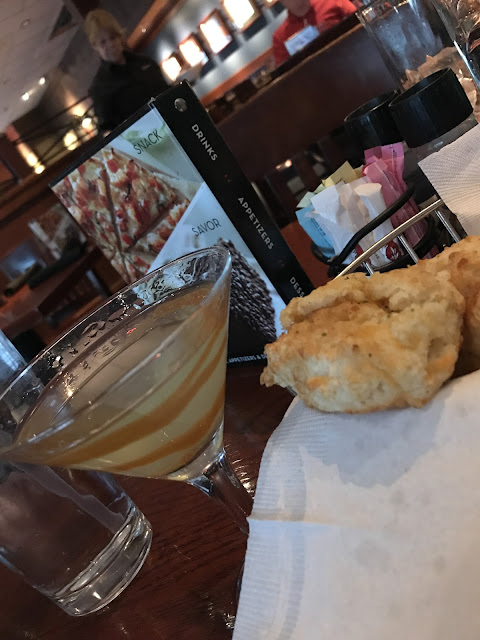
at Red Lobster without thinking
of her breasts cupped in seashells,
hair wild with kelp and ocean waves.
Thursday, June 16, 2022

June 16: Black Bird, Open Mic, Safe Harbor

Santiago spies a dolphin . . . 

"Dolphin," the old man said aloud. "Big dolphin."

He shipped his oars and brought a small line from under the bow. It had a wire leader and a medium-sized hook and he baited it with one of the sardines. He let it go over the side and then made it fast to a ring bolt in the stern. Then he baited another line and left it coiled in the shade of the bow. He went back to rowing and to watching the long-winged black bird who was working, now, low over the water.

Tonight, I guest-hosted an open mic for a friend who's facing some big struggles right now.  I won't share the details of those struggles.  That's not my place.  Let's just say that she's rowing her boat through some very rough seas at the moment.

I read some of my new poems and a couple blog posts for the open mic.  My son read an essay that he wrote for fun  about his grandparents and aunts.  For fun.  I don't know any 13-year-old boys who write for pleasure.  I did when I was his age, but I'm certainly the exception.  And his essay was better than anything I've ever graded in the college composition classes I've taught.

And a great poet friend of mine was there, as well.  She read two poems she'd written--one for the memorial service of her sister and one for the memorial service of her significant other.  They were both heartbreaking and beautiful.  Both of us have lost two people we loved in the last six months.

It seemed that was the theme of the evening.  Dealing with struggles and loss.  Also, reclaiming life and those moments when beauty breaks through the darkness.  My poet friend, as she was leaving at the end of the night, said, "This was really healing."

That's it.  We're all rowing our little boats on very big, unpredictable waters.  Every once in a while, we find a safe harbor.  A place where poetry and light lives and green trees walk in the wind.

Saint Marty found safe harbor tonight.


Wednesday, September 27, 2017

September 27: Time Window, Worry About Tomorrow, Shades Drawn

People drifted away now, seeing the color return to Billy's cheeks, seeing him smile.  Valencia stayed with him, and Kilgore Trout, who had been on the fringe of the crowd, came closer, interested, shrewd.

"You looked as though you'd seen a ghost," said Valencia.

"No," said Billy.  He hadn't seen anything but what was really before him--the faces of the four singers, those four ordinary men, cow-eyed and mindless and anguished as they went from sweetness to sourness to sweetness again.

"Can I make a guess?" said Kilgore Trout.  "You saw through a time window."

"A what?" said Valencia.

"He suddenly saw the past or the future.  Am I right?"

"No," said Billy Pilgrim.  He got up, put a hand into his picket, found the box containing the ring in there.  He took out the box, gave it absently to Valencia.  He had meant to give it to her at the end of the song, while everybody was watching.  Only Kilgore Trout was there to see. 

"For me?" said Valencia.

"Yes."

"Oh, my God," she said.  Then she said it louder, so other people heard.  They gathered around, and she opened it, and she almost screamed when she saw the sapphire with a star in it.  "Oh, my God," she said.  She gave Billy a big kiss.  She said, "Thank you, thank you, thank you."

Time window.  I'm sitting in my office at the university right now, and I would give my left testicle for a window of any kind right now.  I'm staring at four, cream-colored walls.  There's not a whole lot of distraction, and I sort of like it that way.  It makes it easier to concentrate on blog posts or reading or grading.

I have plenty of time windows in this office, though.  It doesn't take much to get me to stare into some pane of the past.  For instance, just a moment ago, I was thinking about the day after the birth of my son.  I taught a class of freshman composition, and I showed pictures of my newborn.  The teenage girls "awwed" and "oooohed."  The teenage guys kind of rolled their eyes, and I think one of them asked, "Does this mean you're going to push back the due date of the paper?"

My window into the future is kind of limited at the moment.  All I see is myself, in about five hours, leaving campus, exhausted and hungry.  I also see myself freezing my ass off at a football game this Friday night.  Aside from that, I got nothing.  Future windows are always foggier than past windows.

Some people would probably say that gazing through times windows is a waste of time.  It either makes you sad and nostalgic, or fearful and anxious.  In the Gospel of Matthew, Jesus says, "So don't worry about tomorrow, for tomorrow will bring its own worries.  Today's trouble is enough for today."  Translation:  no time windows for you.  It's good advice, from a pretty good source.

So, I'm going to try to keep my shades drawn on time windows for the rest of the afternoon and evening.  I'm just going to focus on the next moment, which involves a chicken sandwich and paper grading.

Or maybe Saint Marty should plan out his life for the next five years, instead.


Sunday, July 23, 2017

July 23: Need to Withdraw, Beverly Matherne, "I Wonder What It Was Like"

I am feeling the need to withdraw today for some reason.  Not be around too many people.  That doesn't work too well when you're the father of a teenage daughter and eight-year-old son.  Plus, I usually have dinner at my parents' house on Sunday evening.  It's one of the few times in the week that I can visit with my siblings.

Yet, I have cloistered myself at my parents' dining room table, headphones on, listening to music and writing blog posts.  When I'm done blogging, I will probably pretend that I'm still blogging, just so that I won't have to talk to anyone.  I know it's a terrible thing to do, but my weeks are full of human interaction.  On weekends, I try to be as antisocial as possible.  It helps me recharge my supply of human compassion and empathy for the week.

I think that poets need to do this every once in a while, too.  Poetry requires a certain amount of isolation and introspection.  To think and feel things through.  Figure things out.  Find the perfect word and phrase.  To wonder and speculate.

So, if you're looking to talk to Saint Marty today, he won't be answering his phone, unless you are a publisher; head of a university English Department looking for a full-time poet; or member of the Swedish Academy selecting the next winner of the Nobel Prize in Literature.

I Wonder What It Was Like

by:  Beverly Matherne

I wonder what it was like
when Mama met Daddy
that spring dance
at Ascension Catholic high,
her brown hair
to the slim waist
of her white organdy dress,
Daddy's Billiantined hair,
his green eyes sparkling.

I wonder what it was like,
their white shoes
scuffing waxed linoleum
to Louis  Armstrong's band,
crawfish and Jax Beer
and fruit punch and
magnolias filling the air.

I wonder what it was like,
their high-pitched laughs,
the differences between their dialects:
l' epouvantail, la paillasse.

I wonder what it was like,
Daddy tipsy, reciting
"To-morrow, and to-morrow . . ."
to show he knew English,
Mama's movie-star smile,
her perfect white teeth,
their long stroll on the levee,
as the Mississippi licked the shore
and rolled on, rolled on . . .


Wednesday, March 29, 2017

March 29: Worse Places, Chicken Pot Pie, Better Off

Billy Pilgrim was packed into a boxcar with many other privates.  He and Roland Weary were separated.  Weary was packed into another car in the same train.

There were narrow ventilators at the corners of the car, under the eaves.  Billy stood by one of these, and, as the crowd pressed against him, he climbed part way up a diagonal corner brace to make more room.  This placed his eyes on a level with the ventilator, so he could see another train about ten yards away.

Germans were writing on the cars with blue chalk--the number of persons in each car, their rank, their nationality, the date on which they had been put aboard.  Other Germans were securing the hasps on the car doors with wire and spikes and other trackside trash.  Billy could hear somebody writing on his car, too, but he couldn't see who was doing it.


Most of the privates on Billy's car were very young--at the end of childhood.  But crammed into the corner with Billy was a former hobo who was forty years old.

"I been hungrier than this," the hobo told Billy.  "I been in worse places than this.  This ain't so bad."

I really love the hobo in this passage.  Jammed into a boxcar with a dozens of other people, probably starved for days, exhausted from marching and marching, the hobo still isn't feeling too bad.  Think about it.  It's better to be a prisoner of war than a homeless person in the United States.  That says quite a bit.  In the wealthiest country of the world, there are hobos dying of hunger and exposure.

I am not going to get all political here.  I'm not going to focus on the poor and working poor.  People who work two, sometimes three jobs and still can't pay their bills or feed their kids.  Minimum wage that doesn't even provide a minimum living.  Kids that only get hot meals at school.  Senior citizens who can't afford their medications.

Nope, I'm not going to talk about any of that.

I'm going to talk about chicken pot pie, which I had for dinner tonight.  It was delicious, with crispy crust and chunks of meat, potatoes, and peas.  I had two pieces, and it made me feel warm and satisfied.  I'm thankful that I had a warm meal tonight.  I'm better off than a good portion of the world's population.

Sometimes, it's easy to forget how lucky I am.  A loving wife.  Two great kids.  A house.  A car that works.  A couple decent jobs where I am relatively respected.  Books to read.  A laptop computer to write blog posts on.  A warm bed to sleep in.

As the hobo tells Billy Pilgrim, this ain't so bad.

Saint Marty is thankful for chicken pot pie and his kids and wife and books and laptop tonight.


Friday, June 17, 2016

June 17: Road Crew, Construction, Moving a Tree Trunk

Women are bringing coffee in mugs to the road crew.  They've barely made a dent in the tree trunk, and they're giving up.  It's a job for power tools; the water's going down anyway, and the danger is past.  Some kid starts doing tricks on a skateboard; I head home.

Dillard joins a crowd of people watching a road crew at work.  Tinker Creek is flooding, and a tree has washed up against a bridge.  The tree has to be removed, or property may be damaged.  And, as with any situation that promises potential disaster, it attracts a crowd of onlookers.  Sort of like when residents of Washington D.C. rode out into the countryside in carriages and on horseback to watch one of the first battles of the Civil War.  As if it was a three-ring service. 

There's a lot of construction going on in my hometown right now.  Streets are torn up and blocked off.  Traffic is slow.  When I go to work in the morning, I never know what I'm going to encounter.  New potholes.  New closures.  Sometimes traffic barrels smashed and in the road.  And the road crew moving tractors and trucks into place.

I don't have time to stop and watch the work.  I simply catch the before and after each day.  Before the work begins and after it ends.  I'm always amazed by work crews.  For months, these guys and gals look as if they're accomplishing nothing.  They simply push piles of gravel and dirt from one place to another.  Then, near the end of construction season, suddenly miracles happen.  Buildings sprout up overnight.  Paved roads and roundabouts appear.  Two lanes become four lanes. 

Writing sometimes goes like that for me.  I struggle and push words around, day after day.  Sentences are put in place, moved, taken apart, put back together.  I get up in the morning, and there's a blank page.  At the end of the day, there may be a new paragraph or stanza.  If I'm really lucky, a poem or essay or story will eventually emerge.

That's where I am this weekend.  Like the road crew, I've been moving dirt around for a few weeks.  Laying down gravel and asphalt.  Tomorrow or Sunday, I'm hoping to be done with my current writing project.  It would be a nice Father's Day gift to myself.

I haven't been feeling like much of a writer recently.  Aside from these blog posts (which don't really count), I haven't produced a whole lot of written work recently.  I'm hoping that all the pieces are going to fall into place somehow.

That's Saint Marty's hope--he needs to move a tree trunk, as Dillard says.