Showing posts with label Seamus Heaney. Show all posts

Thursday, August 15, 2024

August 14: "Reader," Four Shillings Short, "Barred Owl"

So, I had a poetry-filled day.

Started out by writing poetry on the roof of the library with one of my best poetry pals.  (See the end of this post for one of my rooftop compositions.)  Then I wrote an email to a poet I admire, hoping to book this person for next year's Great Lakes Poetry Festival.  After that, it was a lot of busy work, helping move shelves and books for a library remodel, answering other emails, arranging concerts.

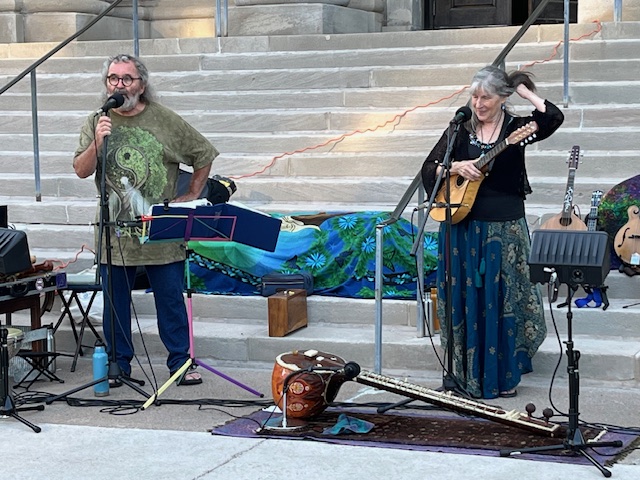
This evening, I hosted a concert by a Celtic group named Four Shillings Short (a lovely husband/wife team--Aodh Og O'Tuama and Christy Martin).  I spent a couple hours speaking with them both, and I found out the Aodh Og's parents were good friends with Nobel Prize-winning poet Seamus Heaney (one of my poet gods).  Aodh Og met Heaney a couple times in his life.  Imagine this news being shared with me nonchalantly, like talking about a good cup of coffee, while the top of my head comes off.

After the concert, I went to another event to share some of my Bigfoot poems.  My daughter and son came for the reading, and we had some cider, ate pizza, and listened to music.  When it was my turn, two musician/artist friends accompanied me with guitar and saxophone.  It was a wonderful way to end the night, and there were a lot of people there to listen.  (Maybe they were simply there for the kombucha, but I like to think they showed up for the words and music.)

In today's poem, Billy Collins addresses one member of his audience . . . 

Reader

by: Billy Collins

Looker, gazer, skimmer, skipper,
thumb-licking page turner, peruser,
you getting your print-fix for the day,
pencil-chewer, note take, marginalianist
with your checks and X's,
first-timer or revisiter,
browser, speedster, English major,
flight-ready girl, melancholy boy,
invisible companion, thief, blind date, perfect stranger--

that is me rushing to the window
to see if it's you passing under the shade trees
with a baby carriage or a dog on a leash,
me picking up the phone
to imagine your unimaginable number,
me standing by a map of the world
wondering where you are--
alone on a bench in a train station
or falling asleep, the book sliding to the floor.


I just got home after this long day of poetry and music.  I'm a little exhausted, but also quite filled-up.  For the most part, I often don't feel like a real artist in any way.  My job is all about supporting and helping other artists and musicians and writers.  Rarely do I get a chance to share my work with an audience.  It was a wonderful gift.

So, looker, gazer, skimmer, skipper--Saint Marty felt like a real poet today.  

Barred Owl

by: Martin Achatz

Who cooks for you?  Who cooks for you all?
In the night, I hear the question
echo through the pines.
It's 11,000 years old,
has been heard by tyrannosaur,
stegosaur, mammoth, dodo.
Who cooks for you?  Who cooks for you all?
Like a mother seeing a crowd
of kids, worried over their health, safety.

Think of those ancient birds
circling, circling the horny backs 
of giants, crying out their concern, 
extinction just a Pleistocene
chipmunk that can be hunted, caught,
shredded with beak and claw, eaten
as the glaciers slowly crawl by.
Who cooks for you?  Who cooks for you all?


Monday, March 15, 2021

March 15: Giving Them All They Want, Satchel, Seamus Heaney, Walking the Same Path

Merton the teacher . . . 

But I liked teaching very much—especially teaching this kind of a class, in which most of the students had to work for their living, and valued their course because they had to pay for it out of their own savings. Teaching people like that is very flattering: the class is always so eager to get anything you have to give them, and the mere fact that they want so much, is liable to give you the impression that you are capable of giving them all they want. 

For my part I was left more or less free to go ahead and teach them according to my own ideas. Now if people are going to write, they must first of all have something to write about, and if a man starts out to teach English composition, he implicitly obliges himself to teach the students how to get up enough interest in things to write about them. But it is also impossible for people to learn to write unless they also read. And so a course in composition, if it is not accompanied somewhere along the line by a course in literature, should also take a little time to teach people how to read, or at least how to get interested in a book. 

Therefore, I spent most of the time throwing out ideas about what might or might not be important in life and in literature, and letting them argue about it. The arguments got better when they also included discussion of thestudents’ favorite ideas, as expressed on paper. It soon turned out that although they did not all have ideas, they all had a definite hunger for ideas and for convictions, from the young man who wrote a theme about how happy he had been one summer when he had had a job painting a church, to the quiet Catholic housewife who sat in one of the middle rows viewing me with a reassuring smile and an air of friendly complicity whenever the discussion got around near the borders of religion. So it was a very lively class, on the whole. 

But it was only to last a term. And when January came around, they told me, down in the office, that they were going to give me a class in straight, unalleviated grammar in the spring session. 

Grammar was something I knew absolutely nothing about, and only the most constant vigilance had kept it out of sight in the composition class. Besides, since I was entering the monastery in the summer, I assured myself that I ought to take a last vacation, and I was already leafing through books about Mexico and Cuba, trying to decide where I would spend the money that I was no longer going to need to support myself in the world. 

I told the heads of my department that I could not teach grammar in the spring, because I wanted to prepare myself for life in the cloister. They asked me what made me want to do such a thing as that, and sadly shook their heads, but did not try to argue me out of it. They told me I could come back if I changed my mind—and it almost sounded as if they were saying: “We’ll take you back when you’ve been disillusioned and given up this fantastic notion as a bad job.”

I agree with Merton about writing.  It is impossible to learn how to write well without reading.  A lot.

Many people wonder why the satchel I carry with me all of the time is so overburdened with books.  Currently, I'm hauling books of poems by Seamus Heaney and Natasha Trethewey and Joy Harjo, a biography of Charles Dickens, Flight of the Diamond Smugglers by Matthew Gavin Frank, and various notebooks, journals, and sketchbooks.  Plus, I squeeze in my laptop and some power cords.

I tell people who ask my why, WHY do I need all these books, "Well, you never know when you're going to get stuck in an elevator for a few weeks."  The answer is weirdly specific enough to disarm the inquirer of any follow-up questions, and I am able to change the topic.

Here's my real answer to this query:  I carry piles of books with me everywhere I go because I like to surround myself with friends.  The voices in the books speak to me in deep ways.  They don't try to make small talk about the weather or sports teams.  No, these friends talk about subjects that are essential and important.  Just this morning, Seamus Heaney said to me, "Out there in Jutland / In the old man-killing parishes / I will feel lost, / Unhappy and at home." (Heaney, "The Tollund Man," Wintering Out.)  And Natasha Trethewey answered back " . . . Here is the threshold I do not cross: / a sliver of light through the doorway finds his tattoo, / the anchor on his forearm tangled in its chain."  (Trethewey, "Fouled," Thrall,) 

I live my days with lots of unanswered, unanswerable questions.  Like almost every human being on this planet.  When those questions become loud and insistent, I turn to the friends in my satchel.  They don't try to hand me easy answers aimed at making me feel better.  In fact, they don't try to make me feel better at all.  Instead, they speak words that help me understand that I am not alone in my struggle.  That they are walking the same path that I'm on.

That is what true friendship and love is all about.  Not solving all the problems of life.  Rather, being a fellow traveler.  Through thick, thin, in the old man-killing parishes, at the threshold of the doorway, in a sliver of light.  Preach, Seamus.  Hallelujah, Natasha.

Saint Marty says a holy "amen" for his friends whose voices cry out in the wilderness.


Monday, February 22, 2021

February 22: Power of My Decision, Wide-Spread Leprosy, Seamus Heaney

 Merton makes a momentous decision . . . 

I cannot say what caused it: it was not a reaction of especially strong disgust at being so tired and so uninterested in this life I was still leading, in spite of its futility. It was not the music, not the fall air, for this conviction that had suddenly been planted in me full grown was not the sick and haunting sort of a thing that an emotional urge always is. It was not a thing of passion or of fancy. It was a strong and sweet and deep and insistent attraction that suddenly made itself felt, but not as movement of appetite towards any sensible good. It was something in the order of conscience, a new and profound and clear sense that this was what I really ought to do. 

How long the idea was in my mind before I mentioned it, I cannot say. But presently I said casually: 

“You know, I think I ought to go and enter a monastery and become a priest.” 

Gibney had heard that before, and thought I was fooling. The statement aroused no argument or comment, and anyway, it was not one to which Gibney was essentially unsympathetic. As far as he was concerned, any life made sense except that of a business man. 

As we went out the door of the house I was thinking: 

“I am going to be a priest.” 

When we were on the Chicken Dock, my mind was full of the same idea. Around three or four in the afternoon Gibney left and went home to Port Washington. Peggy and I sat looking at the dirty river for a while longer. Then I walked with her to the subway. In the shadows under the elevated drive over Tenth Avenue I said: 

“Peggy, I mean it, I am going to enter a monastery and be a priest.” 

She didn’t know me very well and anyway, she had no special ideas about being a priest. There wasn’t much she could say. Anyway, what did I expect her to say? 

I was glad, at last, to be alone. On that big wide street that is a continuation of Eighth Avenue, where the trucks run down very fast and loud—I forget its name—there was a little Catholic library and a German bakery where I often ate my meals. Before going to the bakery to get dinner and supper in one, I went to the Catholic library, St. Veronica’s. The only book about religious Orders they seemed to have was a little green book about the Jesuits but I took it and read it while I ate in the bakery. 

Now that I was alone, the idea assumed a different and more cogent form. Very well: I had accepted the possibility of the priesthood as real and fitting for me. It remained for me to make it, in some sense, more decisive. 

What did that mean? What was required? My mind groped for some sort of an answer. What was I supposed to do, here and now? 

I must have been a long time over the little book and these thoughts. When I came out into the street again, it was dusk. The side streets, in fact, were already quite dark. I suppose it was around seven o’clock. 

Some kind of an instinct prompted me to go to Sixteenth Street, to the Jesuit Church of St. Francis Xavier. I had never been there. I don’t know what I was looking for: perhaps I was thinking primarily of talking to some one of the Fathers there—I don’t know. 

When I got to Sixteenth Street, the whole building seemed dark and empty, and as a matter of fact the doors of the church were locked. Even the street was empty. I was about to go away disappointed, when I noticed a door to some kind of a basement under the church. 

Ordinarily I would never have noticed such a door. You went down a couple of steps, and there it was, half hidden under the stairs that led up to the main door of the church. There was no sign that the door was anything but locked and bolted fast. 

But something prompted me: “Try that door.” 

I went down the two steps, put my hand on the heavy iron handle. The door yielded and I found myself in a lower church, and the church was full of lights and people and the Blessed Sacrament was exposed in a monstrance on the altar, and at last I realized what I was supposed to do, and why I had been brought here. 

It was some kind of a novena service, maybe a Holy Hour, I don’t know: but it was nearly ending. Just as I found a place and fell on my knees, they began singing the Tantum Ergo.... All these people, workmen, poor women, students, clerks, singing the Latin hymn to the Blessed Sacrament written by St. Thomas Aquinas. I fixed my eyes on the monstrance, on the white Host. 

And then it suddenly became clear to me that my whole life was at a crisis. Far more than I could imagine or understand or conceive was now hanging upon a word—a decision of mine. 

I had not shaped my life to this situation: I had not been building up to this. Nothing had been further from my mind. There was, therefore, an added solemnity in the fact that I had been called in here abruptly to answer a question that had been preparing, not in my mind, but in the infinite depths of an eternal Providence. 

I did not clearly see it then, but I think now that it might have been something in the nature of a last chance. If I had hesitated or refused at that moment—what would have become of me? 

But the way into the new land, the promised land, the land that was not like the Egypt where I persisted in living, was now thrown open again: and I instinctively sensed that it was only for a moment. 

It was a moment of crisis, yet of interrogation: a moment of searching, but it was a moment of joy. It took me about a minute to collect my thoughts about the grace that had been suddenly planted in my soul, and to adjust the weak eyes of my spirit to its unaccustomed light, and during that moment my whole life remained suspended on the edge of an abyss: but this time, the abyss was an abyss of love and peace, the abyss was God. 

It would be in some sense a blind, irrevocable act to throw myself over. But if I failed to do that ... I did not even have to turn and look behind me at what I would be leaving. Wasn’t I tired enough of all that? 

So now the question faced me: 

“Do you really want to be a priest? If you do, say so...” 

The hymn was ending. The priest collected the ends of the humeral veil over his hands that held the base of the monstrance, and slowly lifted it off the altar, and turned to bless the people. 

I looked straight at the Host, and I knew, now, Who it was that I was looking at, and I said: 

“Yes, I want to be a priest, with all my heart I want it. If it is Your will, make me a priest—make me a priest.” 

When I had said them, I realized in some measure what I had done with those last four words, what power I had put into motion on my behalf, and what a union had been sealed between me and that power by my decision.

I don't think that I have ever had a moment of clarity like this.  Merton is absolutely sure in his decision.  It may have come after years of being faithless.  False starts and ignored signs.  Yet, here Merton finally is:  hearing God's voice and answering with an emphatic "yes."

I ruminate.  Ponder.  Weigh options.  Think.  Think about it again.  Then, I may seek out advice from one or two people.  Sometimes more.  After I have done all this, I'm usually no closer to an answer than when I started the whole process.  

I wish a lived in Biblical times.  Aside from wide-spread leprosy and some plagues of locusts, things were a lot simpler back then.  If you prayed and prayed for something, eventually God sent down an angel who knocked on your door, asking for some food and lodging.  If you were smart enough to be a hospitable host, in the morning, that angel would answer your prayer.  Your barren wife would be with child.  Your possessed child would be unpossessed.  Your terminally ill mother would get out of bed and make breakfast for everyone in the house.

God was a lot more transparent back then.  Miracles more plentiful.  Angels as common as sheep.  

These days, God doesn't write answers on walls or send seraphic messengers.  Cities don't get destroyed by pillars of fire, and, the last time I checked the weather forecast, the meteorologist wasn't predicting 40 days of rain.  Miracles have been replaced by metaphors.

That means that poets have become the prophets of our time.  They deal in truth, even if they tell it slant.  The best poems--the ones that take my breath away--have the power of prophecy in them.  Think about it.  Even Rodney Dangerfield got inspired by Dylan Thomas in Back to School to not go gentle into that good night.  

I think that's why, when I'm really churning over a really difficult question or problem, I pick up a collection of poems.  For me, it's a sacred act.  Words elevated to God's breath.  My favorite gospel text, as my one Constant Reader already knows, is John:  "In the beginning was the Word, and the Word was with God, and the Word was God."  

Tonight has been a struggle for me.  Without delving into the details, let me just say that I reached for a little Seamus Heaney, from his poem "Digging":

. . .

The cold smell of potato mould, the squelch and slap
Of soggy peat, the curt cuts of an edge
Through living roots awaken in my head.
But I've no spade to follow men like them.

Between my finger and my thumb
The squat pen rests.
I'll dig with it.

Life can be difficult sometimes, full of mold and squelch and slap.  Hard earth that needs to be turned by a spade, over and over and over, until it yields something living.  Something that can feed and sustain you.

Tonight, I'm digging with my pen, looking for answers.

Saint Marty will let you know when something green starts to grow.


Wednesday, December 2, 2020

December 2: Miracles Cannot Happen, Be a Match, Life I was Meant to Live

Merton enters graduate school . . .

Ultimately, I suppose all Oriental mysticism can be reduced to techniques that do the same thing, but in a far more subtle and advanced fashion: and if that is true, it is not mysticism at all. It remains purely in the natural order. That does not make it evil, perse, according to Christian standards: but it does not make it good, in relation to the supernatural. It is simply more or less useless, except when it is mixed up with elements that are strictly diabolical: and then of course these dreams and annihilations are designed to wipe out all vital moral activity, while leaving the personality in control of some nefarious principle, either of his own, or from outside himself. 

It was with all this in my mind that I went and received my diploma of Bachelor of Arts from one of the windows in the Registrar’s office, and immediately afterwards put my name down for some courses in the Graduate School of English. 

The experience of the last year, with the sudden collapse of all my physical energy and the diminution of the brash vigor of my worldly ambitions, had meant that I had turned in terror from the idea of anything so active and uncertain as the newspaper business. This registration in the graduate school represented the first remote step of a retreat from the fight for money and fame, from the active and worldly life of conflict and competition. If anything, I would now be a teacher, and live the rest of my life in the relative peace of a college campus, reading and writing books. 

That the influence of the Huxley book had not, by any means, lifted me bodily out of the natural order overnight is evident from the fact that I decided to specialize in eighteenth century English Literature, and to choose my subject for a Master of Arts Thesis from somewhere in that century. As a matter of fact, I had already half decided upon a subject, by the time the last pile of dirty snow had melted from the borders of South Field. It was an unknown novelist of the second half of the eighteenth century called Richard Graves. The most important thing he wrote was a novel called the Spiritual Quixote, which was in the Fielding tradition, a satire on the more excited kind of Methodists and other sects of religious enthusiasts in England at that time. 

I was to work under Professor Tyndall, and this would have been just his kind of a subject. He was an agnostic and rationalist who took a deep and amused interest in all the strange perversions of the religious instinct that our world has seen in the last five hundred years. He was just finishing a book on D. H. Lawrence which discussed, not too kindly, Lawrence’s attempt to build up a synthetic, home-made religion of his own out of all the semi-pagan spiritual jetsam that came his way. All Lawrence’s friends were very much annoyed by it when it was published. I remember that in that year one of Tyndall’s favorite topics of conversation was the miracles of Mother Cabrini, who had just been beatified. He was amused by these, too, because, as for all rationalists, it was for him an article of faith that miracles cannot happen. 

I was once like Thomas Merton, heading into graduate school, so certain of what I was going to do.  Who I was going to become.  In graduate school, I was influenced by a lot of people, friends and teachers and mentors.  For Merton, it was Professor Tyndall, agnostic, skeptic, non-believer in anything miraculous.  Merton had an idea of who he was going to become, too.  Just like me.  And, of course, just like me, he turned out to be someone completely different.

You see, I thought I was going to be an important intellectual.  A college professor.  Best-selling writer.  Nobel Prize-winning poet.  I was going to set the world on fire.  With myself.  I was going to be a match, igniting everything and everyone with my light.  

Now, decades later, I realize how stupid I was.  I'm sure Merton thought the same thing.  Time has a way of doing that.  Making you reevaluate.  I'm sure there are thousands of failed bestselling writers out there.  People who dreamed they were going to be the next Stephen King.  Just like there are probably a lot of former English graduate students out there who thought they were going to be Seamus Heaney or Louise Gluck.

Here's the thing:  there is only one Stephen King.  One Louise Gluck.  And there is only one me.  We can spend years and years and years trying to be someone else.  I was like that.  I fought being the person I was supposed to be.  I wanted to be a fiction writer.  A full-time professor at a big university.  Rich, famous, loved.  A big shot, as my dad used to say.  

The universe had different plans for me.  Better plans.  I became a teacher.  That gives me purpose.  A poet.  That gives me empathy, insight.  A church musician.  That gives me spiritual connection.  A husband and father.  That gives me love.  I have a better life than I ever imagined when I was in graduate school.

You see, unlike Merton's mentor, I do believe in miracles.  I think we are surrounded by them, all day, every day.  We live them.  Live with them.  My wife is a miracle, for all the struggles we have.  My daughter and son.  Miracles.  Every poem I write--a gift, a miracle.  Sitting here, writing this blog post.  A miracle. 

This life I was mean to live.  A miracle.

Saint Marty gives thanks for that.


Sunday, August 12, 2018

August 12: Seamus Heaney, "Blackberry-Picking," Summer Person

Blackberry-Picking

by:  Seamus Heaney

for Philip Hobsbaum

Late August, given heavy rain and sun
For a full week, the blackberries would ripen.
At first, just one, a glossy purple clot
Among others, red, green, hard as a knot.
You ate that first one and its flesh was sweet
Like thickened wine: summer's blood was in it
Leaving stains upon the tongue and lust for
Picking. Then red ones inked up and that hunger
Sent us out with milk cans, pea tins, jam-pots
Where briars scratched and wet grass bleached our boots.
Round hayfields, cornfields and potato-drills
We trekked and picked until the cans were full,
Until the tinkling bottom had been covered
With green ones, and on top big dark blobs burned
Like a plate of eyes. Our hands were peppered
With thorn pricks, our palms sticky as Bluebeard's.

We hoarded the fresh berries in the byre.
But when the bath was filled we found a fur,
A rat-grey fungus, glutting on our cache.
The juice was stinking too. Once off the bush
The fruit fermented, the sweet flesh would turn sour.
I always felt like crying. It wasn't fair
That all the lovely canfuls smelt of rot.
Each year I hoped they'd keep, knew they would not.

_________________________

Had some blackberries for breakfast this morning, along with blueberries and crisp bacon with eggs.  It was all delicious.  I'm generally not the kind of person who takes pictures of food, but those blackberries were dark and beautiful and full of summer.

I used to be a winter person.  Loved the first snow of winter.  Waited for blizzards, with their banshee winds and screams.  Then I was an autumn person for a very long time.  The colors and lettuce morning air.  Now, I'm a summer person.  I mourn when I see the first leaf turning color at the end of August.  I want warmth and laziness and blackberries.

Saint Marty must be getting old.


Monday, September 18, 2017

September 18: Poet of the Week, Paul Muldoon, "Hedgehog"

Around this time of year, in literary circles, Paul Muldoon's name gets thrown around a lot.  He's an Irish poet.  A contemporary of Seamus Heaney.  Muldoon read at Heaney's funeral. 

Certainly, Paul Muldoon deserves to win the Nobel Prize in Literature.  I think he will, some day.  Maybe this year.  Who knows?

But, if his name isn't spoken in Sweden this October, Paul Muldoon can at least boast that he was named Poet of the Week by Saint Marty. 

That should be a consolation.

Hedgehog

by:  Paul Muldoon

The snail moves like a
Hovercraft, held up by a
Rubber cushion of itself,
Sharing its secret

With the hedgehog. The hedgehog
Shares its secret with no one.
We say, Hedgehog, come out
Of yourself and we will love you.

We mean no harm. We want
Only to listen to what
You have to say. We want
Your answers to our questions.

The hedgehog gives nothing
Away, keeping itself to itself.
We wonder what a hedgehog
Has to hide, why it so distrusts.

We forget the god
Under this crown of thorns.
We forget that never again
Will a god trust in the world.


Thursday, September 5, 2013

September 5: Ring Lardner, Seamus Heaney, Sad News

...What really knocks me out is a book that, when you're all done reading it, you wish the author that wrote it was a terrific friend of yours and you could call him up on the phone whenever you felt like it.  That doesn't happen much, though.  I wouldn't mind calling this Isak Dinesen up.  And Ring Lardner, except that D. B. told me he's dead...

Holden has strong opinions about writers.  Early in Catcher we find out that Ring Lardner is one of his favorites.  And, of course, the ultimate test for Holden is whether, when you're done reading a book, you imagine being good friends with its author.


That's a pretty good test.  There are several writers I would put in that category for myself:  Sharon Olds, Flannery O'Connor, John Irving, J. K. Rowling.  Today, I just found out that one of my favorite poets passed away on August 30.  Irish poet Seamus Heaney.  According to Google, he fell down outside a restaurant, entered a hospital to have an operation, and died the next day.  According to Heaney's son, Michael, the poet's last words, texted to his wife of 47 years, were "Noli timere," Latin for "Do not be afraid."

This news has weighed on me most of this evening.  Heaney's work was amazing.  Smart.  Stunning.  Moving.  Important.  His death is a great loss to world literature.  And poetry has lost a great friend.

That's a piece of Saint Marty's mind.

R. I. P. Seamus Heaney

Saturday, March 16, 2013

March 16: Terrific Friend, Seamus Heaney, "The Spirit Level," New Cartoon

What really knocks me out is a book that, when you're all done reading it, you wish the author that wrote it was a terrific friend of yours and you could call him up on the phone whenever you felt like it. That doesn't happen much, though.

I know I've used this Holden quote before when I've talked about books and writers I love.  I can honestly say that I love the writer I'm going to talk about today, but I don't think I'd want to call him up on the phone whenever I felt like it.

Seamus Heaney, the Nobel Prize winning Irish poet, is one of my favorite writers.  His poems are like precious stones, cut and polished and glinting with light.  However, I've talked to people who have met Heaney, and, from their reports, he's kind of an asshole in person.  He can afford to be.  He's brilliant and accomplished and doesn't suffer fools very gladly.  I wouldn't mind having dinner and drinks with him, but I don't know if I'd be able to hold up my end of the conversation for very long.  I have a feeling I'd end up being one of those fools.

The Spirit Level is Heaney's collection of poems published in 1996 by Farrar Straus Giroux.  His poems, as always, are stunning, filled with the music and myth and mud of the world.  He's able to take ordinary stuff of everyday life and transform into something beautiful.  In the poem "St. Kevin and the Blackbird," he takes as his subject the sacred nature of Nature:

St. Kevin and the Blackbird

And then there was St. Kevin and the blackbird.
The saint is kneeling, arms stretched out, inside
His cell, but the cell is narrow, so

One turned-up palm is out the window, stiff
As a crossbeam, when a blackbird lands
And lays in it and settles down to nest.

Kevin feels the warm eggs, the small breast, the tucked
Neat head and claws and, finding himself linked
Into the network of eternal life,

Is moved to pity:  now he must hold his hand
Like a branch out in the sun and rain for weeks
Until the young are hatched and fledged and flown.

*

And since the whole thing's imagined anyhow,
Imagine being Kevin.  Which is he?
Self-forgetful or in agony all the time

From the neck on out down through his hurting forearms?
Are his fingers sleeping?  Does he still feel his knees?
Or has the shut-eyed blank of underearth

Crept up through him?  Is there distance in his head?
Alone and mirrored clear in love's deep river,
'To labour and not to seek reward,' he prays,

A prayer his body makes entirely
For he has forgotten self, forgotten bird
And on the riverbank forgotten the river's name.

Heaney is a master of making these kinds of moves, from hagiography into legend into feather and finger.  His poems have that kind of muscle, assured in each leap of thought and image.  I'm not always sure where his leaps land.  Sometimes, I find myself in places strange and frightening.  But Heaney is always there, in command, leading me where he wants me to go: 

Postscript 

And some time make the time to drive out west
Into County Clare, along Flaggy Shore,
In September or October, when the wind
And the light are working off each other
So that the ocean on one side is wild
With foam and glitter, and inland among stones
The surface of a slate-grey lake is lit
By the earthed lightning of a flock of swans,
Their feathers roughed and ruffling, white on white,
Their fully grown headstrong-looking heads
Tucked or cresting or busy underwater.
Useless to think you'll park and capture it
More thoroughly.  You are neither here not there,
A hurry through which known and strange things pass
As big soft buffetings come at the car sideways
And catch the heart off guard and blow it open.

That's what Seamus Heaney does.  He blows our hearts open with his every word.  He may puzzle me, make me feel inadequate, a little foolish.

But Seamus Heaney also makes Saint Marty want to be a better writer, to strive to understand the mysteries of everyday life just a little more.
 
Confessions of Saint Marty


Friday, March 15, 2013

March 15: End of Day, Seamus Heaney, "The Rain Stick"

I am approaching my twelfth hour of waking.  The day's chores are done.  The house smells clean.  Lemon.  Lysol.  I'm sitting in the living room in the quiet, awaiting the noise of son and daughter.  For now, though, there is peace.  An end-of-day peace.  A peace in which all I hear is the tick-tick-tick of the clock on the wall, counting down the seconds to night.  I am tired but full as I look around this room.  It is like a yard shoveled after a snowstorm, an empty basket waiting dirty clothes.  I know how Noah felt standing on the deck of the ark as the rain clouds rolled in.  He felt worthy of a nap, a time to sit and pick the splinters from his calloused hands.

This P.O.E.T.S. Day, I have chosen to share a poem by Seamus Heaney, in honor of Saint Patrick's Day.  You see, Heaney was the second writer from Ireland to win the Nobel Prize in Literature.  The first was W. B. Yeats.  Anyway, this poem comes from Heaney's collection The Spirit Level.

Saint Marty wishes all of you a restful evening.

The Rain Stick

for Beth and Rand

Upend the rain stick and what happens next
Is a music that you never would have known
To listen for.  In a cactus stalk

Downpour, sluice-rush, spillage and backwash
Come flowing through.  You stand there like a pipe
Being played by water, you shake it again lightly

And diminuendo runs through all it scales
Like a gutter stopping trickling.  And now here comes
A sprinkle of drops out of freshened leaves,

Then subtle little wets off grass and daisies;
Then glitter-drizzle, almost-breaths of air.
Upend the stick again.  What happens next

Is undiminished for having happened once,
Twice, ten, a thousand times before.
Who cares if all the music that transpires

Is the fall of grit or dry seeds through a cactus?
You are like a rich man entering heaven
Through the ear of a raindrop.  Listen now again.

The ear of a raindrop