Merton is confronted with Catholic complacency . . .
One night there came to those nuns and to those clerics and to St. Bonaventure
in general and myself in particular, someone sent from God for the special
purpose of waking us up, and turning our eyes in that direction which we all
tended so easily to forget, in the safety and isolation of our country stronghold,
lost in the upstate hills.
It was right, of course, that my interior life should have been concerned first
of all with my own salvation: it must be that way. It is no profit for a man to gain
the whole world, and suffer the loss of his own soul, and anyway, one who is
losing his own soul is not going to be able to do much to save the souls of others,
except in the case where he may be giving out Sacraments which work, as they
say, ex opere operato, without any intrinsic dependence on the sanctity of the
one dispensing them. But now it was necessary that I take more account of
obligations to other men, born of the very fact that I was myself a man among
men, and a sharer in their sins and in their punishments and in their miseries and
in their hopes. No man goes to heaven all by himself, alone.
I was walking around the football field, as usual, in the dark. The Alumni Hall
was full of lights. It was not the night for movies. There was some speaker there.
I had not paid much attention to the list of speakers that had been invited to
come and stand on that platform and tell the clerics and Sisters all about some
important topic. I knew there would be one from The Catholic Worker, and that
David Goldstein, who was a converted Jew and ran an organization for street�preaching by laymen, was invited to speak, and I knew Baroness de Hueck, who
was working among the Negroes in Harlem, was also going to come.
As far as I knew, this night was the one listed for David Goldstein, and I
hesitated for a moment wondering whether I wanted to go and hear him or not.
At first, I thought: “No,” and started off towards the grove. But then I thought: “I
will at least take a look inside the door.”
Going up the steps to the second floor of the Hall, where the theater was, I
could hear someone speaking with great vehemence. However, it was not a
man’s voice.
When I stepped in to the room, there was a woman standing on the stage. Now
a woman, standing all alone on a stage, in front of a big lighted hall, without any
decorations or costume or special lighting effects, just in the glare of the hall�lights, is at a disadvantage. It is not very likely that she will make much of an
impression. And this particular woman was dressed in clothes that were
nondescript and plain, even poor. She had no artful way of walking around,
either. She had no fancy tricks, nothing for the gallery. And yet as soon as I came
in the door, the impression she was making on that room full of nuns and clerics
and priests and various lay-people pervaded the place with such power that it
nearly knocked me backwards down the stairs which I had just ascended.
She had a strong voice, and strong convictions, and strong things to say, and
she was saying them in the simplest, most unvarnished, bluntest possible kind of
talk, and with such uncompromising directness that it stunned. You could feel
right away that most of her audience was hanging on her words, and that some of
them were frightened, and that one or two were angry, but that everybody was
intent on the things she had to say.
I realized it was the Baroness.
I had heard something about her, and her work in Harlem, because she was
well known and admired in Corpus Christi parish, where I had been baptized.
Father Ford was always sending her things they needed, down there on 135th
Street and Lenox Avenue.
What she was saying boiled down to this:
Catholics are worried about Communism: and they have a right to be, because
the Communist revolution aims, among other things, at wiping out the Church.
But few Catholics stop to think that Communism would make very little
progress in the world, or none at all, if Catholics really lived up to their
obligations, and really did the things Christ came on earth to teach them to do:
that is, if they really loved one another, and saw Christ in one another, and lived
as saints, and did something to win justice for the poor.
For, she said, if Catholics were able to see Harlem, as they ought to see it,
with the eyes of faith, they would not be able to stay away from such a place.
Hundreds of priests and lay-people would give up everything to go there and try
to do something to relieve the tremendous misery, the poverty, sickness,
degradation, and dereliction of a race that was being crushed and perverted,
morally and physically, under the burden of a colossal economic injustice.
Instead of seeing Christ suffering in His members, and instead of going to help
Him, Who said: “Whatsoever you did to the least of these my brethren, you did
it to Me,” we preferred our own comfort: we averted our eyes from such a
spectacle, because it made us feel uneasy: the thought of so much dirt nauseated
us—and we never stopped to think that we, perhaps, might be partly responsible
for it. And so people continued to die of starvation and disease in those evil
tenements full of vice and cruelty, while those who did condescend to consider
their problems, held banquets in the big hotels downtown to discuss the “Race
situation” in a big rosy cloud of hot air.
If Catholics, she said, were able to see Harlem as they should see it, with the
eyes of faith, as a challenge to their love of Christ, as a test of their Christianity,
the Communists would be able to do nothing there.
But, on the contrary, in Harlem the Communists were strong. They were
bound to be strong. They were doing some of the things, performing some of the
works of mercy that Christians should be expected to do. If some Negro workers
lose their jobs, and are in danger of starving, the Communists are there to divide
their own food with them, and to take up the defense of their case.
If some Negro is dying, and is refused admission to a hospital, the
Communists show up, and get someone to take care of him, and furthermore see
to it that the injustice is publicized all over the city. If a Negro family is evicted,
because they can’t pay the rent, the Communists are there, and find shelter for
them, even if they have to divide their own bedding with them. And every time
they do these things, more and more people begin to say: “See, the Communists
really love the poor! They are really trying to do something for us! What they
say must be right: there is no one else who cares anything about our interests:
there is nothing better for us to do than to get in with them, and work with them
for this revolution they are talking about....”
Do the Catholics have a labor policy? Have the Popes said anything about
these problems in their Encyclicals? The Communists know more about those
Encyclicals than the average Catholic. Rerum Novarum and Quadrigesimo Anno
are discussed and analyzed in their public meetings, and the Reds end up by
appealing to their audience:
“Now we ask you, do the Catholics practice these things? Have you ever seen
any Catholics down here trying to do anything for you? When this firm and that
firm locked out so many hundreds of Negro workers, whose side did the
Catholic papers take? Don’t you know that the Catholic Church is just a front for
Capitalism, and that all their talk about the poor is hypocrisy? What do they care
about the poor? What have they ever done to help you? Even their priests in
Harlem go outside and hire white men when they want somebody to repaint their
churches! Don’t you know that the Catholics are laughing at you, behind the
back of their hands, while they pocket the rent for the lousy tenements you have
to live in?...”
The Baroness was born a Russian. She had been a young girl at the time of the
October Revolution. She had seen half her family shot, she had seen priests fall
under the bullets of the Reds, and she had had to escape from Russia the way it
is done in the movies, but with all the misery and hardship which the movies do
not show, and none of the glamour which is their specialty.
She had ended up in New York, without a cent, working in a laundry. She had
been brought up a Roman Catholic, and the experiences she had gone through,
instead of destroying her faith, intensified and deepened it until the Holy Ghost
planted fortitude in the midst of her soul like an unshakeable rock. I never saw
anyone so calm, so certain, so peaceful in her absolute confidence in God.
Catherine de Hueck is a person in every way big: and the bigness is not
merely physical: it comes from the Holy Ghost dwelling constantly within her,
and moving her in all that she does.
Sadly, the truth that Merton is confronted with in this passage is still a truth today. A lot of people who say the are Christians or Catholics do not want to get their hands dirty with the true work of being Christians or Catholics. Instead, they just want to sit in a church pew, listen to pretty music, say "amen," and walk out the doors into their comfortable lives.
The realities of our current world are this: racism and social injustices are rampant; hatred of people because of who they are becomes church doctrine; the divide between rich and poor is becoming a Grand Canyon; and illness rages because politicians (in my country, at least) have chosen to make simple and true science a partisan issue. And people are suffering and dying because of these realities.
If you feel indicted by these statements, I'm not going to try to convince you that you're not guilty. Because we are ALL guilty. We all travel through our lives, associating with people who think, look, and act just like us. Because it's easier. I live in a community where racial diversity is non-existent. I associate with people who love poetry and music and art, and who think that Donald Trump is the second coming of Adolf Hitler. (He is, by the way.) I have little patience for racists or homophobes or xenophobes. If you don't believe in vaccines as a way to end or control the pandemic, please remove me from your contact list.
You see, we all exclude and isolate when we should include and embrace. That's what Jesus Christ talked about over 21 centuries ago. If you are a Christian and don't believe this, you aren't reading the same Bible that I am. Love is love. Black. White. Muslim. Jew. Gay. Straight. Transgender. Whatever. If we all lived by that credo, the world would be a much better place. And the words of Jesus Christ wouldn't just exist on the page. They would live and breathe and sing and dance.
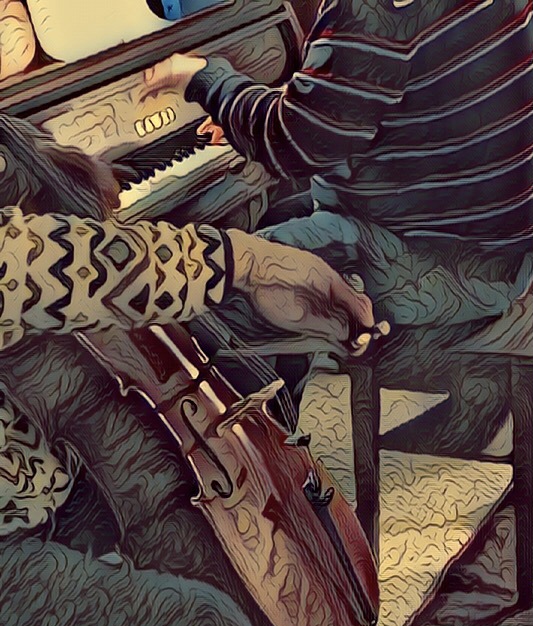
Tonight, I attended a small Christmas party at the rectory of my church. I read poetry and a short story and an essay. There were vocal performances. A piano and cello duet. A sing-along. And everybody had a wonderful time. Nobody was worried whether those in attendance were Catholic or Buddhist or straight or gay or Republican or Democrat or Rastafarian. There was just love and acceptance. Plus a lot of wine and Irish whiskey, which probably helped with the sing-along at the end.
The world should be like that. Everyone loving and sharing and welcoming. That would be the Holy Ghost dwelling constantly within, as Merton says. It would be one big party, with everyone helping everyone else. Nobody left in the dark alley, hungry and alone and bereft.
That's the vision of Saint Marty for tonight.