Sunday, August 4, 2024

August 4: "The Lodger," Depression-Era, Chronologically Privileged

Billy Collins repurposes his sword . . . 

The Lodger

by: Billy Collins

After I had beaten my sword into a ploughshare,
I beat my ploughshare into a hoe,
then beat the hoe into a fork,
which I used to eat my dinner alone.

And when I had finished dinner,
I beat my fork into a toothpick,
which I twirled on my lips
then flicked over a low stone wall

as I walked along the city river
under the clouds and stars,
quite happy but for the thought
that I should have beaten that toothpick into a shilling

so I could buy a newspaper to read
after climbing the stairs to my room.


Collins transforms a thing meant to harm/kill into things that sustain, nourish, and aid.  He plows and hoes with it, eats and picks clean his teeth with it.  Then he throws it over a stone wall.  Later, he regrets not pounding that toothpick into money to purchase a newspaper.

My parents were Depression-era babies, born right after the time the Stock Market crashed and the world started to starve.  My mother never wasted anything, especially when it came to food.  My dad hoarded everything.  In our garage, he had several shelves jammed with jars of screws and nuts and bolts, all sorted and organized.  When my dad died, he left behind an entire warehouse of stuff he just couldn't throw out.  Toilet tanks and seats.  Old Christmas trees and decorations.  I think there might have even been some used car tires.

My parents raised nine kids, too, so Mom and Dad really understood the motto "Waste not, want not."  I lucked out as the youngest of the family.  While my siblings had to wear hand-me-downs, I didn't.  Between my three brothers and myself came five sisters, so I didn't have to endure used clothing.  Some people may think that I was spoiled.  I prefer the term "chronologically privileged."  

Here's the thing, though:  I've got a Depression-era mentality when it comes to writing.  I never trash anything I write.  When I was a kid, I started keeping diaries.  I graduated to journals eventually.  I have boxes and boxes of these notebooks, but I've never gone back to reread any of them.

Maybe there are brilliant poems or short stories or essays in them.  Or maybe memories that I've blocked from my mind.  Perhaps a little pornography, especially in my high school diaries.  If someone ever decides to write my literary biography, that person will have plenty of primary source material to draw from.

There is a poem (one of the first I ever wrote) that I lost.  I even won an award for this poem when I was an undergraduate.  I know it is buried in a notebook in one of those boxes under my bed.  If you're reading this post many years from now, you need to find "In the Parking Lot at Bonanza."  (It may also be titled "Blueberries.") 

It's one of the best things Saint Marty's ever written.  He thinks.


Saturday, August 3, 2024

August 3: "Height," Acrophobia, Lily

Billy Collins doesn't suffer from vertigo . . . 

Height

by: Billy Collins

Viewed from the roof of a tall building,
people on the street
are said to take on the appearance of ants,

but I have been up here for so long
gazing down over the parapet,
that the ants below have begun to resemble people.

Look at that one lingering
near a breadcrumb on the curb,
does he not share the appearance of my brother-in-law?

And the beautiful young ant
in the light summer dress
with the smooth, ovoid hear,

the one heading up the lamppost--
could she not double for my favorite cousin
with her glad eyes and her pulled-back hair?

Surely, one with the face
of my mother and another with the posture
of my father will soon go hobbling by.


I'm not a fan of high places.  I learned this fact about myself in the absolute worst place for a person who suffers acrophobia--at the top of the Empire State Building.  Before that day, I'd never had a panic attack in my life.  But there I was, 1,250 feet above Manhattan, trying to keep my heart from leaping out of my chest like an alien parasite.

Nowadays, I avoid situations that put me in high places--buildings, summits, roofs, trees, porches, bridges.  Every Saturday, I play the pipe organ in the choir loft of a Catholic church.  That means I'm about 20 or 30 feet above the sanctuary.  How do I manage to do this?  I'll share my secret:  I don't look down unless absolutely necessary.

I played tonight.  Avoided the railing.  Glanced down only once or twice.  The Mass went well.  There were more people in the pews than I expected.  It was warm again today, but not quite as humid.  So, it didn't feel like I was being slowly broiled as I played.  And, outside the church, the flower garden was open for business.

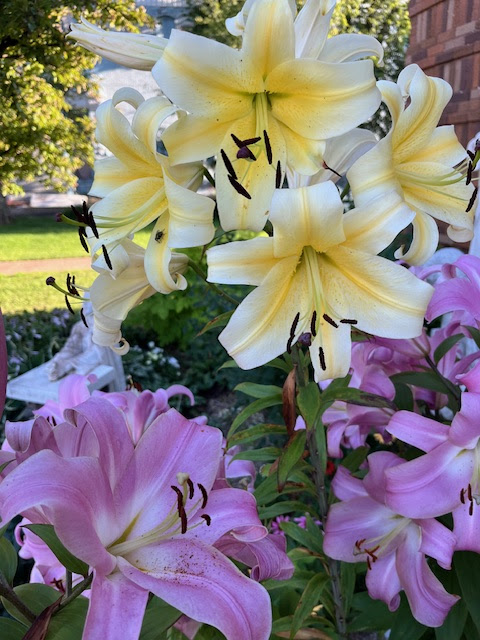
I often think those wide-angle, Cinemascope views of landscapes are humbling.  Nothing can make you feel more insignificant.  However, sticking my face into those blossoms as I left church this evening was humbling, too.  A universe of beauty in the mouth and breath of a lily.

Saint Marty was grounded and flying at the same time.


Friday, August 2, 2024

August 2: "Freud," Hot Day, "Swamp Music"

Billy Collins has a dream . . . 

Freud

by: Billy Collins

I think I know what he would say
about the dream I had last night
in which my nose was lopped off in a sword fight,
leaving me to wander the streets of 18th-century Paris
with a kind of hideous blowhole in the middle of my face.

But what would be his thoughts
about the small brown leather cone
attached to my face with goose grease
which I purchased from a gnome-like sales clerk
at a little shop called House of a Thousand Noses?

And how would he interpret
my stopping before every gilded mirror
to admire the fine grain and the tiny brass studs,
always turning to show my best profile,
my clean-shaven chin slightly raised?

Surely, narcissism fails to capture
my love of posing in those many rooms,
sometimes with an open window behind me
showing the blue sky which would be eclipsed
by the Eiffel Tower in roughly a hundred years.


I've said it before, and I'll say it again:  I never remember my dreams.  They're gone almost as soon as I open my eyes.  Good or bad, dreams simply don't stick with me.  I tried keeping a dream journal once.  However, I never turned on a light to scribble in my journal in the middle of the night or early morning.  Just not motivated enough, I guess.

That doesn't mean I don't have dreams.  Of course, I do.  Not about having my nose lopped off in a sword fight.  Or wearing a leather cone over the blowhole of my missing schnoz.  I wish I could say that my dreams are filled with Pulitzer or Nobel Prizes.  Or Donald Trump handcuffed, sporting prison orange.  Or Bigfoot knocking on my front door to pose for some selfies with me.  

Usually, by the time I finally fall asleep at night, I'm so exhausted that I don't even remember falling asleep.  The next thing I know, sunlight is streaming through my bedroom curtains and it's time to face another day.  As most of my loyal disciples know, I'm sort of a night owl, so it takes a while for sleep to catch me.  When it does, it hits me over the head with a sledgehammer.  

It was another hot day.  Almost ninety degrees with humidity that made breathing feel like inhaling water.  At work, I painted walls and ceilings.  There's a big reorganization happening at the library, and I was lending a hand with the prep.  So, from about 9 a.m. to 1:30 p.m., I was on a ladder with a paint roller in my hand.  

In the afternoon, I wrote in a bayou for a couple hours.  It was part of an event that celebrated sacred green spaces and the generation of art.  It was beautiful to sit in that place, surrounded by cattails and bugs and tamaracks and jewelweed.  One of the other artists saw a deer.  The biggest creature I saw was the mosquito that bit my arm.  I was sharing a spot with one of my best poet friends and mentors.  I got a new poem out of the experience.  (See below.)

And now, Saint Marty's feet and arms are sore, his shoulders are a little sunburned, and it's almost midnight.  Not a dream in sight.  

Swamp Music

by: Martin Achatz

          Swamps keep you humble,
remind you how tall tamaracks
can grow, how there are universes
of grass and fern and jewelweed
all around us with constellations
that buzz and trill and croak.  Medieval 
astronomers believed planets sang 
in the black swamp of space, music so 
beautiful only saints and angels could
hear it.  If you pause in a swamp, quiet
your tumbled mind, you may still
catch this cosmic chorale without
need for being pure as whole milk.
Just pay attention to each leaf, every
mosquito that lights on your arm,
all the bird song, insect song, grass song.
          Perhaps that's what those old
white guys really heard so long ago.  Not
a Mars and Jupiter duet.  Rather, nuthatches
in white pines, sap humming through
veins of alder, the lullaby of dirt and water
beneath their calloused soles.  They heard
that, believed nothing on earth could
make such beauty.  As I sit now
in the middle of this bayou, I know
how tiny I am, a thing that will eventually
become part of this green symphony once
again, my body feeding its hungry musicians
as they stretch and grow and tune.


Thursday, August 1, 2024

August 1: "See No Evil," Homeless Problem, "Unclean"

Billy Collins monkeys around . . . 

See No Evil

by: Billy Collins

No one expected all three of them
to sit there on their tree stumps forever,
their senses covered with their sinuous paws
so as to shut out the vile, nefarious world.

As it happened,
it was the one on the left
who was the first to desert his post
uncupping his ears,
then loping off into the orbit of rumors and lies,
but also into the realm of symphonies,
the sound of water tumbling over rocks
and wind stirring the leafy domes of trees.

Then the monkey on the right lowered his hands
from his wide mouth and slipped away
in search of someone to talk to,
some news he could spread,
maybe something to curse or shout about.

And that left the monkey in the middle
alone with his silent vigil,
shielding his eyes from depravity's spectacle,
blind to the man whipping his horse,
the woman shaking her baby in the air,
but also unable to see

the russet sun on a rough shelf of rock
and apples in the grass at the base of a tree.

Sometimes, he wonders about the other two,
listens for the faint sounds of their breathing
up there on the mantel
alongside the clock and the candlesticks.

And some nights in the quiet house
he wishes he could break the silence with a question,

but he knows the one on his right
would not be able to hear,
and the one to his left,
according to their sacred oath--
the one they all took with one paw raised--
is forbidden forever to speak, even in reply.


It's so easy to be one of these monkeys--ignoring all the evils and cruelties of the world.  Being self-centered.  Humans have selective memories.  We erase the shit that hurts us and cling to what makes us happy.  This fact explains how we ended up with Donald Trump running for President of the United States again.  Mitch McConnell--see no evil.  Lindsey Graham--hear no evil.  However, Republicans do have a habit of speaking evil.  A lot.

In a way, though, we all have a habit of looking away from tragedy and disaster.  One of the first pieces of advice I received on my first trip to New York City was not to look at or even acknowledge homeless people.  I understand this warning, but I had a hard time following it.  At the end of most days in the Big Apple, I had no loose change or dollar bills left in my pockets.  

I live in a country where school shootings happen with alarming frequency.  In fact, they're so common that most people I know barely acknowledge them anymore.  Tragedy has become as common as meatloaf.  Mass shootings sometimes aren't even headline news.  The monkey oath at work again.

People say we have a homeless "problem" where I live.  When I'm working at the library, I encounter a lot of homeless people, especially in the winter when temperatures are brutally (almost fatally) cold in the Upper Peninsula of Michigan.  I don't ignore these individuals, but I also don't go out of my way to help them out.  Sure, I donate canned goods to food drives and organize fundraising events for local shelters.  I could do a lot more.  Maybe I have a little bit of the monkey in me, as well.

I wrote with one of my best poet pals again this morning.  Worked for half a day at the library.  Drove home, did some laundry, prepared for the online poetry workshop I was supposed to lead tonight.  (Nobody showed up for the workshop, so I went for a walk with my wife, instead.)  Now, I'm watching the Paris Olympics.

I'm a lucky guy.  I have family and friends who love me.  A roof over my head.  Food in the fridge.  Jobs that almost pay all my bills.  A really cute puppy.  Good health.  It's so easy to take all these blessings for granted.

Saint Marty, though,  isn't taking anything for granted tonight, including the fan that's keeping him cool right now.

Unclean

by: Martin Achatz

He was homeless, obvious to anyone
who saw his dirty denim shorts,
ripped tee shirt, shoes that weren't
really shoes anymore but rather
fabric and rubber bound to his feet
with leather laces crisscrossed
from his toes to ankles, looking
like tiny boa constrictors.  Men, women,
children gave wide berth, cast glances
at him as they passed, the younger
merely curious, the older with a pallor
of fear in their cheeks, as if they expected
him to start banging a tin cup for money
or food or in warning, like in Biblical 
times when lepers rang bells, called out 
"Unclean!" as strangers approached.  
I passed him several times as I worked 
through the library, him paging through 
a book that contained pictures of finches
and jays and raptors, his lips moving
silently over the text as if he was
cramming for a final exam.  I never
spoke with him or offered him coffee
or maybe one of the apples from my lunch.
I just let him sit there, a solitary island
filled with the cries of birds and slaps
of emerald and vermillion wings.