Monday, February 7, 2011

February 7: Saint Moses

It's so easy to get angry and remain angry.  I inherited the ability to hold grudges for years, as evidenced by my last two blogs about Professor Ihateyourshittywriting.  That experience occurred over ten years ago, and I still go around telling people not to read her books because she was an asshole to me 15 or so years ago.  But I come across this trait naturally.  My father is the most stubborn man I've ever met.  He's, I believe, 83-years-old, and I don't think he's recovered from FDR being re-elected three times.  (My dad's a Republican in the let's-rid-the-world-of-the-red-menace-Ronald-Reagan kind of way.)  So, you see, I'm a bottle-fed grudge holder.

I'm not proud of this aspect of my personality.  It's un-Christian and unhealthy.  But I'm really good and funny at it, which makes me sort of a warmer, more charming version of someone like Bill O'Reilly (less the bigoted, small-minded, sphincter-headed, Republican opinions).  I've learned to accept my shortcoming and even turn it to my advantage in my blog posts.  I was watching a talk given by Ron Reagan Jr. on TV this weekend.  He was discussing how people who absolutely hated his father's politics would meet his father for a few minutes and come away saying, "Yeah, I don't agree with his policies, but he's a helluva nice guy."  I hope that's the way I come off.

You might be wondering where I'm headed with this little ramble.  Well, when I taught my Sunday School class yesterday, I had the people in it write about a time "when you gave in/surrendered to something you've been fighting a long time."  In my journal response, I found myself writing about a feud I've been having with a relative for years.  Let's call him Robert, because I harbor a dislike for the actor Robert Pattinson (mostly because he's young, good-looking, and over-rated).  My Robert is just as stubborn, mean, petty, and spiteful as I can be.  As I said, it runs in the family.  However, he is not half as witty or winning as me.  Therefore, he's just plain angry and ugly at times. Even thinking about my altercations with him right now causes my heart to pound a little faster and harder. As I wrote about him for Sunday School, I realized how much effort I expend at being angry at him, how tired and frustrated it makes me feel. It's like watching an episode of Extreme Makeover: Home Edition and realizing that the "before" condition of the house is better than the current condition of your own home. It just sucks the energy and happiness right out of you.

Moses, today's feast saint, is known for being a peacemaker.  He was a hermit who lived "in the region between Syria and Egypt" in the fourth century.  Because of his reputation for holiness, Moses was eventually persuaded to become bishop of the region, and he spent the rest of his life securing peace between the Romans and the Saracens ("nomad tribes of the Syro-Arabian desert").  Considering the current unrest in the Middle East and Egypt, the world could still use the healing powers of Moses.

And so could I.  It's so easy, however, to hang on to old hurts and habits.  I've gotten so used to disliking and dismissing Robert that to change my ways is tantamount to turning the Titanic.  Even though the iceberg's dead ahead, it takes a good mile of sea to alter course.  This is what I wrote in my journal for Sunday School:  "I'm just going to have to learn to love and accept Robert the way he is.  I know that's what Jesus does with me.  Therefore, I accept Robert, and all of his petty, childish, mean, competitive, cruel ways."

I guess Saint Moses would even want me to forgive him for Twilight and New Moon.

Friday, February 4, 2011

February 4: Saint Veronica

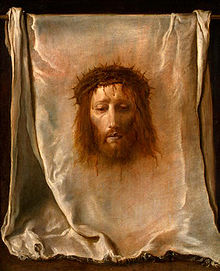
The story of Veronica is full of story and legend.  According to tradition, Veronica met Christ on His way to Calvary and gave Him a cloth to wipe His blood-soaked face.  Christ left the image of His face on the cloth.  According to an Italian legend, Veronica kept the veil and used it to cure Roman Emperor Tiberius of some serious illness.  Eventually, she gave the cloth to Pope Clement for safe-keeping.  She may have married a convert named Zacheus.  She may have carried relics of the Virgin Mary to France, where she may have died in the city of Soulac.  She also may have been the "woman with an issue of blood" whom Christ miraculously cured.  Nothing about Veronica is verifiable, including whether she even existed.  However, her story is one of great compassion and sacrifice, an identification with the suffering Christ.  For that alone, her story is worth knowing.

When a friend read my last blog on John Bosco, she suggested I post the story that my professor hated so much and let you, my readers, tell me if it's as bad as I was led to believe.  Since Veronica has so many stories swirling around her, I thought her feast would be the perfect day to post my story.  I still harbor some mental scars from my workshop of this story.  And it doesn't help that my instructor has become a somewhat big-name author.  (She never made it on Oprah's Book Club, but, as you may recall, she did win the National Book Award.)  Every time I see her name or face in print, my stomach still clenches a little bit.  But I've decided, in honor of Saint Veronica, to post my story without any changes or editing.

I'd love it if my readers would post some comments and feedback on the story.  Let me know if it's really bad.  Hopefully, you can be a little kinder than Professor Ihateyourshittywriting.  So please, let me know what you think.  I'm not sure how many people actually read my blog or simply stumble upon it by mistake and immediately redirect their computer searches.  But, if you have the time to read and leave a comment, you will be doing me a great favor.  I think.  Remember Veronica comforting the wounded Christ.  Lay a little Veronica on me.  Read on and then leave your opinion.  I can take it.  I think.  The story's called...

Danny's Feet

Danny and I used to swim naked in Lake Superior when we were kids.  Under the July sun, we would strip on the shore, our seven-year-old bodies smooth as polished agates.  Our hair glowed, like driftwood bleached white by the summer days.  Danny and I were the same age, height, and weight.  Our skin tanned to walnut, and as we shed our shorts and t-shirts, the cool air from the lake raised goose-flesh on our arms and legs.  Standing beside Danny, ready to charge into the lake, I knew even our mothers wouldn't have been able to tell us apart, if only Danny would have taken off his socks.

Danny never took off his socks.  His feet and calves flashed like lighthouses in the dark of the forest when we played hide-and-seek at dusk.  When he was allowed to spend a night with us at our family camp in Calumet, we never needed a flashlight when we had to go to the outhouse.  I just sent him down the path ahead of me.  The white of his socks were like flares.  We never went inside the outhouse, instead creeping behind it to pee into the black forest.  I imagined deer and bears fleeing in panic from the beacons of Danny's feet.

One night, standing behind the outhouse, listening to our urine hissing against the ground before us, I asked Danny why he never took off his socks.  His pee stopped mid-stream and then resumed.

"My feet are different," he said.  His voice flattened the noises of the woods, as if the crickets and birds had been stunned silent by his answer.

I waited until he finished peeing, and as he turned to go back to the camp, I touched his back.  "Different how?"  I couldn't see his face in the darkness.  My hand was hot against his shirtless shoulder.

His breath quickened, like he had just finished a foot race.  "Mom says," he paused.  "Mom says the Greek god Mercury had wings on his ankles.  She says he could run faster than a lightning bolt."  He turned to face me, and even though I couldn't see his eyes, I felt his stare.

After almost a minute of silence, I reached over and pulled Danny's right sock down.  He lifted his foot, and I pulled the sock off.  I did the same with the left sock.

The darkness ate Danny's legs.  I reached out and found his calf.  I ran my hand down to his ankle and felt the smooth knob of bone.  His leg was tense, like the eye of a tornado, a boiling calm.  My fingers explored his foot, the arch, the veins.  Danny lifted his foot again, and my fingertips found the hard callouses on the heel and ball.  I moved to his toes, feeling each long digit's joint, nail, ridges, and pad.  When I reached the pinkie, I found Danny's secret.

Danny had two pinkie toes, webbed together.  I ran my fingers over them again and again, feeling the two nails and the two knuckles branching from a single base.  The tissue connecting them was paper thin, allowing each toe to move independently of the other.

I reached over to Danny's other foot and found the same:  two pinkies joined in one thin embrace of skin.  I moved back and forth between his feet, caressing, flexing, rolling each of the paired toes until their skin burned from my attentions.

Then Danny stepped away from me.  His feet disappeared into the darkness, removing from my grasp his toes.  I stared down at the discarded socks, glowing in the path like misplaced moonlight.  Danny made a noise that might have been a whimper, and then he was gone.  I heard him run to the cabin, open the screen door, and gently close it behind him.

I reached down and scooped up Danny's socks, half expecting their whiteness to run through my fingers like water.  I stood and started up the path to the cabin.  Feeling the packed earth beneath my toes, I wondered if Mercury ever felt the dirt, cool and damp, beneath the miracle of his feet.

Monday, January 31, 2011

January 31: Saint John Bosco

John Bosco is the patron saint of editors.  I can find no reason in his biography why he holds this title.  I was expecting him to have started a famous Catholic newspaper or edited the work of some great theologian.  At the very least, I expected him to be a writer of some renown.  He wasn't.  Born in 1815 in Turin, Italy, John was the son of sheep herders.  In fact, he spent much of his childhood tending livestock in the fields.  When he was about to enter the seminary, his mother told him, "If at any time you come to doubt your vocation, I beseech you, lay it aside at once.  I would rather have a poor peasant for my son than a negligent priest."

Since I'm writing this blog post about him, John Bosco obviously did NOT become a poor peasant or a negligent priest.  He founded two religious orders--the Salesian Society of St. Francis de Sales and the Daughters of Mary Help of Christians--both dedicated to the "care of young boys and girls."  Plus, it only took him 46 years to be elevated to the status of sainthood.  Considering the fact that some people wait hundreds of years for that distinction, John Bosco's canonization was like a hundred yard dash.

I really like the advice of John Bosco's mother.  Basically, it boils down to this:  if you can't do something right, don't do it at all.  Of course, it probably sounded a lot prettier in Italian.  I agree with her.  I hate doing any task in a half-ass manner.  If I'm involved with any project, if my name is going to be associated with it, I want it to be done well.

I could stop writing there.  After all, John Bosco is the patron saint of editors, so I'm sure he would appreciate the brevity and concision.  There is wisdom in what I have already written for young and old alike.  But, of course, I'm not going to leave it there.  It's too easy.  Too pat.

So, let me tell you a little story about my years in a PhD program at a prominent Michigan university.  I was taking a graduate-level fiction workshop.  I already had a Master's degree in fiction writing, so I felt pretty confident about my abilities.  I submitted a story to be workshopped.  On the night my piece was to be critiqued, the professor did what she normally did:  sat back, scratched her snaky mane of black curls, and said, "So what do you guys think?"  It wasn't an actual invitation for anyone in the class to speak.  This was our opportunity to wait for her to pronounce judgement, like Nero in the Colosseum.  After a minute of uncomfortable silence and shuffling papers, she opened her pinched mouth and said something along the lines of, "This story belongs in a high school class, not my graduate level fiction master seminar."  I'm sure what she said was more tactful than that, but the result was the same.  She had drawn first blood.  What ensued was an hour-long feeding frenzy.  When graduate student writers sense weakness, they turn on each other like teenage boys at a dodge ball game.  They do this either to deflect attention from their own inadequacies, or to draw attention to their ability to agree with the professor's opinion the most.  At the end of my hour of glory, I felt raw, exposed, eviscerated.  When the class took a break, I packed up my books and left.

I didn't retire to the fields of Turin to tend sheep, but I wasn't able to write fiction again for almost three years.  To this day, when I show off a story I've written, I have the impulse to immediately apologize for it.  A few months ago, when I was cleaning out a desk drawer, I found a copy of my infamous story from that painful night.  I have to admit, it wasn't the best thing I've ever written, but it wasn't that bad, either.

What I learned from that experience is that, as a teacher, I have the power to build up or completely crush my student's confidence and self-esteem.  I try to keep in mind the hurt I felt that night when I now enter the classroom as an instructor.  I don't want to inflict the same trauma on any of the boys and girls in my charge.  John Bosco would appreciate that, I think.

And my professor?  That bitch won the National Book Award for fiction.  Go figure.


Friday, January 28, 2011

January 28: Saint Thomas Aquinas

Last night, I hosted the monthly meeting of my book club.  The fourth Thursday of every month is one of my favorite evenings.  My friends and some family come over, sit around, eat really good food, and talk about a really good book.  I try to keep a handle on the club's literary selections; I can't stand being forced to read a book in which I have little to no interest.  One time, I made the mistake of going to the bathroom in the middle of one of our get-togethers.  When I came back, my club members had selected the books for the next six moths.  (I know I have written about this occurrence before, but I still suffer flashbacks to Edith's Story, a dreadful Holocaust memoir that I endured one November.  I take literature quite personally, and I hate wasting my reading time on books for which innocent trees are murdered for no good reason.  If I sound like a book snob, I am.)

Last night's book was worth the slaughter of a forest.  It was Emma Donoghue's Room, and it ranks as one of my favorite reads of the last twelve months.  It's based on the real-life story of Jaycee Dugard, a woman who was snatched off the street by a man when she was 11-years-old.  The man held her captive in his backyard for eighteen years, raping her on a frequent basis.  During her captivity, she gave birth to and raised two children.  Donoghue uses the basic elements of this news account for her novel.  It's about an imprisoned woman who raises her young son in an 11' by 11' room for the first five years of his life.  The novel is narrated by the five-year-old son, Jack.  Donoghue manages to turn a story premise that has the potential to be incredibly depressing and grim into a heartbreaking, coming-of-age tale.  Room reminds me of some of my favorite novels--Catcher in the Rye, To Kill a Mockingbird, and The Lovely Bones.  It's all about narrative voice.  Donoghue's Jack reminds me of Scout and Holden and Susie.  His point of view transforms his prison into a universe of mother-son love.

Everything outside the parameters of that universe becomes a threatening Wonderland, and Jack must learn to navigate this space.  His perception of the real world is that of an alien, a creature without even the normal vocabulary for "grass" or "wind" or "sun."  That's what is so engaging about the entire book.  Donoghue manages to hold up a mirror to our world and reveal its ugliness, absurdity, and beauty.

Okay, I know this blog is starting to sound like an Amazon.com customer review, but when I read a good piece of literature, I generally become a little obsessed with getting other people to share my experience.  Therefore, for the time being, I'm going to be a cheerleader for Emma Donoghue.  Even my incredible ego won't get in the way.  Much.  I'll admit, when I finished reading Room, I sat back and thought, "Damn, I wish I'd written that."  If you're one of my few constant readers (shout out to my five followers!), you know I have a problem with jealousy.  I admire the work of other writers, but I prefer to keep the literary spotlight amongst my close friends and associates firmly focused on myself.  (Yes, I did write "amongst."  I trying to sound like a serious critic.)  If that means I have to make snarky and mean-spirited comments about other authors, so be it.  Room has had incredible success since its publication.  It got glowing reviews, hit the bestseller lists, and, I assume, will be nominated for all kinds of awards.  It's got that literary-awards cachet.  Usually, for me, that trinity of good fortune kicks my envy machine into overdrive.  In this case, I can't do it.

When a little-known writer comes out of nowhere with a really wonderful book that receives all kinds of recognition and popular/monetary rewards, it gives me hope.  If it can happen to Emma Donoghue, my mind reasons, it can happen to me.  That's why I won't say that Room becomes a little long-in-the-tooth near its conclusion.  That's why I won't say that the novel lacks a polish of craft that could make it truly great.  That's why I won't say that Donoghue lapses into melodrama and stereotype at points--with suicide attempts, a cold and insensitive father, and an exploitative TV interviewer.  I won't say any of that, because it would make me sound small and petty.

Today's saint is Thomas Aquinas.  Thomas was a remarkable guy.  He knew from a very young age that he wanted to enter the religious life, even though his family was titled and wealthy.  But, of course, he gave it all up, because that's just what saints-in-training do.  Aside from being holy and devout, Thomas was a brilliant philosopher, theologian, and writer, even though he was nicknamed the "Dumb Ox" by his fellow students because of his "silent ways and huge size."  Thomas' writings fill twenty volumes, including the classic Summa Theologica.  His work  is "characterized by brilliance of thought and lucidity of language."  If I had been a student with Thomas, I would have hated him because all the teachers would have been "Thomas did this" and "Thomas did that" and "Thomas said this" and "Did you read the paper Thomas wrote?"  Despite the fact that he turned down every "ecclesiastical dignity" offered to him, including Archbishop of Naples, Thomas was still famous in his own lifetime.  And humble.  Killer combo for sainthood.

There you go.  A saint and a bestselling author.  I appreciate good writing, admire brilliant thinking.  I've already said that.  Go and read Room and the Summa Theologica.  You won't be disappointed.  I don't begrudge Emma Donoghue and Saint Dumb Ox their success and glory.  I'm a bigger person than that.  Really, I am.