Friday, February 11, 2011

February 11: Our Lady of Lourdes

My daughter has been at Walt Disney World all week with her aunts.  She calls me every morning before she heads out for whatever adventure the day holds in store.  This morning when she called, she was crying.  Between her sobs, I got a story about one of my sisters teasing her in front of a group of people.  I also got the impression that I was talking to a very tired little girl.  Last night, she stayed at the Magic Kingdom for the fireworks and the electrical parade.  My guess is she didn't get back to the hotel room until well past midnight.  And I know when my daughter gets tired, she cries at the smallest of slights.  A mosquito bite can send her into hysterics.  So I spent most of my conversation with her this morning listening to her cry.

My daughter has always been mature, having spent the first eight years of her life as an only child.  When my daughter was newly born, my wife went through a six-month cycle of depressions and manias.  My daughter spent a good portion of those six months in a dark bedroom, contentedly nursing and sleeping with my weeping wife.  I've always thought those formative early days with my wife gave my daughter an emotional intelligence well beyond her age.  It has also made her incredibly sensitive.

Later, when my wife moved out of our house because of her sexual addiction, my daughter rarely exhibited any signs of distress or trauma.  She was five-years-old at the time, and I was in worse shape than she was.  During that year, she helped me clean the house; she climbed into bed with me and asked me to read her Shel Silverstein and Roald Dahl books.  When I got quiet and moody, she asked to sit in my lap, put her head against my chest, and listened to my breaths and heartbeats.  When she did cry for my wife, she was usually overwhelmed and very tired.  The way she was this morning on the phone.

Saint Bernadette, age 14
In the Catholic Church, when a young person gets confirmed, she or he can pick a confirmation name.  It's supposed to be the name of a saint for which the confirmand feels some kind of attachment or affinity.  In reality, it's usually a name that belongs to a popular movie or rock star (for a girl) or an NBA/NFL player (for a boy).  My daughter, when she was confirmed, chose the name Bernadette.  She chose this name because it's also the confirmation name of one of her favorite aunts and also because of Saint Bernadette.  Bernadette was a 14-year-old girl from Lourdes, France, who saw visions of the Virgin Mary.  At the grotto where the Virgin supposedly appeared to Bernadette, a spring of water flows.  This water has been used in the miraculous healing of many people.  A friend of mine visited Lourdes seven or eight years ago and brought me a vial of the water.  When I first learned of my wife's addiction, I would take the vial of water and, when my wife was asleep at night, put drops of it on her forehead, praying for her to be cured.  Those of my readers who don't believe in such miracles probably view me as some fanatic, snake-kissing faith healer.  I'm not.  I was just desperate for hope and comfort.

My daughter loved the story of a little girl being able to talk to the Virgin Mary.  The first of Bernadette's visions of Mary occurred on February 11, 1858.  Therefore, today is the feast of Our Lady of Lourdes, in commemoration of the Virgin's first visit.  Bernadette, at a very young age, had to shoulder a lot of adult responsibility.  She dealt with skeptical townspeople, hostile Church officials, and fame that began to rival Hannah Montana's.  Bernadette remained grounded and compassionate.  My daughter has also faced a lot of adult circumstances.  Mental illness.  Sexual addiction.  Hostile relatives.  A broken mother.  A broken father.  Yet my daughter is still grounded and loving.  She chose her confirmation name well.

The other day, in my Good Books class where we're reading The Color Purple, I had my students write a letter to a person whom they lost or to whom they couldn't talk any more.  I chose to write a letter to my daughter when she's 43-years-old.  Here's that letter:

Dear C. at 43,

By the time you read this letter, I may no longer be alive.  You are as old as I am right now.  I hope you are happy and have people in your life whom you love and who love you.  If you have followed the path you've had your heart set on since kindergarten, you illustrate children's books, have a husband and three kids, and still dance ballet.

What I want to tell you is how much joy you brought into my world.  Even in the most difficult times in my life, you have been a light for me.  You know, or will know, the struggles we've had in our family because of mental illness.  You know, or will know, your mother struggled/struggles with bipolar and sexual addiction  I hope when you are my age that you realize I did my best to give you the most normal childhood I could. 

My biggest fear is that you will be touched by mental illness, as well.  It's something I think and pray about every day.  If you have been diagnosed with a mental illness, never hang your head.  Don't let people treat you like a freak or an outcast.  You are my daughter.  Don't ever be ashamed.  You have a mental illness.  It's just a part of you like your freckles or red hair or smile.  Don't let it define you.

You are beautiful.  You are strong.  You are the best thing that ever happened to me.

Love,

Daddy

Tuesday, February 8, 2011

February 8: Saint Josephine Bakhita

Right now, I'm teaching Cormac McCarthy's novel The Road to my writing and literature class.  It's one of my favorite books, but my students, as I anticipated, are struggling.  They're struggling with McCarthy's language and style.  His themes and ideas.  More than one of them have said out loud during discussions, "I hate this book."

What I really think my students are struggling with is maturity.  Most of them are only just out of high school a year or so.  I guess I can't really expect them to feel the terror of the dying father for his young son in The Road when they can barely keep a goldfish or fern alive.  They just don't have the life experience to appreciate the book.  Today, I tried again to make them "get it."  I had them write a journal entry about the one thing that's most important in their lives.  My goal was to make them think about the difference between need and want.

One of my students wrote about his eyesight.  Another wrote about her cocker spaniel.  One girl wrote about her faith in God.  They were all incredibly sincere and earnest.  The students who didn't read their journal entries out loud looked stricken, as if I were going to ask them to strip naked and dance to "Funky Town" for everybody.  I could tell that I hit pay dirt with some of them, that I pushed through the layers of Facebook and iPhone numbness to something real, raw, and alive.  Then I read them what I had written:

"This novel makes me stop and evaluate all the things I regard as important or necessary on a day-to-day basis:  Diet Mountain Dew, books, teaching, students, lobster pizza, car, jobs, money.  However, when I reflect on the nittiest and grittiest, those things in my life that really do give me a reason to get up every morning, I would have to list just three:  my son, my daughter, and my wife.  I can't winnow the list any more.  It's a choice I can't even contemplate.  There's a terrible scene in William Styron's book Sophie's Choice where his main character, Sophie, is forced to choose which of her two children will live and which will be executed.  It's a moment so brutal and agonizing that I can barely read it.  If I were asked to choose just one thing I cherish most, the one thing I would rescue from destruction, I couldn't.  I couldn't make a choice like Sophie makes.  It's unthinkable to me.  Wife?  Daughter?  Son?  I know I'd end up like Sophie, haunted the rest of my days by the cries of the choice I didn't make."

Too many people in the world today are forced to make decisions like that in places like Sudan, Rwanda, and Sierra Leone.  Life-and-death decisions.  Today's saint, Josephine Bakhita, was stolen from her family in Sudan by slave traders around the year 1879.  After many years and many owners, Josephine was freed.  She wound up in the convent of the Canossian Daughters of Charity.  She joined the order and served as "cook, gate keeper, and keeper of linens."  She died on February 6, 1947.  When Pope John Paul II canonized her in 2000, he referred to her as a "universal sister...[who] can reveal to us the secret of true happiness."

Josephine Bakhita--former slave, nun, servant--found happiness in the religious life, in throwing her energies into helping others.  She became Christ in the lives of people who were sick, broken, cast-off.  She took a life of slavery and turned it into a life of compassion and love.  That was Josephine Bakhita's choice.

You see, it's all about the choices we make.  That's what I wanted my students to understand today.  When all the elements of my life are distilled--job, money, iPad, Kindle, car, clothes, stuffed-crust pizza, all of it boiled off--what are the oxygen and hydrogen of my daily existence?  What do I need to survive?

If it's a cell phone, I may be a student. 

If it's food, money, a car, I may be a janitor.  A nurse.  A lawyer.  The President of the United States.

If it's love and compassion, I may be a husband.  A father.  Or a saint.

It's my choice.

Monday, February 7, 2011

February 7: Saint Moses

It's so easy to get angry and remain angry.  I inherited the ability to hold grudges for years, as evidenced by my last two blogs about Professor Ihateyourshittywriting.  That experience occurred over ten years ago, and I still go around telling people not to read her books because she was an asshole to me 15 or so years ago.  But I come across this trait naturally.  My father is the most stubborn man I've ever met.  He's, I believe, 83-years-old, and I don't think he's recovered from FDR being re-elected three times.  (My dad's a Republican in the let's-rid-the-world-of-the-red-menace-Ronald-Reagan kind of way.)  So, you see, I'm a bottle-fed grudge holder.

I'm not proud of this aspect of my personality.  It's un-Christian and unhealthy.  But I'm really good and funny at it, which makes me sort of a warmer, more charming version of someone like Bill O'Reilly (less the bigoted, small-minded, sphincter-headed, Republican opinions).  I've learned to accept my shortcoming and even turn it to my advantage in my blog posts.  I was watching a talk given by Ron Reagan Jr. on TV this weekend.  He was discussing how people who absolutely hated his father's politics would meet his father for a few minutes and come away saying, "Yeah, I don't agree with his policies, but he's a helluva nice guy."  I hope that's the way I come off.

You might be wondering where I'm headed with this little ramble.  Well, when I taught my Sunday School class yesterday, I had the people in it write about a time "when you gave in/surrendered to something you've been fighting a long time."  In my journal response, I found myself writing about a feud I've been having with a relative for years.  Let's call him Robert, because I harbor a dislike for the actor Robert Pattinson (mostly because he's young, good-looking, and over-rated).  My Robert is just as stubborn, mean, petty, and spiteful as I can be.  As I said, it runs in the family.  However, he is not half as witty or winning as me.  Therefore, he's just plain angry and ugly at times. Even thinking about my altercations with him right now causes my heart to pound a little faster and harder. As I wrote about him for Sunday School, I realized how much effort I expend at being angry at him, how tired and frustrated it makes me feel. It's like watching an episode of Extreme Makeover: Home Edition and realizing that the "before" condition of the house is better than the current condition of your own home. It just sucks the energy and happiness right out of you.

Moses, today's feast saint, is known for being a peacemaker.  He was a hermit who lived "in the region between Syria and Egypt" in the fourth century.  Because of his reputation for holiness, Moses was eventually persuaded to become bishop of the region, and he spent the rest of his life securing peace between the Romans and the Saracens ("nomad tribes of the Syro-Arabian desert").  Considering the current unrest in the Middle East and Egypt, the world could still use the healing powers of Moses.

And so could I.  It's so easy, however, to hang on to old hurts and habits.  I've gotten so used to disliking and dismissing Robert that to change my ways is tantamount to turning the Titanic.  Even though the iceberg's dead ahead, it takes a good mile of sea to alter course.  This is what I wrote in my journal for Sunday School:  "I'm just going to have to learn to love and accept Robert the way he is.  I know that's what Jesus does with me.  Therefore, I accept Robert, and all of his petty, childish, mean, competitive, cruel ways."

I guess Saint Moses would even want me to forgive him for Twilight and New Moon.

Friday, February 4, 2011

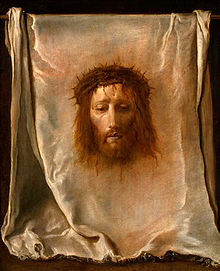
February 4: Saint Veronica

The story of Veronica is full of story and legend.  According to tradition, Veronica met Christ on His way to Calvary and gave Him a cloth to wipe His blood-soaked face.  Christ left the image of His face on the cloth.  According to an Italian legend, Veronica kept the veil and used it to cure Roman Emperor Tiberius of some serious illness.  Eventually, she gave the cloth to Pope Clement for safe-keeping.  She may have married a convert named Zacheus.  She may have carried relics of the Virgin Mary to France, where she may have died in the city of Soulac.  She also may have been the "woman with an issue of blood" whom Christ miraculously cured.  Nothing about Veronica is verifiable, including whether she even existed.  However, her story is one of great compassion and sacrifice, an identification with the suffering Christ.  For that alone, her story is worth knowing.

When a friend read my last blog on John Bosco, she suggested I post the story that my professor hated so much and let you, my readers, tell me if it's as bad as I was led to believe.  Since Veronica has so many stories swirling around her, I thought her feast would be the perfect day to post my story.  I still harbor some mental scars from my workshop of this story.  And it doesn't help that my instructor has become a somewhat big-name author.  (She never made it on Oprah's Book Club, but, as you may recall, she did win the National Book Award.)  Every time I see her name or face in print, my stomach still clenches a little bit.  But I've decided, in honor of Saint Veronica, to post my story without any changes or editing.

I'd love it if my readers would post some comments and feedback on the story.  Let me know if it's really bad.  Hopefully, you can be a little kinder than Professor Ihateyourshittywriting.  So please, let me know what you think.  I'm not sure how many people actually read my blog or simply stumble upon it by mistake and immediately redirect their computer searches.  But, if you have the time to read and leave a comment, you will be doing me a great favor.  I think.  Remember Veronica comforting the wounded Christ.  Lay a little Veronica on me.  Read on and then leave your opinion.  I can take it.  I think.  The story's called...

Danny's Feet

Danny and I used to swim naked in Lake Superior when we were kids.  Under the July sun, we would strip on the shore, our seven-year-old bodies smooth as polished agates.  Our hair glowed, like driftwood bleached white by the summer days.  Danny and I were the same age, height, and weight.  Our skin tanned to walnut, and as we shed our shorts and t-shirts, the cool air from the lake raised goose-flesh on our arms and legs.  Standing beside Danny, ready to charge into the lake, I knew even our mothers wouldn't have been able to tell us apart, if only Danny would have taken off his socks.

Danny never took off his socks.  His feet and calves flashed like lighthouses in the dark of the forest when we played hide-and-seek at dusk.  When he was allowed to spend a night with us at our family camp in Calumet, we never needed a flashlight when we had to go to the outhouse.  I just sent him down the path ahead of me.  The white of his socks were like flares.  We never went inside the outhouse, instead creeping behind it to pee into the black forest.  I imagined deer and bears fleeing in panic from the beacons of Danny's feet.

One night, standing behind the outhouse, listening to our urine hissing against the ground before us, I asked Danny why he never took off his socks.  His pee stopped mid-stream and then resumed.

"My feet are different," he said.  His voice flattened the noises of the woods, as if the crickets and birds had been stunned silent by his answer.

I waited until he finished peeing, and as he turned to go back to the camp, I touched his back.  "Different how?"  I couldn't see his face in the darkness.  My hand was hot against his shirtless shoulder.

His breath quickened, like he had just finished a foot race.  "Mom says," he paused.  "Mom says the Greek god Mercury had wings on his ankles.  She says he could run faster than a lightning bolt."  He turned to face me, and even though I couldn't see his eyes, I felt his stare.

After almost a minute of silence, I reached over and pulled Danny's right sock down.  He lifted his foot, and I pulled the sock off.  I did the same with the left sock.

The darkness ate Danny's legs.  I reached out and found his calf.  I ran my hand down to his ankle and felt the smooth knob of bone.  His leg was tense, like the eye of a tornado, a boiling calm.  My fingers explored his foot, the arch, the veins.  Danny lifted his foot again, and my fingertips found the hard callouses on the heel and ball.  I moved to his toes, feeling each long digit's joint, nail, ridges, and pad.  When I reached the pinkie, I found Danny's secret.

Danny had two pinkie toes, webbed together.  I ran my fingers over them again and again, feeling the two nails and the two knuckles branching from a single base.  The tissue connecting them was paper thin, allowing each toe to move independently of the other.

I reached over to Danny's other foot and found the same:  two pinkies joined in one thin embrace of skin.  I moved back and forth between his feet, caressing, flexing, rolling each of the paired toes until their skin burned from my attentions.

Then Danny stepped away from me.  His feet disappeared into the darkness, removing from my grasp his toes.  I stared down at the discarded socks, glowing in the path like misplaced moonlight.  Danny made a noise that might have been a whimper, and then he was gone.  I heard him run to the cabin, open the screen door, and gently close it behind him.

I reached down and scooped up Danny's socks, half expecting their whiteness to run through my fingers like water.  I stood and started up the path to the cabin.  Feeling the packed earth beneath my toes, I wondered if Mercury ever felt the dirt, cool and damp, beneath the miracle of his feet.